Quick answer
A Fritz Hansen stamp or label tells you who made a chair. On its own it rarely tells you the year. To date a Series 7, Ant or other Fritz Hansen piece with any confidence, you need to read the mark together with the model number, the base and fixings, the materials and any retailer's label, and to keep the design date and the production date firmly apart.
That last point causes most of the confusion. The Ant was designed in 1952 and the Series 7 in 1955, and both are still in production. A listing that says "Arne Jacobsen, 1955" is giving you the design date. Whether a particular chair was made in 1958, 1978 or 2008 is a separate question, and the answer is usually a range rather than a year.
The short answer
| Evidence | What it tells you | How far to trust it |
|---|---|---|
| A Fritz Hansen stamp, label or moulded "FH" mark | The maker, and usually country of origin ("Made in Denmark") | Good for maker; weak for date unless a year is printed |
| A printed or stamped year on a label | When that label was applied | Good, but the label dates the label, not every part |
| A Danish Furniture Makers' Control label | Made in 1960 or later | Good; it is a floor, not a date |
| A Danish retailer's label (for example Illums Bolighus) | Sold new in Denmark | Useful supporting evidence |
| The base, caps and glides | Earlier or later production | Moderate; parts were replaced |
| The model number | Which version of the design it is | Good for identification, not for year |
Fritz Hansen in outline
Fritz Hansen, a Danish cabinetmaker, founded the company in 1872. In 1915 it made its first chairs in steam-bent wood, and in 1934 it began working with Arne Jacobsen, starting with the solid beech Bellevue chair.
The dates that matter for dating furniture are these:
- 1952: the Ant (model 3100), designed for the canteen of Novo, the Danish pharmaceutical company, which ordered 300.
- 1955: the Series 7 (model 3107), launched with and without arms and on a swivel base, and shown at the H55 exhibition in Helsinki.
- 1957: the Grand Prix chair.
- 1958: the Egg and Swan, designed for the SAS Royal Hotel in Copenhagen, which opened in 1960.
- 1968: the colour palette for the Series 7 that Jacobsen designed, according to the Danish retailer Scandinavian Design Center.
- 1982: Fritz Hansen acquired the rights to most of Poul Kjærholm's furniture.
Kjærholm pieces made before 1982 were produced by E. Kold Christensen, not Fritz Hansen, which is itself a useful dating clue.
What the stamps and labels look like
Fritz Hansen's marks were not standardised across products or decades, and the company has not published a public chronology of them. What is documented is patchy, so this section separates recorded examples from collectors' observations.
On plywood chairs (Ant, Series 7, Grand Prix)
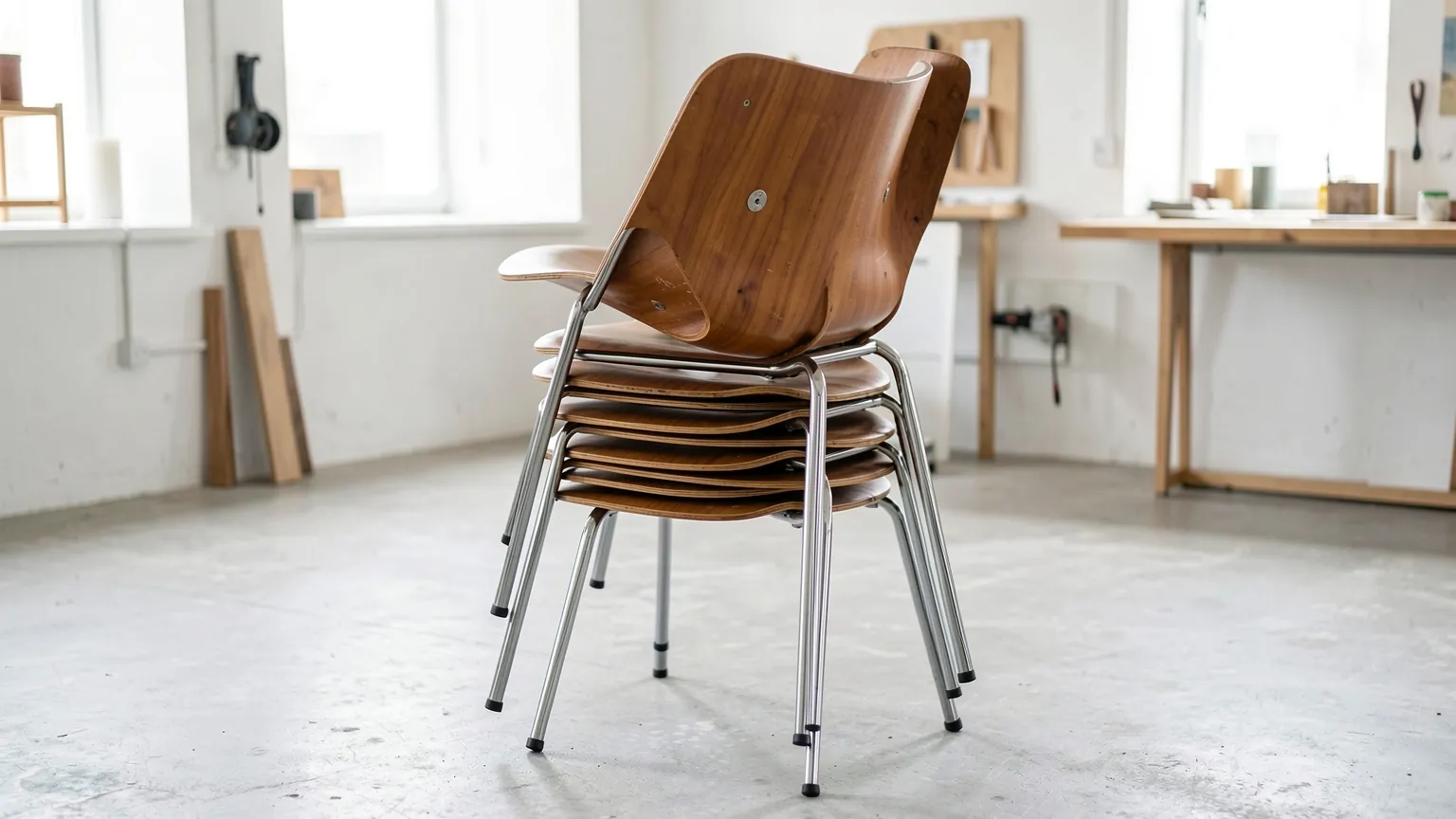
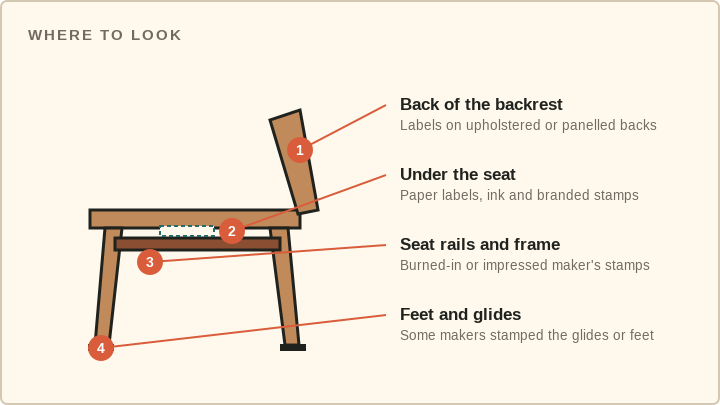
Look under the seat, around the circular plate where the base is fixed. Dealers describe a Fritz Hansen stamp on the bolt cover or a stamped number on the underside of genuine chairs, and a paper label applied under the seat. Listings of 1960s chairs refer to "the original label" or an "engraved signature" that the seller reads as a date. In practice, a printed year on an original label is the most precise evidence a plywood Fritz Hansen chair is likely to carry.
Collectors on the Design Addict forum describe early Series 7 chairs with metal caps stamped "FH Danmark" covering the base fixings, and later chairs with plastic caps. One contributor suggested the change came in the late 1960s, perhaps 1967, but offered it as a guess. Treat metal caps as a sign of earlier production, not as proof of a decade.
On upholstered and cast-base chairs (Egg, Swan)
The cast aluminium star bases of the Egg and Swan often carry a moulded mark. A Bonhams Skinner catalogue entry describes an Egg chair with "FH Made in Denmark" and a number moulded under the base, together with a label from Illums Bolighus, the Copenhagen design store. Dealers also describe Egg chairs dated by a year on the label, such as one "produced by Fritz Hansen in Denmark and dated 1974".
The mark dates the part it is on
Bases, caps, glides and upholstery were routinely replaced. A 1960s label under the seat of a chair with a modern base tells you the shell is from the 1960s and nothing about the base. The same caution applies to Herman Miller, as explained in dating Herman Miller by its label.
The Danish Control label
Fritz Hansen chairs are found with the Danish Furniture Makers' Control label, as on the Series 7 discussed on the Design Addict forum. Because the scheme began in 1960, a genuine example on a Fritz Hansen chair means the piece was made in 1960 or later. Its absence proves nothing, since labels peel and the scheme was voluntary. Our guide to the Danish Control stamp explains what it does and does not certify.
Model numbers
Fritz Hansen numbers its chairs, and the number identifies the version, not the year. The best-known are:
| Model | Design | Designed |
|---|---|---|
| 3100 | Ant chair | 1952 |
| 3107 | Series 7 chair, armless, four legs | 1955 |
| 3130 | Grand Prix chair | 1957 |
| 3316 | Egg chair | 1958 |
| 3320 | Swan chair | 1958 |
The Series 7 family also includes armchair, swivel, bar stool and child's versions, each with its own number. A model number printed on a label is good evidence the chair left the factory as that model, which helps when a base or arm has been changed.
Dating from construction
When the label is missing, the chair itself is the evidence.
- Legs on the Ant. The original Ant had three legs. Wikipedia records that the first legs were plastic and were replaced by tubular steel, and that a four-legged version was also made. One dealer history says the four-legged version came only after Jacobsen's death in 1971. A three-legged Ant is consistent with earlier production, though three-legged versions have also been made more recently.
- Shell. The Series 7 shell is made from nine layers of pressure-moulded veneer. Copies often have a thicker, less refined shell and an exaggerated waist.
- Finish. Teak and other natural veneers, and black lacquer, are common on 1950s and 1960s chairs. Wide colour ranges belong mainly to later decades.
- Base. Check whether the base, caps and glides are consistent with each other, and look for signs of later replacement such as newer screws or a cleaner finish than the shell.
Record each observation as you go with the object research checklist.
Original, refurbished or copy?
Fritz Hansen's own refurbishment programme, ReNEW, restores older Series 7 chairs, including changing bases and colours, so a chair can be genuinely old and look new. Unlicensed copies of the Series 7 and Ant are very common. The famous 1963 Lewis Morley photograph of Christine Keeler used an imitation chair with a hole cut in the back, and the Victoria and Albert Museum holds that chair as "the Keeler chair", maker unknown.
The difference between a current production chair, a licensed reissue and a copy is set out in our guide to originals, licensed reissues and reproductions. For timber, see telling teak, walnut and rosewood apart, and for other makers' marks, the general guide to mid-century labels and maker marks.
Related guides
- What is Danish modern furniture?: the designers, makers and how to recognise it
- Børge Mogensen: the J39, Hunting and Spanish chairs
- Thonet labels and stamps: dating bentwood chairs
Common questions
Where is the stamp on a Fritz Hansen chair?
On plywood chairs such as the Series 7 and Ant, look under the seat around the plate where the base is fixed, including on the caps over the bolts. On the Egg and Swan, look under the cast aluminium base, which often carries a moulded "FH Made in Denmark" mark.
Does a Fritz Hansen stamp show the year?
Sometimes. Some labels carry a printed year, but many marks show only the maker and country. When there is no year, the chair has to be dated from its base, fixings, finish and any other labels, and the result is usually a range.
When was the Series 7 chair made?
It was designed in 1955 and has been made continuously by Fritz Hansen since then. The design date does not tell you when a particular chair was made.
How can I tell a real Series 7 from a copy?
Look for a Fritz Hansen mark under the seat, a nine-layer veneer shell with a fine edge, and a base and waist in correct proportion. Copies often have thicker shells, exaggerated curves and no maker's mark.
Are three-legged Ant chairs older?
The original 1952 Ant had three legs and a four-legged version came later, so three legs are consistent with early production. They are not proof of age on their own, because three-legged Ants have continued to be made.
References
- Fritz Hansen (company), Ant (chair) and Model 3107 chair, Wikipedia
- Series 7 and Fritz Hansen, arnejacobsen.com
- The Keeler Chair, Victoria and Albert Museum
- Dating a Series 7 chair?, Design Addict forum, 2010
- Series 7: 60 years, Scandinavian Design Center, 2014
- Buying vintage Fritz Hansen Series 7 chairs, PatinaHall, 2026
- Arne Jacobsen for Fritz Hansen, Egg chair, lot 212, Bonhams Skinner