Quick answer
A Thonet label or stamp is good evidence of who made a bentwood chair and roughly when. It is rarely evidence of a single year. Read together with the wording, the method of marking and the way the chair is built, the marks will usually place a piece in a span of a few decades, and they will tell you whether it came from the Viennese firm, its interwar successor Thonet-Mundus, the American company or one of the factories that carried on after the Second World War.
The difficulty is that Thonet made chairs for more than 150 years, in many countries, and the same designs stayed in production almost unchanged. The No. 14 café chair of 1859 is still made today. So the mark matters more on a Thonet than on most furniture, because the shape alone often cannot separate an 1890s chair from a 1990s one.
The short answer: what each kind of Thonet mark suggests
| Mark | What it usually indicates | Confidence |
|---|---|---|
| Printed paper label with a "GT" monogram and Vienna wording | Gebrüder Thonet, Vienna, roughly 1860s to 1919 | Good, if the label is original to the chair |
| "THONET" branded or punched into the inside of the seat rail | Gebrüder Thonet from about 1880 onward; long-lived | Good for maker, weak for date |
| "THONET AUSTRIA" on a label or stamp | Austrian-made Thonet; wording used over a long period | Moderate |
| Label or stamp naming Thonet-Mundus, or a country such as Poland or Czechoslovakia | The interwar group, 1921 onward, made in central European factories | Moderate |
| "TON" mark | Czech state factory successor, after the Second World War | Good: not a Thonet-made chair in the company sense |
| Tag reading "Thonet Industries, Inc." with a US address | The American company, 1938 to 1987 | Good; the address narrows it further |
Each of those lines comes with caveats, which the rest of this guide sets out.
Who "Thonet" actually was at different dates
Knowing the company's history is what makes the marks readable, because every change of ownership changed the wording.
- 1853: Michael Thonet transferred the business to his sons under the name Gebrüder Thonet (Thonet Brothers), based in Vienna.
- 1856: the Koryčany factory in Moravia opened, the first of several large plants in what is now the Czech Republic, Poland and Hungary.
- 1859: the No. 14 chair. Wikipedia's account of the model gives some 50 million sold by 1930.
- 1921: Gebrüder Thonet merged with Mundus AG, forming Thonet-Mundus. The Thonet family bought back the shares in 1938.
- 1938: Leopold Pilzer, head of Thonet-Mundus, bought three American furniture makers and organised them as Thonet Industries, Inc., headquartered in New York (Harry Rinker's account, 2013 and 2019).
- After 1945: the factories in the Eastern Bloc were taken by the state. The Czech plants later traded as TON. Georg Thonet rebuilt the German works at Frankenberg, Hesse, between 1945 and 1953.
- 1976: the European business split into a German company (Gebrüder Thonet, now Thonet GmbH) and an Austrian one (Thonet Vienna).
- 1987: Shelby Williams bought Thonet Industries in the United States, separating it from the European firm. It joined CF Group in 1999.
Three companies, one name
Today there are three descendants of the original firm: Thonet GmbH in Germany, Gebrüder Thonet Vienna in Austria and TON in the Czech Republic, plus an American Thonet that has been independent since 1987. A modern chair from any of them can be entirely genuine. "Genuine Thonet" only means something once you say which Thonet, and when.
Paper labels
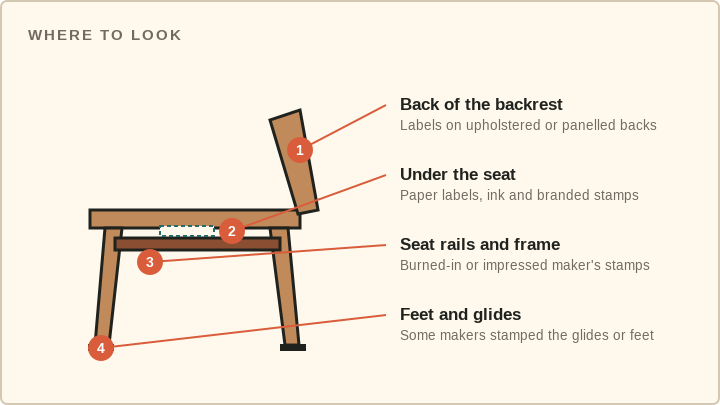
Thonet began using paper labels in the early 1860s. They were glued inside the seat rail and very often lost, so a missing label proves nothing.
The most detailed public study is by the collector blog Bugholzblog, drawing on the German literature on bentwood. It describes three variants of a first label (1a used from 1861 to 1870, 1b and 1c from 1870 to 1881), a second label registered with the Vienna Chamber of Commerce in July 1881 and used until 1919, and a simplified label after the First World War that dropped the reference to Vienna and reduced the "GT" ornament to a single "T". The second label is the commonest. Hungarian, Russian and French variants exist for those markets.
Museum records agree with the outline. The National Gallery of Victoria's side chair of about 1880 (accession 2012.91) has a paper label printed with "von Gebrüder Thonet in Wien" and a "GT" monogram on the inside of the seat rail. The Victoria and Albert Museum's settee W.41-1979, dated about 1905, carries a "THONET WIEN" paper label alongside a branded "THONET".
Not every source agrees on the end dates. A 2026 dealer guide from Antiga puts paper labels at about 1860 to 1900, against Bugholzblog's 1881 to 1919 for the second label. Treat any single label date as approximate, and trust the Vienna wording and the monogram over a decade.
Branded and punched stamps
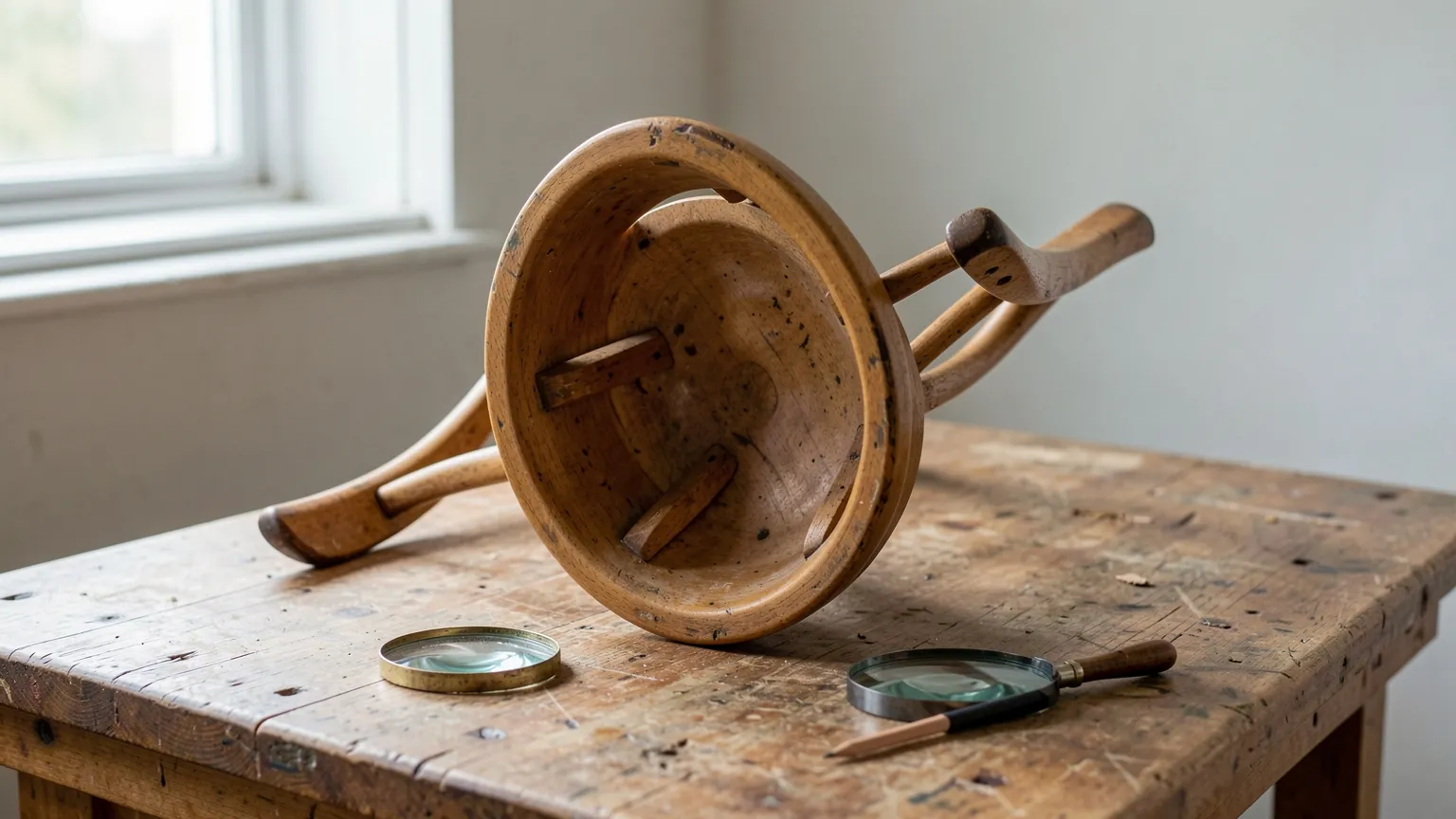
Stamps survive where labels do not. Look on the inside of the seat ring or the underside of the seat frame.
- Early embossed stamps recorded by Bugholzblog include "Thonet Wien", "GB. Thonet Wien" and "GT". One, reading "Thonet Wien Gump. 396", is found on chairs still made from laminated rather than solid bent wood, which places it very early.
- From about 1880, Thonet marked chairs with a black "Thonet" stamp, later "Thonet Austria", applied on a round plate cut into the seat frame. The plate was first about 40 mm across and later enlarged to 62 mm.
- A plain "THONET" brand or punch is the most widespread mark. The NGV chair has "THONET" punched into the seat rail as well as its label, and the V&A settee has it branded.
The V&A's chair CIRC.542-1962, catalogued as about 1865, has a label on both side rails reading "THONET AUSTRIA / 6811". The number is most likely a model or order reference rather than a date. Since other sources place "Thonet Austria" wording later than the 1860s, either the museum's date or the label's age is open to question, and that disagreement is a useful reminder that marks were not applied with the consistency collectors would like.
Small letters, numerals and symbols scratched or punched on legs and rails (the NGV chair has 16, X, III and V/X) are usually assembly or batch marks. A popular theory that letters identify individual factories is unproven, according to Bugholzblog.
Thonet in the United States
For American buyers this is the most useful section, because many Thonet chairs on the US market were made there.
Thonet Industries, Inc. was formed in 1938 and opened a factory at Statesville, North Carolina, in 1941, followed by plants at Sheboygan, Wisconsin, and in New York City. Simmons bought the company in 1962. In 1973 manufacturing operations moved to York, Pennsylvania. Gulf and Western bought Simmons in 1979, and in 1987 Shelby Williams bought Thonet Industries' assets.
A tag recorded in one of Rinker's columns reads "MANUFACTURED BY / THONET INDUSTRIES, INC." with "391 East Princess Street, York, PA" and "Factory: Statesville, NC", on chairs that also carried a branded "THONET". A York address places such a tag in 1973 or later. A label from before 1987 that names Thonet Industries points to the American company, not the European one.
American Thonet also made modern designs that have nothing to do with bentwood, from mid-century plywood and steel chairs to contract seating, so a Thonet tag on a 1960s office chair is not an error.
TON and other successors
Chairs from the former Thonet factories in Czechoslovakia were made after the war under state ownership and sold as TON (Továrna Ohýbaného Nábytku, the bent furniture factory), which Antiga dates from 1953. A TON label or stamp means the chair is not a pre-war Thonet, though it may be made on the same lines and to the same designs. These are often good chairs, and they are a separate category, not a fake.
The same goes for chairs by Thonet's historic rivals, such as Jacob & Josef Kohn and Fischel, which made bentwood to very similar patterns. Their marks are different and their value is assessed on its own terms.
Checks that go beyond the mark
Because labels can be lost, swapped or faked, a mark should agree with the construction.
- Screws: Phillips-head screws did not appear until the 1930s, so on a chair claimed to be 19th century, original screws should be slotted. Check that the screws look undisturbed before drawing a conclusion, as replacements are common.
- Wood: Thonet bentwood is steam-bent solid beech. For how solid timber differs from veneer, see veneer or solid wood.
- Seat: original cane or pressed plywood seats were often replaced. A new seat does not make a chair a reproduction, but it does affect value.
- Wear: genuine age shows on the feet, the inside of the seat ring and around the screws. Uniform distressing is a warning sign.
Record each of these as you go. The object research checklist is built for exactly this.
Original, licensed or reproduction?
A chair made today by Thonet GmbH or Gebrüder Thonet Vienna is a current production piece of a historic design, not a reproduction. A chair by an unrelated maker copying the shape is a reproduction, with or without a "Thonet style" description. The distinction is set out more fully in our guide to originals, licensed reissues and reproductions.
For marks on other makers' furniture, start with the general guide to mid-century furniture labels and maker marks, and compare the far more precise label sequence in dating Herman Miller by its label. Other identification guides are collected in the collecting and buying section.
Common questions
Where is the label on a Thonet chair?
Look on the inside of the seat ring or the underside of the seat frame. Paper labels were glued to the inside of the rail; stamps and brands are usually on the underside or inside face of the seat frame. Some chairs also have assembly numbers punched into the legs.
Does a "Thonet" stamp mean the chair is antique?
No. Thonet used a plain "THONET" brand or stamp for many decades, and companies called Thonet still make bentwood chairs today. The wording, the method of marking and the construction together suggest a date; the name alone does not.
What does "Thonet Industries" on a label mean?
It identifies the American company formed in 1938, which made furniture at Statesville, North Carolina, and later had its offices in York, Pennsylvania. It was sold to Shelby Williams in 1987.
Is a chair marked TON a fake Thonet?
No. TON is the post-war Czech successor to Thonet's factories there and made bentwood chairs to the same historic designs. It is a different maker, so it should not be sold as a Thonet, but it is not a fake.
My chair has no label or stamp. Can it still be a Thonet?
Yes. Paper labels were often lost and stamps can be faint or hidden under later finishes. Without a mark, an attribution has to rest on construction and comparison with documented examples, and it should be described as attributed rather than certain.
References
- Chair, Thonet, about 1865, CIRC.542-1962, Victoria and Albert Museum
- Settee, Gebrüder Thonet, about 1905, W.41-1979, Victoria and Albert Museum
- Side chair, Gebrüder Thonet, Vienna, about 1880, 2012.91, National Gallery of Victoria
- How to identify a genuine Thonet, Bugholzblog, 2020
- Gebrüder Thonet and No. 14 chair, Wikipedia
- Rinker on Collectibles, column 1387 and column 1717, Harry Rinker, 2013 and 2019
- Thonet heritage, Thonet (United States)
- Thonet chair: how to tell an original from a reproduction, Antiga, 2026