Quick answer
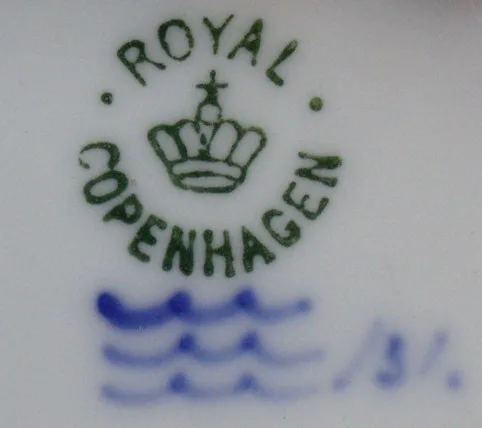
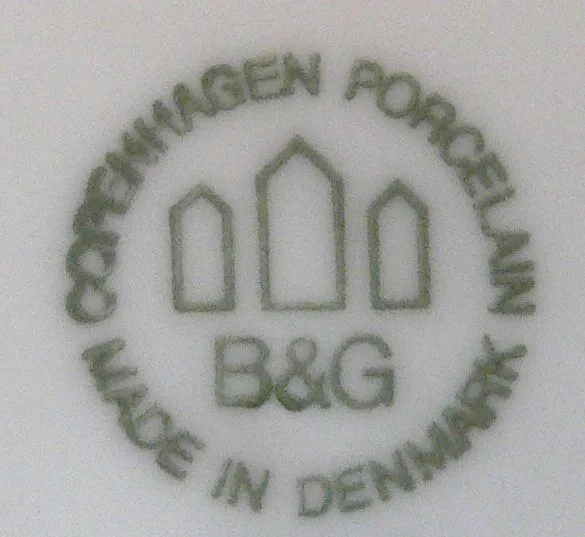
Royal Copenhagen porcelain can usually be dated from its mark. The three wavy blue lines have been used since 1775, the crown and the words around it changed several times between the 1880s and 1920s, and from the mid-1930s a small line or dot placed against one letter of the printed mark encodes the year. Bing & Grøndahl, Royal Copenhagen's great rival until the two merged in 1987, marked its porcelain with three towers and the letters B & G, and the colour and wording of that mark changed over time.
The details of the date code are not agreed between published sources, so this guide sets out the system as it is usually described, flags the disagreements and suggests how to check a reading.
Royal Copenhagen: the main marks
| Mark | Period | Notes |
|---|---|---|
| Three wavy lines, hand-drawn | From 1775; hand-drawn lines usually mean before 1885 | Early pieces sometimes have a dot before the lines |
| More regular lines, drawn with a three-nib pen or printed | 1885 to 1890 | |
| Circle with crown and "Royal Copenhagen" over the lines | From 1889 | WorthPoint gives slightly different dates for the circle marks |
| Small crown over waves over "Denmark", for export | From about 1890 (WorthPoint: 1892) | For pieces exported to the United States |
| Crown over "DANMARK" | 1894 to 1897 (WorthPoint: to 1900) | The Danish spelling; the only period it was used, according to Marks on China |
| "Royal Copenhagen" in place of the circle | 1897 to 1922 | |
| Crown over "DENMARK" over waves, printed in capitals | From 1923 | The crown is often green, the waves blue under the glaze |
| Date code: line or dot against a letter | From 1935 (some sources say 1925) | See below |
The factory's own account adds two points: the three waves were the factory's trademark from its founding in 1775, standing for the Sound, the Great Belt and the Little Belt, and the crown was first painted by hand and was being stamped under the glaze by the 1870s. Every painter also had a personal mark on the base.
How the Royal Copenhagen date code works
From the mid-1930s, Royal Copenhagen added a tiny mark to the printed words so that each year, or later each group of years, could be told apart. The principle is simple: the letters of the printed mark are counted off in order, one per year, and a short line or dot is placed above or below the letter for that year.
Royal Copenhagen does not publish this code itself: its own history of the mark covers the waves, the crown and painters' marks but not year marks. The system below comes from collectors' and dealers' references, which is another reason to treat a single reading with care. The fullest published version, by Gaile Griffin Peers on Marks on China, runs like this:
- 1935 to 1949: an underglaze line above a letter of ROYAL COPENHAGEN, starting with R for 1935, O for 1936, Y for 1937 and so on.
- From 1950: an underglaze line below the letters, starting with R for 1950, O for 1951 and Y for 1952, and continuing through the letters of the mark.
- Late 1960s to 1984: one letter covers several years, for example a line under G for 1968 to 1974, under E for 1975 to 1979 and under N for 1980 to 1984.
- From 1985: the line spans two letters: RO for 1985 to 1991, then later pairs for later periods.
Overglaze dots were used in parallel on some pieces from 1935, counted along the word DENMARK read backwards (KRAMNED) and then COPENHAGEN read backwards (NEGAHNEPOC), first below the letters and then above them.
Check before you trust a single letter
The published sequences are not fully consistent. Marks on China gives A as 1967 for the post-1950 underline series, though counting the letters gives a different year, and its dot and line series overlap in the 1980s. WorthPoint dates the start of the code to 1925 and describes the post-1985 pairs differently (RO, RY, RA, RL and RC rather than RO, YA and AL). Use the code to place a piece within a few years, and confirm it against the style of the mark and the pattern's production history.
Other numbers on Royal Copenhagen
Larger pieces often carry a model or pattern number and a painter's mark. Painters originally used numbers; later, when "Royal Copenhagen Denmark" was printed around the crown, painters' numbers were replaced by lower-case initials, according to Coscombe Fine Porcelain. The pattern number identifies the design, which can be checked against catalogues; the painter's mark identifies the decorator but, as WorthPoint notes, information about some painters has been lost.
Royal Copenhagen also marked pieces it judged to be second quality by scratching through the wavy lines on the base. This is widely reported by dealers but was not documented in the sources consulted for this guide, so look for it as one clue rather than a rule.
Bing & Grøndahl
Bing & Grøndahl was founded on 15 April 1853 by the modeller Frederik Vilhelm Grøndahl with the brothers Meyer Hermann Bing and Jacob Herman Bing. Its mark is three towers, taken from the coat of arms of Copenhagen, usually with the letters B & G and "Made in Denmark" or "Denmark".
- Colour: Coscombe Fine Porcelain notes that the three towers were printed in green, and that until the late 1940s the initials B & G were printed in blue, after which they were green too. A blue B & G therefore suggests an earlier piece.
- Wording: the wording around the towers changed over time and can be used to date figurines loosely.
- Christmas plates: B&G issued Christmas plates from 1895, the first of their kind. They carry the year, so they need no dating.
In 1987 Bing & Grøndahl merged with the Royal Porcelain Factory under the Royal Copenhagen name. Pieces made after that are marked as Royal Copenhagen.
A step-by-step method
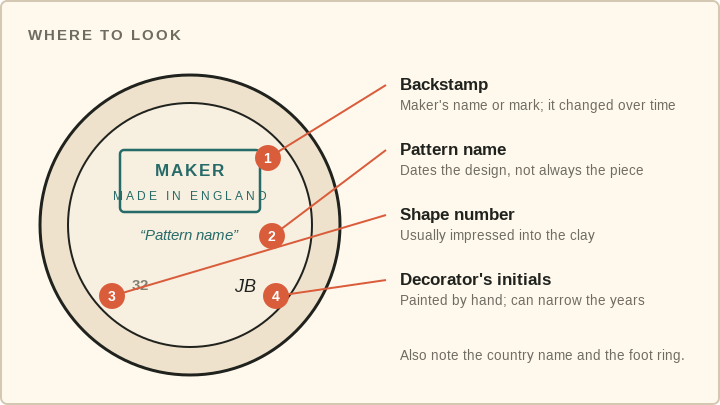
- Identify the maker: wavy lines for Royal Copenhagen, three towers for Bing & Grøndahl.
- Read the wording and spelling around the mark: "Danmark" or "Denmark", "Royal Copenhagen" in a circle or not.
- For Royal Copenhagen from 1935, look closely with a lens for a small line or dot against one letter and note which.
- Note any pattern, model or painter's number.
- Check for scratches through the wavy lines.
- Record what you find with the object research checklist.
For Danish furniture marks, see our guides to the Danish Control stamp and Fritz Hansen stamps and labels. For British pottery marks, see Poole and Denby. More guides are in collecting and buying.
Related guides
- How to identify pottery marks: a method for any mark
- Scandinavian glass signatures: Orrefors, Kosta, Holmegaard and Iittala
- What is Danish modern furniture?: the designers, makers and how to recognise it
Common questions
How do I date Royal Copenhagen porcelain?
Start with the form of the mark: the wavy lines, the crown and the wording around them changed several times between the 1880s and 1923. From the mid-1930s a small line or dot against one letter of the printed mark encodes the year or a group of years.
What do the three wavy lines on Royal Copenhagen mean?
They represent the three waterways of Denmark: the Øresund, the Great Belt and the Little Belt. They have been Royal Copenhagen's mark since 1775.
What does a line through the wavy lines mean?
A scratch through the wavy lines is widely reported to mark a piece the factory judged to be second quality. It does not mean the piece is a fake.
How can I date Bing & Grøndahl?
Look at the three towers mark and its wording. According to Coscombe Fine Porcelain, the B & G initials were printed in blue until the late 1940s and in green afterwards. Christmas plates carry their year.
When did Bing & Grøndahl and Royal Copenhagen merge?
In 1987. After that, production was marked as Royal Copenhagen.
References
- The three blue waves, Royal Copenhagen (the factory's own history of its mark)
- Bing & Grøndahl, Den Store Danske (Danish national encyclopedia)
- Dating Royal Copenhagen, Gaile Griffin Peers, Marks on China, 2020
- Royal Copenhagen porcelain, WorthPoint Dictionary
- Royal Copenhagen, Bing & Grøndahl and Dahl Jensen factories, Coscombe Fine Porcelain