Quick answer
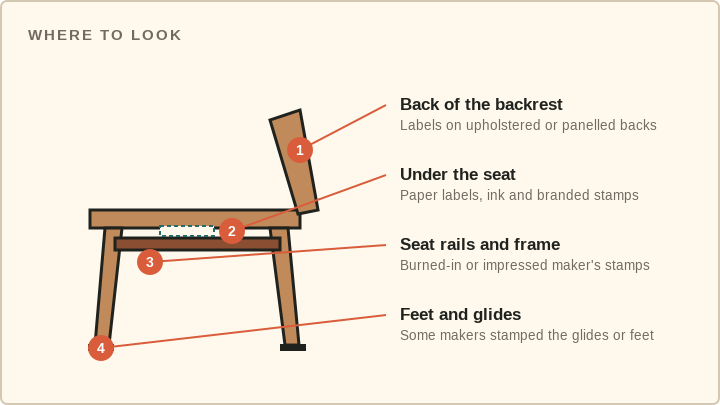
To date an Eames fibreglass shell chair, turn it over. The earliest chairs, made by Zenith Plastics in California from 1950, carry a Zenith label or stamp, or nothing at all, and come in six original colours. From 1959 the shells carry an embossed Herman Miller mark alongside a factory logo, and the range of colours grew. Fibreglass production stopped around 1989 to 1993, and fibreglass chairs made since 2013 have a logo with Charles Eames's signature moulded into the underside. Bases can be swapped, so date the shell first and the base separately.
The dating below follows the Eames Office's own generation guides, which treat armchairs and side chairs separately.
The chair in brief
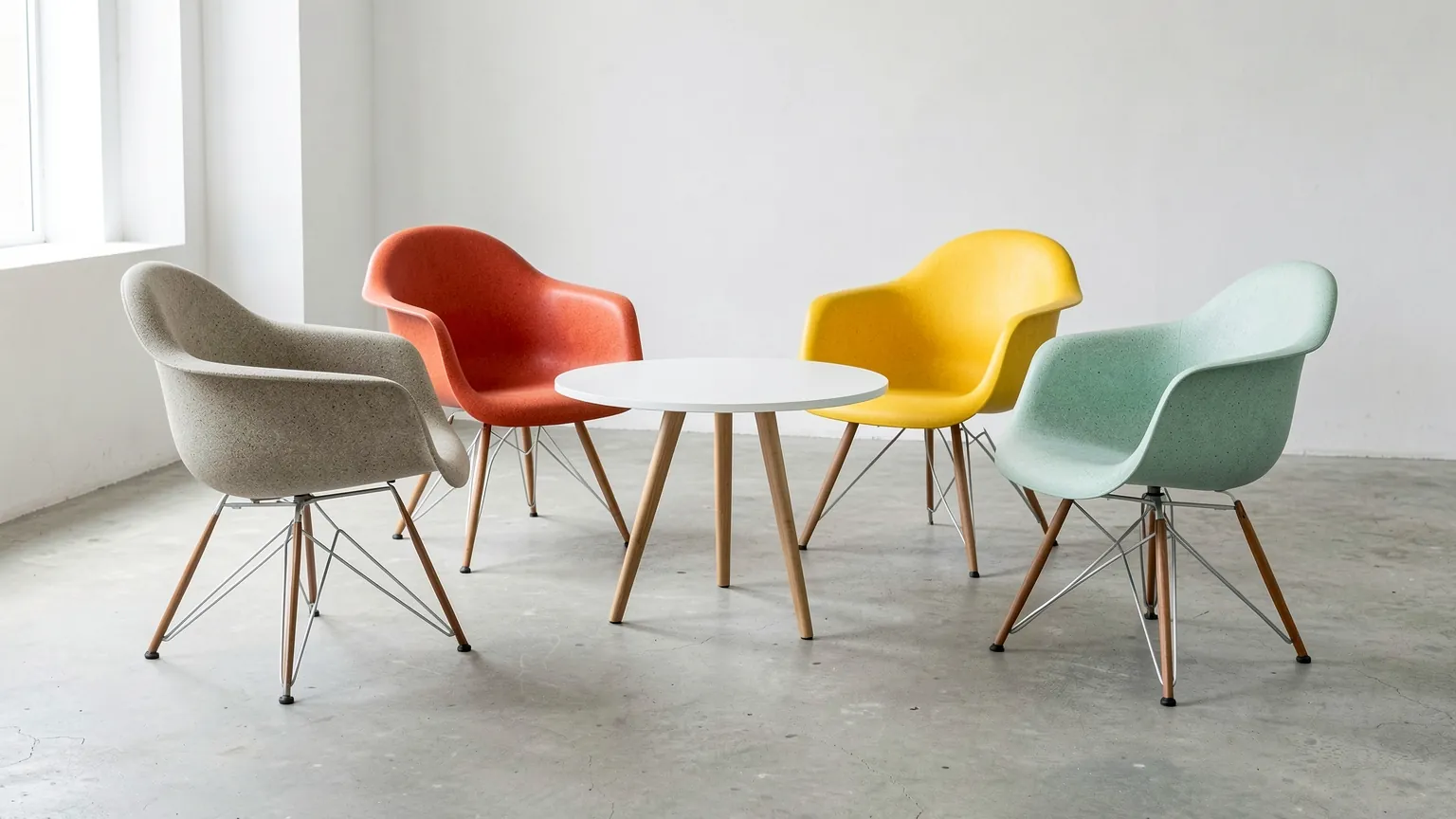
The fibreglass armchair began as an entry to the Museum of Modern Art's International Competition for Low-Cost Furniture Design in 1948. Zenith Plastics began mass-producing the armchair shell for Herman Miller in 1950, and the side chair followed. The shells were sold on a range of bases, each identified by a code: the first letter gives the height (D for dining, L for low, R for rocker), the second whether it is an armchair (A) or side chair (S), and the third the base (R for the wire "Eiffel Tower" rod base, W for wooden dowel legs, X for the X base).
Armchairs by generation
| Generation | Dates | How to recognise it |
|---|---|---|
| First | 1950 to 1953 | Made by Zenith Plastics in Gardena, California. A four-square Zenith Plastics label known as the "checkerboard". Six colours |
| "1.5" | Early 1950s | A label showing half the checkerboard; no difference in the chair itself |
| Second | 1954 to 1955 | No label or a red label; some made at the Eames Office in Santa Monica. Six colours |
| Third | 1955 to 1958 | Three small raised dots under the shell, which can be hard to see; smaller shock mounts. Six colours |
| Fourth | 1959 to 1989 | Herman Miller logo moulded into the shell; several factories; smaller mounts without centre washers; many more colours |
| Fifth | 2013 onwards | Modern fibreglass; larger mounts at the front, smaller at the rear; logos on the underside |
The earliest Zenith armchairs have a thick rolled edge, which dealers call the "rope edge". It is one of the most sought-after features, and listings use it as shorthand for an early Zenith chair.
Side chairs by generation
| Generation | Dates | How to recognise it |
|---|---|---|
| First | About 1951 to 1959 | Made by Zenith. Almost all have no marks moulded in; some have a silver Zenith circle stamp and batch code, date stamps, or a backwards Z. Patent labels from 1957. Small mounts in a narrow fixing, wide from 1955. Six colours |
| Second | About 1959 to 1993 | Herman Miller name embossed alongside a factory logo, and originally a patent label. Many colours; as many as 26 at one time |
| Third | 2013 onwards | A logo with Charles Eames's signature moulded into the fibreglass; straight edges; larger mounts at the front, smaller at the rear |
The original six colours
The first generations came in Elephant Grey (often called elephant hide grey), Red Orange, Lemon Yellow, Greige, Parchment and Seafoam. Wikipedia says the very first chairs came in greige, elephant-hide grey and parchment, with the range expanding later. A chair in one of these colours is consistent with the 1950s; a chair in another colour almost certainly dates from 1959 or later.
When did fibreglass production stop?
The sources disagree. The Eames Office's armchair guide ends the fourth generation in 1989 and its side-chair guide in 1993; Mod City Madness gives "approximately 1989 to 1993". Herman Miller says it switched to a safer plastic when fibreglass production proved unhealthy for the environment, while the Eames Office side-chair guide argues that by 1993 the chairs were simply out of fashion. Either way, a fibreglass Herman Miller shell from the 1990s or 2000s would be unusual. Herman Miller moulded the chair in polypropylene from 2001, and the Eames Office does not count those as a fibreglass generation.
Fibreglass returned in 2013. Herman Miller says a new "dry bind" process, free of monomer, made it possible to produce fibreglass shells safely again, and that the new shells still show the fibre striations and small surface variations that collectors look for.
Upholstered shells
On early upholstered side chairs the pad was removable, held round the edge by a wire tightener, and the shell underneath is clean fibreglass. Later upholstered shells were glued to foam with vinyl edging all the way round, and some had threaded fixings through the shell instead of shock mounts, hidden under the covering.
Copies and reissues
- Fibreglass or plastic. Fibreglass is slightly translucent with a visible fibre texture; polypropylene is more uniform and opaque.
- Modernica. The Los Angeles firm Modernica has also made fibreglass shell chairs; Mod City Madness says it used original tooling bought from Herman Miller. These are legitimate chairs but not Herman Miller ones.
- Unlicensed copies. The design has been widely copied. A shell with no marks, the wrong mount pattern and a light, flexible base should be treated with caution unless it matches a documented first-generation side chair.
See also how to date Herman Miller furniture by its label, the Eames Lounge Chair and originals, licensed reissues and reproductions. Record your findings with the object research checklist; more guides are in collecting and buying.
Common questions
How do I know how old my Eames shell chair is?
Look under the shell. A Zenith label, a silver Zenith stamp or no marks at all, with one of the six original colours, points to the 1950s. An embossed Herman Miller mark with a factory logo points to 1959 to about 1993. A moulded logo with Charles Eames's signature means a chair made since 2013.
What is a rope edge Eames chair?
An early fibreglass armchair made by Zenith Plastics, with a thick rolled edge round the rim. It is among the earliest and most sought-after versions.
When did Herman Miller stop making fibreglass shell chairs?
Around 1989 to 1993; sources differ. Herman Miller made the chair in polypropylene from 2001 and brought fibreglass back in 2013.
What do DSR, DAW and RAR mean?
They are model codes: height (D for dining, R for rocker), type (A for armchair, S for side chair) and base (R for the wire rod base, W for wooden legs, X for the X base). So DSR is a dining-height side chair on a wire base, and RAR a rocking armchair on a rod base.
References
- Eames fiberglass side chair generations, armchair generations (2019) and abbreviations, Eames Office
- Eames Fiberglass Armchair, Wikipedia
- Eames Molded Fiberglass Chairs, Herman Miller
- Charles and Ray Eames furniture collector's guide, Mod City Madness, 2026
- 1950s first-generation rope edge shell armchair by Zenith/Herman Miller, Chairish listing