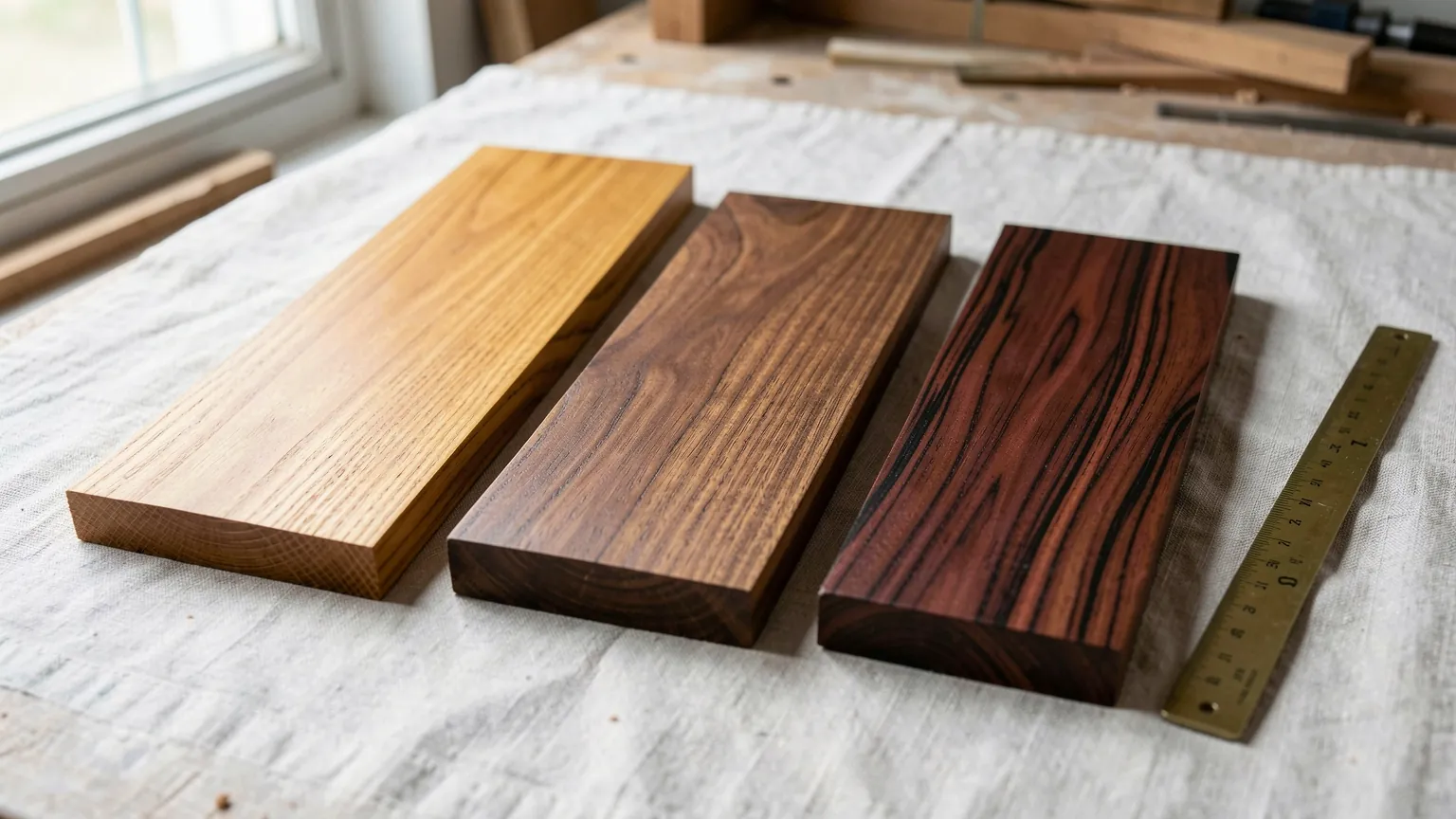
Teak is golden to mid-brown, fairly straight in the grain and slightly greasy to the touch. Walnut is a cooler, chocolate brown, often with a purplish cast and a more lively figure, and it feels dry. Rosewood is the darkest and heaviest of the three, brown to purple with bold black streaks, and gives off a sweet smell when it is worked. Those three sentences will sort most clean, unstained pieces in good light.
The trouble is that much mid-century furniture is not clean, unstained or solid. Finishes darken and fade, cheaper timbers were stained to look like dearer ones, and most broad surfaces are veneer, so the face of a cabinet can be a different species from its frame. The reliable evidence is in the places nobody finished: the inside of a carcass, the underside of a drawer, a worn edge, the end grain of a leg.
This guide gives the reference descriptions the three timbers are identified by, shows how museums describe them on real objects, and sets out where appearance stops being enough. It also covers the trade rules on rosewood, which matter to anyone buying or selling it.
The three timbers at a glance
The descriptions below come from Commercial Timbers, the wood identification database compiled by H.G. Richter and M.J. Dallwitz and published by the University of Hamburg (version of 4 May 2000). Values are given as the database gives them: a low, typical and high figure.
| Teak | Walnut | Brazilian rosewood | |
|---|---|---|---|
| Botanical name | Tectona grandis | Juglans regia (European), J. nigra (American black walnut) | Dalbergia nigra |
| Heartwood colour | Brown to yellow (golden brown), with streaks | Brown to yellow in J. regia, brown to purple in J. nigra, with streaks | Brown to purple, with black streaks |
| Smell | Distinct | Not recorded | Distinct; aromatic and sweet |
| Feel | Greasy surface | Not described as greasy | Not described |
| Pores | Ring-porous or semi-ring-porous | Semi-ring-porous, sometimes diffuse-porous | Diffuse-porous |
| Basic specific gravity | 0.44–0.63–0.82 | 0.45–0.64–0.74 | 0.72–0.8–0.85 (up to 0.88) |
| Other | Silica in the vessels | Often in short radial rows of two or three pores | Listed on CITES Appendix I |
Two points stand out from the table. Teak and walnut overlap in weight, so heft will not separate them; rosewood is reliably heavier. And the pore pattern differs: on a clean end grain, teak and walnut tend to show larger pores clustered where each year's growth began, while rosewood's pores are scattered evenly. That is a test for a hand lens, not for a photograph.
What museum records call them
Museum catalogues show both the timbers in use and the care that is needed in naming them.
| Object | Date | Material as catalogued | Record |
|---|---|---|---|
| Charles and Ray Eames, Low Side Chair (LCM), Herman Miller | 1946 | Molded walnut veneered plywood, chrome-plated steel rods | MoMA 156.1973 |
| Charles and Ray Eames, Lounge Chair and Ottoman, Herman Miller | 1956 | Molded rosewood, plywood, leather, cast aluminium | MoMA 336.1960 |
| Grete Jalk, Lounge Chair, Poul Jeppesen | 1963 | Teak plywood | MoMA 1427.2000 |
| Jacob Kjær, Armchair, Christiansen & Larsen | 1959 | Teak, oak and leather | The Met 61.7.42 |
| Charles and Ray Eames, three-legged side chair, Evans Products | 1945 | Moulded birch plywood (another field: red-stained Canaletta plywood) | V&A W.10-1982 |
Three lessons come out of these five records.
"Walnut" and "rosewood" usually mean a veneer. MoMA's description of the 1946 chair says "walnut veneered plywood": the walnut is the outer layer. The same applies to most cabinet furniture of the period. The species on show tells you about the face, not the core.
Teak often sits beside cheaper timbers. The Met's Kjær armchair is catalogued as teak, oak and leather. Mixed timbers in one piece are normal, and a hidden rail in a different wood is not, by itself, a sign of repair or reproduction.
Even a museum can disagree with itself. The Victoria and Albert Museum's record of an early Eames side chair, W.10-1982, gives "moulded birch plywood" in its materials note and "red stained moulded Canaletta plywood" in its physical description. Stained plywood is hard to identify by eye. If a catalogue can carry two answers, a sale listing written from a photograph deserves more doubt.
Where to look on a piece of furniture
Unfinished surfaces first. The back of a carcass, the inside of a drawer front and the underside of a top are often left raw or lightly sealed. Colour there is closer to the timber's own colour than on a polished, sun-faded face.
Edges and wear. On a veneered panel, look at the edge. A thin face layer over a different core, or a lipping strip of solid wood glued along the edge, tells you the panel is veneered. Identify the face and the lipping separately; do not assume they match.
End grain. Where a leg or rail shows its end grain cleanly, a 10x hand lens will show whether the pores are scattered evenly, as in rosewood, or concentrated in bands, as in teak and walnut.
The touch test for teak. Teak's greasy surface is noticeable on unfinished wood. Under a thick lacquer it disappears, so the absence of a waxy feel on a finished face proves nothing.
Smell. Both teak and rosewood have a distinct smell when freshly cut or sanded, and rosewood's is sweet. On old furniture the smell is weak; the inside of a closed drawer is the best place to notice it. Do not sand a piece to test it.
Weight, with care. Rosewood is markedly denser than teak or walnut, but a veneered cabinet's weight comes mainly from its core, so weight helps only with solid parts such as legs, handles and chair frames.
What misleads
| Problem | Why it misleads | What to do instead |
|---|---|---|
| Stain | Stain changes the colour of the surface, not of the wood beneath; the V&A's Eames chair in the table above is catalogued as red-stained, and a stained pale timber can pass for a darker one | Compare a worn edge or the inside, where stain is thin or absent |
| Fading and darkening | Light and age change the colour of most timbers, lightening some and darkening others, so an exposed face may be far from the wood's original colour | Look where light never reached, such as under a removed handle or inside a drawer |
| Photographs | Colour shifts with light, camera and editing | Ask for a photo in daylight with something white in the frame, and a close-up of an edge |
| Trade names | "Jacarandá" and "caviuna" are recorded as trade names for both Dalbergia nigra and Machaerium scleroxylon, a different genus also sold as Santos palisander | Treat "rosewood" in a listing as a description, not a species |
| Lookalike timbers | Other species share teak's golden-brown colour; afrormosia (Pericopsis elata) is described as brown to yellow, sometimes greenish | Unless a document names the timber, describe it as "teak-coloured" or "appears to be teak" |
| Labels and marks | Maker's labels rarely name a timber, and certification marks are not timber certificates | Use the wood itself as the evidence |
That last row matters because of a common assumption. The Danish Furniture Makers' Control stamp certifies origin and material quality against the association's standard, not species, so a marked piece may be teak, rosewood, oak or a veneer over something cheaper. A maker's paper label, read using our guide to labels and maker marks, can date and place a piece; it rarely names its wood.
Why so much Danish furniture is teak
Teak was a working Danish trade long before it was a style. The East Asiatic Company, founded in Copenhagen in 1897 by H.N. Andersen, traded and shipped teak from Siam, and ran teak concessions there, according to the Royal Thai Embassy in Copenhagen's history of the company. That does not prove where the teak in any particular chair came from, and we have not found a source that gives figures for Danish furniture imports by supplier. It does explain why teak was at hand in Denmark and why Danish exporters used it so widely.
Rosewood and the law
Rosewood is the one timber of the three where identification has legal consequences. These are the dated facts; for a specific sale or shipment, check the current rules with the authority in your country, which in Great Britain is the Animal and Plant Health Agency.
| Date | Change | Source |
|---|---|---|
| 1992 | Brazilian rosewood, Dalbergia nigra, listed on CITES Appendix I, the strictest level | TRAFFIC report, 2013; Royal Botanic Gardens, Kew, 2022 |
| 2017 | The whole genus Dalbergia listed on CITES Appendix II, bringing Indian and other rosewoods into permit controls | Royal Botanic Gardens, Kew, 2022 |
| 2020 (as reported) | CITES annotation #15 amended: finished products containing up to 10 kg of listed Dalbergia wood per shipment exempted from permits, but not Dalbergia nigra | British Antique Dealers' Association business briefing, August 2020 |
In Great Britain, Brazilian rosewood sits in Annex A, the most protected category of the wildlife trade regulations, as the British Antique Dealers' Association's briefing notes. The government's guidance on worked specimens says items manufactured before 3 March 1947 and not reworked since can be traded without an Article 10 certificate, and gives furniture made from rosewood as a typical example of a worked specimen. Most mid-century furniture was made after that date. The British Antique Dealers' Association's briefing states that Dalbergia nigra worked after 3 March 1947 needs an Article 10 certificate for commercial use.
That makes the species question practical. A 1960s cabinet in Indian rosewood (Dalbergia latifolia) and one in Brazilian rosewood can look much alike, and the difference is not reliably visible to a buyer. Older reference works may also be out of date: the Commercial Timbers entry for Indian rosewood, compiled in 2000, records it as not protected under CITES, which stopped being true in 2017. If a seller describes a piece as "Brazilian rosewood", ask what evidence supports it and what paperwork goes with it.
A short method
- Photograph the piece in daylight, then the inside, the back, one worn edge and one end grain.
- Decide what is solid and what is veneer before naming any species.
- Compare unfinished surfaces with the descriptions in the first table: colour, feel, pores.
- Check museum records of the same model, where one exists, for the timbers it was made in.
- Write down what you saw and how sure you are. "Teak veneer on a carcass of an unidentified timber" is a better record than a confident guess, and it fits straight into our object research checklist.
- For rosewood, or any purchase where species changes the price, ask for written evidence. For a disputed case, microscopic identification by a specialist wood anatomist is the standard of proof, not a visual opinion.
More practical guides are collected under collecting and buying.
Common questions
How can I tell teak from walnut?
Teak is golden to mid-brown and has a slightly greasy feel on unfinished surfaces; walnut is a cooler chocolate brown, often with a purplish tone, and feels dry. Both have similar weight and similar pore patterns, so compare colour and feel on an unfinished surface such as a drawer side, not on a polished or faded face.
Is rosewood heavier than teak?
Yes. The Commercial Timbers database gives a typical basic specific gravity of about 0.8 for Brazilian rosewood against about 0.63 for teak. Weight only helps with solid parts, though, because a veneered cabinet's weight comes mainly from its core.
Is my rosewood furniture legal to sell?
It depends on the species and the date. All rosewoods in the genus Dalbergia have been on CITES Appendix II since 2017, and Brazilian rosewood has been on Appendix I since 1992. In Great Britain, Brazilian rosewood furniture worked after 3 March 1947 needs an Article 10 certificate for commercial use, according to the British Antique Dealers' Association. Check current rules with the Animal and Plant Health Agency before selling.
Does a "made in Denmark" or Danish Control mark prove the wood is teak?
No. Neither mark names a timber. The Danish Control mark certifies origin and material quality against the association's standard; the species has to be identified from the wood itself.
Why does my teak furniture look orange?
Usually because of the finish rather than the wood. Teak oils and some lacquers deepen its colour, and a stained surface can make another timber look like teak. Compare the outside with an unfinished inside surface.
References
- H.G. Richter and M.J. Dallwitz, Commercial Timbers: descriptions, illustrations, identification and information retrieval (version 4 May 2000): teak, walnut, Brazilian rosewood, Indian rosewood, Santos palisander, afrormosia
- Charles and Ray Eames, Low Side Chair (model LCM), 156.1973, The Museum of Modern Art
- Charles and Ray Eames, Lounge Chair and Ottoman, 336.1960, The Museum of Modern Art
- Grete Jalk, Lounge Chair, 1427.2000, The Museum of Modern Art
- Jacob Kjær, Armchair, 61.7.42, The Metropolitan Museum of Art
- Charles and Ray Eames, side chair, W.10-1982, Victoria and Albert Museum (collections API record)
- The East Asiatic Company: the ties of trade and people from Bangkok to Copenhagen, Royal Thai Embassy, Copenhagen
- V. Taylor, K. Kecse-Nagy and T. Osborn, Trade in Dalbergia nigra and the European Union, TRAFFIC, 2013
- How a checklist could save Dalbergia, Royal Botanic Gardens, Kew, 25 October 2022
- Business briefing: CITES restrictions lifted on certain rosewoods, British Antique Dealers' Association, August 2020
- Check if your item from an endangered species is a worked specimen, GOV.UK