Quick answer
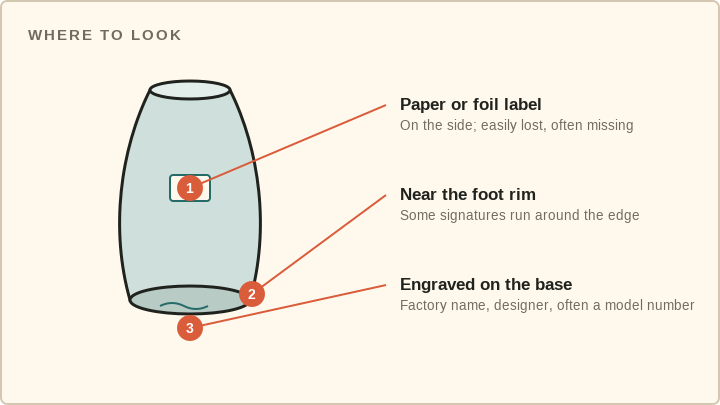
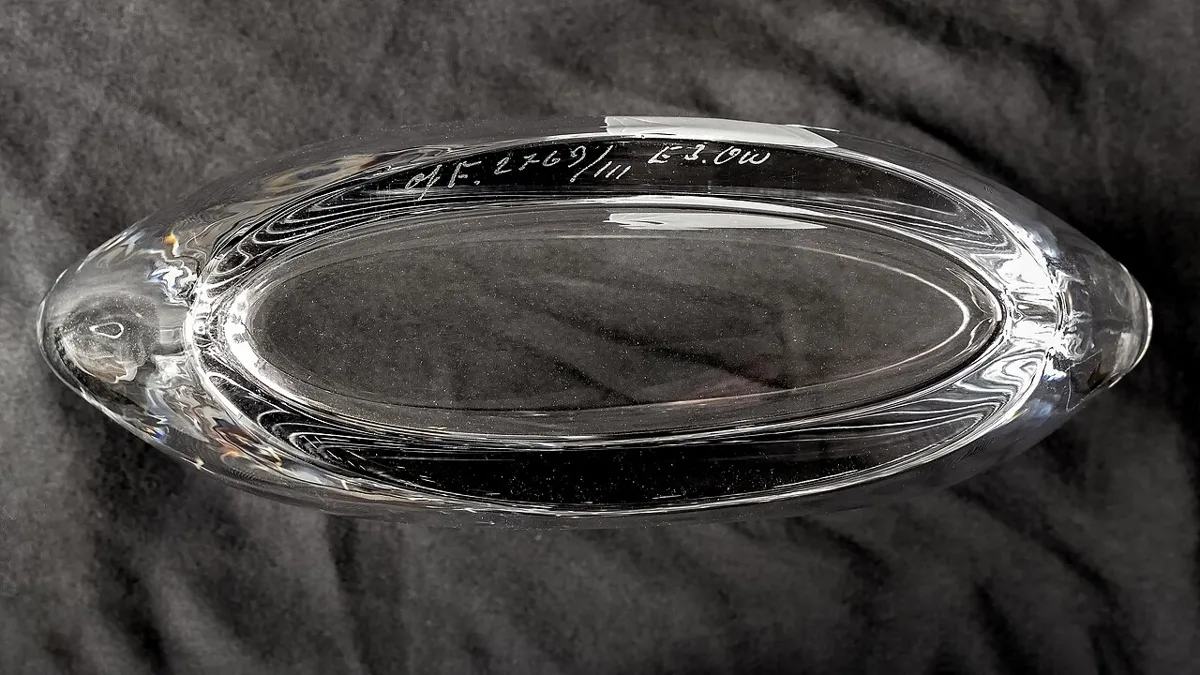
Scandinavian art glass is usually signed on the base, written by hand with a diamond point or applied as a sandblasted or moulded mark. A typical signature gives the factory name ("Orrefors", "Kosta", "Holmegaard" or "Iittala"), a model or code number, and often the designer's name or initials. Orrefors signatures are the most informative, because from 1935 the factory used letter-and-number codes that date a piece to a single year. Holmegaard signatures sometimes include the year itself. Everyday production glass, by contrast, was often marked only with a paper label, which is usually lost.
The tables below cover the four factories collectors ask about most. Designer initials and code letters were not used consistently across all production, so check a signature against documented examples before relying on it.
The four factories at a glance
| Factory | Country | Typical signature | Dating help |
|---|---|---|---|
| Orrefors | Sweden | "Orrefors", a technique name for art pieces (such as Ariel or Graal), a number with a code, and the designer's name or initial | Letter-and-number date codes from 1935 |
| Kosta (later Kosta Boda) | Sweden | "Kosta" with a model number, often prefixed with the designer's initial and a code letter, such as LH for Vicke Lindstrand | Model numbers can be matched to dated pieces; the Kosta Boda name dates from 1976 |
| Holmegaard | Denmark | "Holmegaard" with a year and a designer's monogram, such as "PL" for Per Lütken | The year, where it appears |
| Iittala | Finland | "Iittala" or a designer's name, sometimes moulded into the glass; designers' initials such as "TS" for Timo Sarpaneva | Mostly by model and designer |
Orrefors
Orrefors art glass is the best documented. The Swedish Glass site, which specialises in Orrefors, sets out how its signatures work.
The date codes. From 1935 Orrefors used a letter and a digit to record the year, at first only on cut glass and later more widely. Each letter covers nine years, and the digit gives the year within that block.
| Code | Years |
|---|---|
| A1 to A9 | 1935 to 1943 |
| B1 to B9 | 1944 to 1952 |
| C1 to C9 | 1953 to 1961 |
| D1 to D9 | 1962 to 1970 |
| E1 to E9 | 1971 to 1979 |
| F1 to F5 | 1980 to 1984 |
So a code containing D4 points to 1965. The art techniques had their own systems. Ariel pieces, made from 1937 to 1982 and signed by hand with a diamond pen, carry a serial number that can be matched to a year, with a letter added to the number from 1950. Slip Graal, developed in the late 1930s, had its own numbering from 1940; early pieces have an "S" before the code, which was dropped from 1953. From 1982 Ariel pieces were signed "Gallery" with an edition number, such as 13/60.
Designer initials. Until 1980 Orrefors used single letters or short codes for its designers, and from 1980 two- or three-letter initials.
| Designer | Until 1980 | From 1980 |
|---|---|---|
| Sven Palmqvist | P | SP |
| Edvin Öhrström | F | EÖ |
| Nils Landberg | N | NL |
| Ingeborg Lundin | D | IL |
| Edvard Hald | H | EH |
| Vicke Lindstrand | L | VK |
| Gunnar Cyrén | B | GC |
| Simon Gate | G | SG |
The glass reference site 20th Century Glass gives different codes for some of the same designers, such as "PU" with the pattern number for Palmqvist and "FU" for Öhrström. These may be letters from a different part of the signature, so read the whole signature rather than one group of letters.
Kosta and Kosta Boda
Kosta, founded in 1742, signed its art glass "Kosta" with a model number. Vicke Lindstrand's pieces often carry "LH" or "LS" before the number: 20th Century Glass gives H as the code for handmade glass and S for cut glass. Pieces may also be signed with the designer's name, such as "Kosta, V. Lindstrand". After Kosta and Boda joined as Kosta Boda AB in 1976, signatures read "Kosta Boda" with the designer's name, such as "B Vallien" for Bertil Vallien or "K Engman" for Kjell Engman. Mats Jonasson's animals are signed "Kosta" with "MJ"; 20th Century Glass dates this form to about 1977 to 1981. Kosta Boda later merged with Orrefors, in 1990.
Kosta model numbers are not a date code, but they can be matched to dated pieces: an LH number around 1100 is recorded from the mid-1950s and around 1600 from the late 1950s and early 1960s.
Holmegaard
Holmegaard, the Danish glassworks, signed some pieces "Holmegaard" with a year and a designer's monogram. 20th Century Glass records Per Lütken's pieces signed with "PL" and dates such as 1960 or 1961, and Michael Bang's with "MB". Later pieces by Peter Svarrer and Monica Ritterband carry a sandblasted mark. As with the other factories, not every piece was signed, so an unsigned piece is not necessarily a copy.
Iittala
Iittala, founded in Finland in 1881, marked some designs with a moulded "Iittala" or the designer's name, including Alvar Aalto and Kaj Franck pieces. Timo Sarpaneva's work is often signed "TS", and other art pieces carry the designer's signature with a model number. Sarpaneva also designed the company's "i" logo in 1956. Wikipedia notes that in the early 1960s products were still made under the Karhula name, and that the Iittala name was used for exports from 1988.
Before you trust a signature
A signature can be added to an unsigned piece, and the hand-written diamond-point signatures are the easiest to imitate. Check that the signature matches the style of the glass and the designer, that the model number fits the known range for that designer, and that the base shows wear consistent with the signature's age.
A step-by-step method
- Read the whole signature under a lamp, tilting the glass; photograph it.
- Write down every part: factory, technique, numbers, letters and names.
- For Orrefors, look for a letter-and-digit date code and convert it with the table above.
- Match the designer initials and the model number with documented examples.
- Record what you find with the object research checklist.
For ceramics, see how to identify pottery marks and our guide to Royal Copenhagen and Bing & Grøndahl. More guides are in collecting and buying.
For another Småland maker, see Strömbergshyttan glass marks.
For American pressed glass and other makers' marks, see glass makers' marks: how to identify vintage glass.
Common questions
How do I read an Orrefors signature?
Look for "Orrefors", any technique name such as Ariel or Graal, a number with letter codes, and the designer's name or initial. A letter and digit such as D4 is a date code: from 1935 each letter covers nine years, so D4 is 1965.
Is all Scandinavian glass signed?
No. Art glass was usually signed, but much production glass carried only a paper label, which is often lost. An unsigned piece can still be genuine.
What does LH mean on Kosta glass?
On Vicke Lindstrand's Kosta glass, L is his initial and H is the code for handmade glass, followed by the model number. LS indicates cut glass.
How do I date Holmegaard glass?
Some pieces are signed "Holmegaard" with a year and the designer's monogram, such as "PL" for Per Lütken, which dates them directly. Unsigned pieces have to be dated by design.
References
- How to date Orrefors glass and dating Orrefors Ariel glass, Swedish Glass
- Glass signatures and markings and Kosta Boda glass identification, 20th Century Glass
- Iittala, Wikipedia