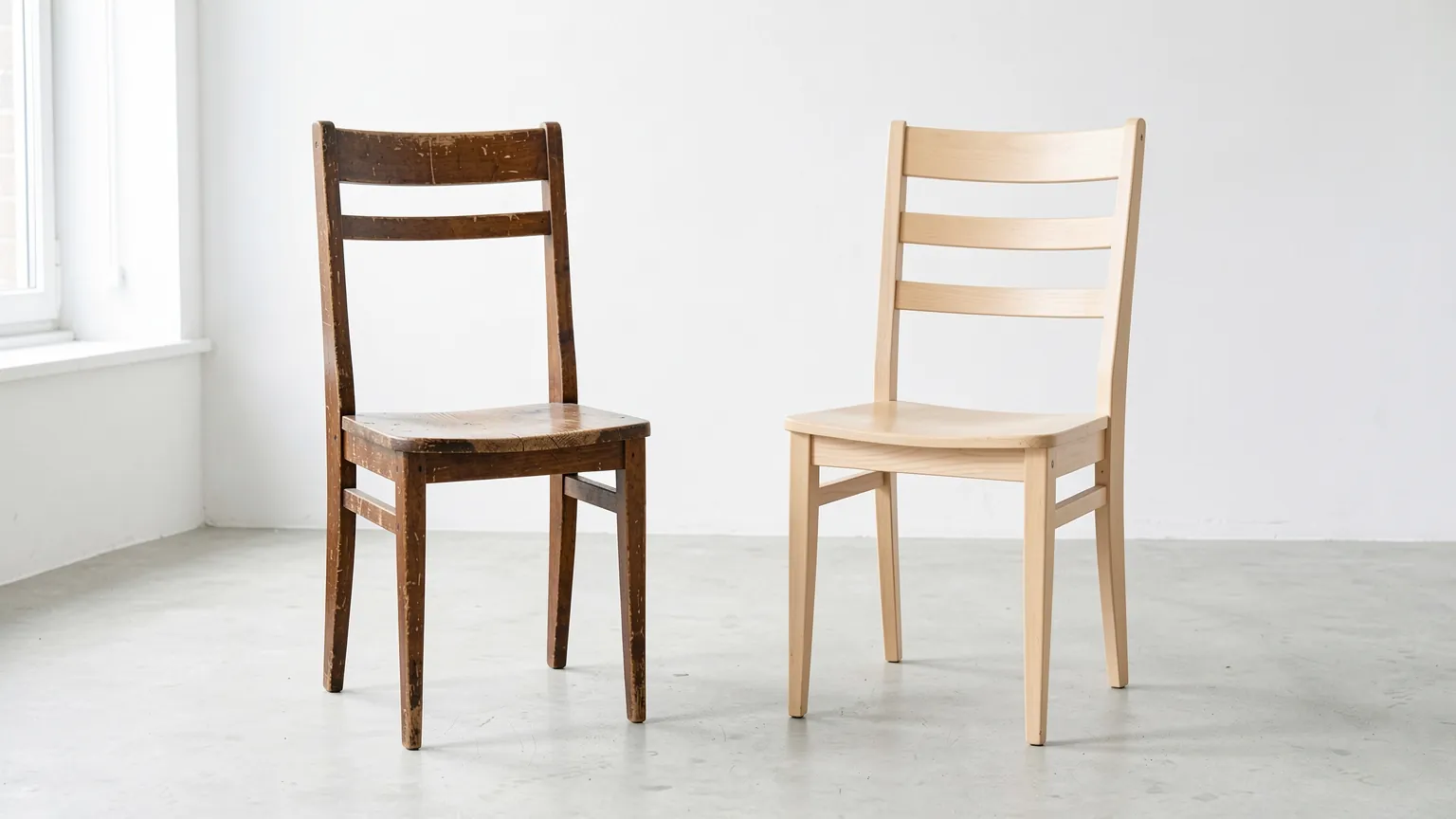
Quick answer
Almost every mid-century chair is built on one of a handful of systems: a joined frame of solid wood, wood bent under steam, a moulded plywood (or later plastic) shell, a metal frame of tubing, rod or cast aluminium, or a combination of these. The seat is then either part of the structure (a shell or a solid seat), woven (cane, rush, seagrass or paper cord), or upholstered over webbing, springs and padding.
Work out the system first. It tells you what the chair is, where it is likely to fail, and which repairs are honest and which are not. A label or stamp, if there is one, comes second; construction is the evidence that is always there.
This guide sets out the main systems with museum records of real chairs, the vocabulary you need to describe them, and the checks that matter for each one when you are inspecting or buying.
What museum records say
Museum catalogue entries describe construction exactly, which makes them a good reference for what an original looks like. These records cover the main systems.
| Chair | Date | Construction as catalogued | Record |
|---|---|---|---|
| Marcel Breuer, Model B32, Gebrüder Thonet | Designed 1928, made after 1930 | Cantilevered chrome-plated tubular steel frame; back of steam-bent beech frames in-filled with caning | V&A W.10-1989 |
| Gerald Summers, armchair, Makers of Simple Furniture | Designed 1934, made 1934–40 | Moulded 13-ply birch plywood | V&A W.26-1978 |
| Ernest Race, BA-3, Race Furniture | Designed 1945, made 1946–48 | Five die-cast aluminium parts (seat frame and four legs of tapered T section); back plate riveted on; seat padded with rubberised hair | V&A W.4-2010 |
| Ernest Race, DA 1 armchair, Race Furniture | 1946 (upholstered about 1965) | Steel rod internal frame with cast aluminium parts visible in the legs; replacement upholstery over foam and Pirelli webbing | V&A W.76:1, 2-1983 |
| Charles and Ray Eames, Low Side Chair (LCM), Herman Miller | 1946 | Moulded walnut-veneered plywood, chrome-plated steel rods | MoMA 156.1973 |
| Hans Wegner, Chair 24, Carl Hansen & Søn | 1950 | Oak or beech frame with paper-cord seat; curved arm and back piece bent under steam pressure | V&A CIRC.327-1970 |
| Gio Ponti, Leggera (model 646), Cassina | 1951–52 | Solid ash pieces joined with dowel joints; seat handwoven in twisted seagrass | V&A W.4-2011 |
| Egon Eiermann, SE 69, Wilde + Spieth | 1952 | Moulded beech plywood seat and back on a tubular steel frame, fixed with screws and rubber mounts | V&A W.13-2017 |
| Michael Inchbald (designer), Mambo chair, maker unknown | 1955 | Welded iron rod frame, woven cane, webbing of rubberised canvas strips, foam rubber cushions | V&A W.13:1 to 4-1981 |
Three points come out of these records.
Mixed construction is normal. The B32 combines tubular steel with bent beech and cane; the SE 69 and the LCM put moulded plywood on metal; the DA 1 hides a steel rod frame inside upholstery, with cast aluminium showing only in the legs. A chair that mixes materials is not, for that reason alone, altered or assembled from parts.
Museums record later work as well as original. The V&A dates the DA 1's upholstery to about 1965, nearly twenty years after the frame, and notes that staples under the Leggera seat were added later to hold a loosening weave. Old repairs and re-covers are part of a chair's history; the point is to know which parts are which.
Material availability shaped construction. The V&A's BA-3 record notes that aluminium was one of the few materials freely available while rationing was still in place, and the chair was made in parts that could be taken apart for transport. The same record notes a CC41 Utility mark under the seat. Reading the period's constraints helps explain why a chair is built the way it is.
The main construction systems
| System | How it works | What to check |
|---|---|---|
| Joined solid-wood frame | Legs, rails and stretchers cut from solid timber and joined with mortise and tenon, dowel or bridle joints, often reinforced with glued and screwed corner blocks under the seat | Movement at each joint, cracks at the joints, missing or replaced corner blocks, metal brackets added later |
| Steam-bent wood | Solid wood softened with steam and bent over a form, used for arms, back rails and whole frames | Splits along the outside of a bend, a bend that has partly sprung back, cracks at fixings |
| Moulded plywood | Thin cross-grained veneers glued and pressed in a mould into a seat, back or one-piece shell | Delamination (layers separating), cracks across the grain at tight curves, failed glue at mounts |
| Plywood or shell on a metal base | Seat and back fixed to a steel frame by screws, bolts, glued or rubber mounts | Perished or detached rubber mounts, stripped screw holes, replaced mounts or bases |
| Tubular steel | Bent steel tube, usually chrome-plated or painted; sometimes cantilevered so the chair has no back legs | Kinks or flattening at bends, rust under lifting chrome, cracked welds, a cantilever that sags or bounces unevenly |
| Rod and wire | Solid steel or iron rod, bent and welded into a frame or grid | Broken welds, rust at joints, bent members, worn-through plating |
| Cast aluminium | Molten aluminium alloy cast into a mould to make legs, frames or whole components | Cracks (casting rarely bends; it breaks), mismatched replacement castings, worn or loose fixings between parts |
| Moulded plastic or fibreglass shell | A one-piece seat moulded in glass-fibre reinforced plastic or, later, other plastics, fixed to a base by mounts | Cracks around mounts, crazing, mounts reglued or replaced |
For plywood and veneer in detail, including why cross-laminated panels move so little, see our guide to veneer and solid wood.
Frames and joints: a short vocabulary
- Rail: a horizontal member, such as the seat rails that run round under the seat or a back rail.
- Stretcher: a horizontal member joining the legs lower down.
- Upright: a vertical member of the back; often the back legs continue upwards to form the uprights, as the V&A records for both the Leggera and the BA-3 describe.
- Mortise and tenon: a tongue (tenon) on one part fitted into a slot (mortise) in the other. The commonest strong joint in wooden chairs.
- Dowel joint: round wooden pegs glued into holes in both parts. Quick to make in quantity; strong when well fitted, but it can loosen as glue fails.
- Bridle or finger joint: interlocking open slots and tongues, often visible from outside and sometimes left on show as a design feature.
- Corner block: a block of wood glued, and often screwed, inside the corner where two seat rails meet, to stiffen the frame.
- Cantilever: a frame that supports the seat from one side only, usually a continuous loop of tube running under the seat and down to the floor at the front.
- Shock mount or rubber mount: a rubber pad or bush between a seat and its frame that holds it and absorbs movement.
When a chair wobbles, find which joint moves before deciding anything. A loose dowel or tenon can be cleaned out and reglued by a restorer. Screws driven through a joint or metal plates added under the seat are a cheaper fix that does more harm in the long run, and they are worth noting in any description.
Seats: woven, solid and upholstered
Woven seats are made from cane, rush, seagrass or paper cord. Chair 24 has a paper-cord seat; the Leggera a seat of twisted seagrass in what the V&A calls a traditional envelope pattern; the B32 has caned panels. Woven seats sag and break with use and are routinely rewoven. A rewoven seat is not a fault if the work is good and the material right; note it, and check the rails the weave is wrapped round for splits.
Solid seats are part of the structure: moulded plywood, plastic or a solid wooden seat. Check them as you would the frame.
Upholstered seats are built in layers, from the frame outwards:
| Layer | Typical materials | What to look for |
|---|---|---|
| Support | Webbing (jute, or rubber webbing such as the Pirelli webbing in the V&A's DA 1), metal springs, or a solid board or plywood base | Slack or snapped webbing, springs that have broken or pushed through, a board replacing original webbing |
| Padding | Horsehair or rubberised hair (as in the BA-3), latex foam rubber (as in the Mambo chair), later polyurethane foam | Crumbling or hardened foam, a seat that bottoms out, lumps or hollows |
| Cover | Wool, cotton, linen, leather, vinyl | Whether it is original; fading on exposed faces and not underneath; tacks or staples that look newer than the rest |
Upholstery on a chair of this age has very often been replaced, sometimes more than once, and that is usually fine. What a buyer needs to know is what was replaced and with what. The underside will tell you a lot: lift the bottom cloth (or look past it) for older tack holes, newer staples, and the webbing or springs.
In the United Kingdom, the Furniture and Furnishings (Fire) (Safety) Regulations 1988 set fire-resistance standards for upholstered furniture supplied in the course of business. Furniture made before 1 January 1950 is outside them. A modern fire label on an older chair usually means it has been re-covered; our guide to labels and maker marks explains the dates. If you are having a chair reupholstered, ask the upholsterer which materials they will use and why.
Common misconceptions
"Construction proves the maker." It does not. Many firms used the same methods, and reproductions copy them. Construction narrows things down and can rule an attribution out; it cannot prove one on its own. For attribution use labels, stamps and documentary evidence as well, for example our guides to Thonet, Fritz Hansen and Knoll.
"Original upholstery is always better." It is valuable evidence, and worth keeping where it can be kept. But perished foam and broken webbing make a chair unusable, and museums hold re-covered chairs too, as the DA 1 shows. A careful re-cover with honest notes is better than a hidden one.
"Screws and staples mean a chair is modern." Original construction often used screws, at corner blocks and to fix seats to frames, as the BA-3 and SE 69 records show. What matters is whether each fixing belongs to the original design or was added as a repair.
"Mixed materials mean a marriage of parts." As the records above show, combining bent wood with steel, or plywood with rod and rubber mounts, was ordinary. Check instead whether the parts match in age, wear and finish.
Where a chair could be an original, a licensed reissue or a copy, our guide to originals, reissues and reproductions sets out the evidence to gather.
A condition check, step by step
- Look at the chair from the side and the front on a level floor. Note any lean, twist or a leg that does not touch.
- Identify the system: joined, bent, moulded, metal, shell or mixed. Name the material of each part.
- Turn it over (on a blanket) and photograph the underside: rails, corner blocks, mounts, fixings and any marks.
- Hold each leg in turn and rock gently. Find which joint or mount moves.
- Check bends, curves and welds for splits, cracks and kinks. Check plywood edges for layers separating.
- On upholstered chairs, press the seat and back for broken webbing, springs or collapsed padding, and look underneath for newer staples and older tack holes.
- Record what is original, what is repaired, what is replaced and what is unknown, and keep the notes with the chair, for example in our object research checklist.
Identifying the timber of a frame or a face veneer is a separate step: see how to tell teak, walnut and rosewood apart. More close readings of objects are collected under furniture and objects.
Common questions
How were mid-century chairs usually made?
Most were built on one of a few systems: a joined solid-wood frame, steam-bent wood, a moulded plywood or plastic shell, or a metal frame of tubular steel, rod or cast aluminium, often combined. The seat was solid, woven in cane, rush, seagrass or paper cord, or upholstered over webbing, springs and padding.
How do I fix a wobbly mid-century wooden chair?
First find which joint moves. A loose mortise and tenon or dowel joint is normally taken apart, cleaned of old glue and reglued by a restorer. Avoid screwing through joints or adding metal plates, which damage the frame and are hard to undo.
Is it acceptable to reupholster a vintage chair?
Usually, yes. Padding and webbing from the period have often perished, and museums hold chairs with later upholstery, such as an Ernest Race DA 1 at the V&A re-covered in about 1965. Record what was replaced and with what, and keep any original labels.
What is Pirelli webbing?
Rubber webbing used as the support layer under a seat or back cushion, in place of jute webbing or springs. The V&A records Pirelli webbing under foam in an Ernest Race DA 1 armchair, upholstered in about 1965. It loses its stretch with age and can be replaced.
Can construction tell me who made a chair?
Not on its own. Many makers shared methods and copies imitate them. Construction can rule an attribution out and narrow the possibilities, but an attribution needs labels, stamps, catalogues or other documents as well.
References
- Marcel Breuer, chair Model B32, Gebrüder Thonet, W.10-1989, Victoria and Albert Museum
- Gerald Summers, armchair, Makers of Simple Furniture, W.26-1978, Victoria and Albert Museum
- Ernest Race, chair BA-3, Race Furniture, W.4-2010, Victoria and Albert Museum
- Ernest Race, armchair DA 1, Race Furniture, W.76:1, 2-1983, Victoria and Albert Museum
- Charles and Ray Eames, Low Side Chair (model LCM), 156.1973, The Museum of Modern Art
- Hans Wegner, Chair 24, Carl Hansen & Søn, CIRC.327-1970, Victoria and Albert Museum
- Gio Ponti, chair Leggera (model 646), Cassina, W.4-2011, Victoria and Albert Museum
- Egon Eiermann, chair SE 69, Wilde + Spieth, W.13-2017, Victoria and Albert Museum
- Michael Inchbald, Mambo chair, W.13:1 to 4-1981, Victoria and Albert Museum
- The Furniture and Furnishings (Fire) (Safety) Regulations 1988, legislation.gov.uk