Quick answer
Denby pottery marks are a reliable guide to period, though rarely to a single year. An early "J Bourne" stamp points to the 19th century; "Danesby Ware" with "Bourne Denby England" points mainly to the 1920s and 1930s; and the later "Denby" marks, including the oval mark, belong to post-war and modern production. For mid-century collectors the most useful single fact is about Glyn Colledge: his signature was hand-painted on pieces until 1960 and stamped afterwards.
The difficulty is that Denby made stoneware continuously from the early 19th century to the present, under several names, and much of its early decorative work was not marked at all. The sections below set out what each mark suggests and where the published accounts disagree.
Denby in brief
A seam of fine clay was found at Denby, Derbyshire, during the building of the Derby to Alfreton road in 1806. William Bourne of Belper took a lease on the clay, and the pottery is generally dated from 1809. His son Joseph Bourne ran it and built its name for salt-glazed stoneware bottles, and the business traded for most of its history as Joseph Bourne & Son. It celebrated its centenary in 1909 and became a limited company in 1916.
Two points shape every Denby mark. First, Denby has only ever made stoneware, never porcelain. Second, the name changed over time: collectors' shorthand "Bourne Denby" is the early name; "Denby" alone is the later one.
The main marks and what they suggest
| Mark | Suggested period | Notes |
|---|---|---|
| "J Bourne" or "Bourne" impressed | 19th century | Found on salt-glazed bottles and early wares; much early output is unmarked |
| "Danesby Ware", usually with "Bourne Denby England" | Mainly about 1920 to the mid-1930s | A name for the decorative ranges; see the disagreement below |
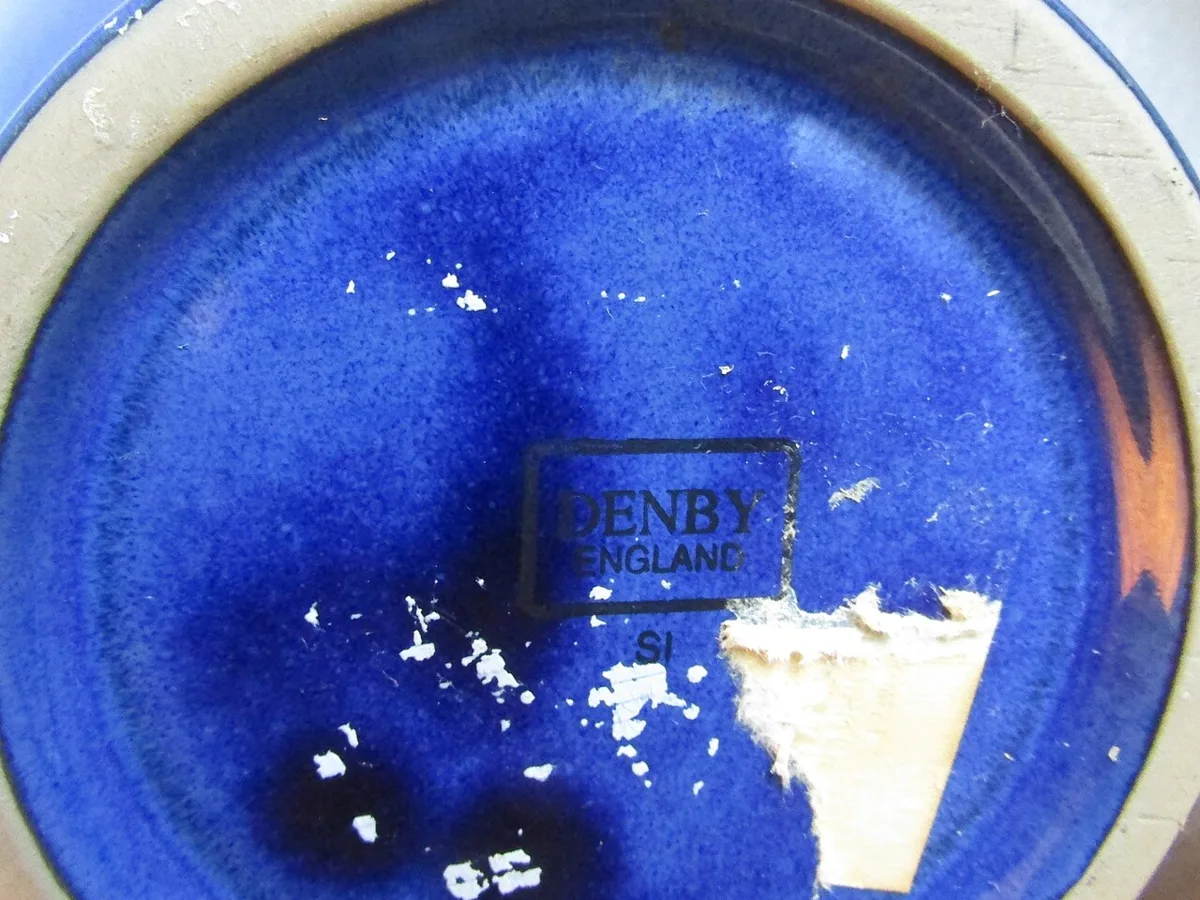
| "Bourne Denby England" | Interwar and into the post-war years | On original Cottage Blue, for example |
| Oval "Denby" mark | Later production | Antiques Info notes later Cottage Blue carries the oval Denby mark |
| Glyn Colledge signature, hand-painted | Before 1960 | On Glyn Ware, Cloisonné, Cheviot and related ranges |
| Glyn Colledge signature, stamped | 1960 and later | Including Glynbourne |
The Colledge rule
Antiques Info's 2005 survey of Denby states that Glyn Colledge's pieces are marked with his signature, hand-painted until 1960 and stamped after. If you collect post-war Denby, that one distinction does more dating work than any other mark.
Danesby Ware: two accounts
"Danesby Ware" was Denby's name for its decorative art pottery, and it appears with ranges such as Electric Blue, Orient Ware, Pastel, Meadow Green, Moorland, Florentine, Antique Green and Silver-grey, as well as some animals and some Cottage Blue.
The sources disagree about when the name was used. A Denby collector writing on the 20th Century Forum dates it from about 1920 into the mid-1930s. Antiques Info's article says the term was first used for art pottery in 1886, revived in 1904, and that Danesby ranges continued to be developed into the 1960s. Both agree its heyday was the 1920s and 1930s, so a Danesby mark points most strongly to the interwar years.
Tube-lined wares from the same period are usually unmarked, so an unmarked interwar piece can still be Denby.
Ranges and their dates
Because the marks overlap, the range is often the better guide to date. The dates below are those given by Antiques Info, the 20th Century Forum and Denby's own history, which do not always give a precise start or end.
| Range or designer | Period | Notes |
|---|---|---|
| Majolica | About 1890 | Streaky dark blue, green and tan |
| Electric Blue, Saffron, Moorland | 1920s | An Electric Blue sweet pea vase is dated about 1925 |
| Orient Ware | From 1926 | Blue shading glaze; the name refers to the glaze |
| Cottage Blue | First issued 1926, reissued after the war | Mottled blue with yellow interior |
| Pastel wares and moulded animals | 1930s | Including the Denby Lamb of 1939 |
| Silver-grey (Alice Teichtner) | About 1931 | |
| Glyn Ware, New Glyn Ware, Cloisonné, Cheviot (Glyn Colledge) | About 1948 to the 1950s | Signed |
| Tigo Ware (Tibor Reich) | Post-war | Black and white abstract |
| Glynbourne (Glyn Colledge) | 1960s | Pastel trailing leaves; a vase of about 1960 cost 25 shillings new |
| Greenwheat | 1950s | Denby lists it among its 1948–1960s designs |
| Chevron, Arabesque, Studio | 1960s–1970s | |
| Designs by David Yorath and Gill Pemberton | 1970s | Eastern-influenced decoration |
| Cascade | 1978 | Rich glazes |
Denby's own timeline spells the interwar designer's name "Albert College"; collectors more often write Colledge, the family name of Glyn Colledge. Treat attributions of the 1920s and 1930s designs with care.
How to date a piece step by step
- Read the mark. Note the exact wording and whether it is impressed, printed or painted.
- Identify the range from glaze, shape and decoration. The range usually narrows the date more than the mark.
- Look for a signature. A Glyn Colledge signature places the piece after 1948; a hand-painted one, before 1960.
- Check that mark and range agree. Original Cottage Blue carries "Bourne Denby England"; a later oval Denby mark on Cottage Blue means post-war production.
- Record what you find with the object research checklist.
What Denby is worth
Most Denby tableware sells for modest sums. Signed Glyn Colledge pieces, rare Danesby colours, large Orient Ware and the animals attract collectors, and unusually large sizes command more. Price guides go out of date quickly, so check recent sold results rather than older printed guides.
For how marks work on furniture, see the guide to mid-century labels and maker marks. For another British pottery with a well-documented marking system, see our guide to Troika pottery marks. More identification guides are in collecting and buying.
Related guides
- How to identify pottery marks: a method for any mark
- Hornsea Pottery marks: horn-and-waves marks and years in the stamp
- West German pottery marks: shape numbers and heights
Common questions
Is Bourne Denby the same as Denby?
Yes. Bourne Denby is the earlier name for the same pottery, run by the Bourne family as Joseph Bourne & Son. Pieces marked "Bourne Denby England" are generally older than those marked simply "Denby".
What does Danesby Ware mean on Denby?
It is the name Denby used for its decorative art pottery, mainly from about 1920 to the mid-1930s, usually alongside a Bourne Denby England mark. One source says the name was used as early as 1886 and that Danesby ranges continued into the 1960s.
How do I date a Glyn Colledge Denby piece?
Look at the signature. According to Antiques Info, Glyn Colledge's signature was hand-painted on pieces until 1960 and stamped after that. His ranges date from about 1948 onwards.
Is unmarked pottery ever Denby?
Yes. Much early Denby and many interwar tube-lined wares are unmarked. An unmarked piece has to be identified from its glaze, shape and stoneware body.
When was Denby founded?
The pottery is generally dated from 1809, after a seam of clay was found at Denby in 1806 during road building. It is still in production today.
References
- Denby Pottery, part one: functional and decorative ware, Zita Thornton, Antiques Info, January/February 2005
- Denby Pottery "Danesby Ware" ranges, 20th Century Forum
- Our history, Denby Pottery
- Joseph Bourne & Son Ltd, Denby Pottery, reprinted from British Potters and Pottery Today (1956), thepotteries.org