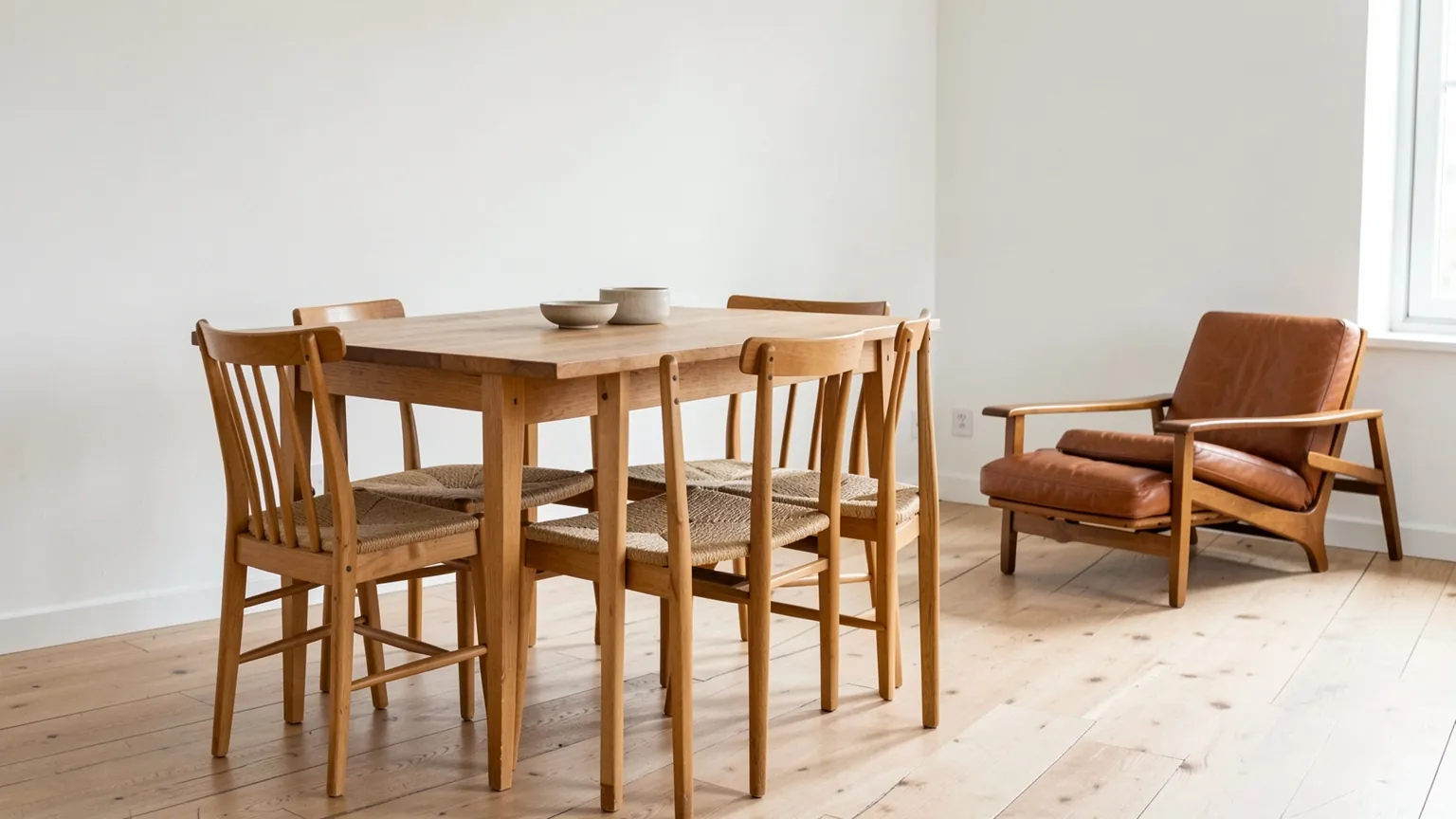
Børge Mogensen (1914 to 1972) was a Danish furniture designer who made solid, plain and affordable furniture for everyday life. Trained under Kaare Klint, he ran the furniture studio of FDB, the Danish consumer co-operative, from 1942, where he designed the J39 chair in 1947. From 1950 he worked independently, and from 1955 he was the sole designer for Fredericia Stolefabrik, which still makes his Hunting Chair (1950), Spanish Chair (1958) and 2213 sofa (1962). His work is mostly solid oak or teak with leather, paper cord or wool.
Where his contemporary Hans Wegner is known for sculptural chairs, Mogensen is known for discipline: furniture worked out from how it would be used. In his own words, quoted by ScandinavianDesign, his goal was "to generate things that will serve people, and place the needs of people at the centre".
Life in brief
- 1914: born on 13 April in Aarhus.
- 1934 to 1942: trains as a cabinetmaker, then studies furniture design at the School of Arts and Crafts in Copenhagen and architecture at the Royal Danish Academy, working in studios including Kaare Klint's.
- 1942: aged 28, takes charge of FDB's furniture design studio.
- 1945 to 1947: teaching assistant to Klint at the Academy.
- 1950: leaves FDB and opens his own studio; the Hunting Chair is shown at the Cabinetmakers' Guild exhibition.
- 1955: Andreas Graversen buys Fredericia Stolefabrik, with Mogensen as its sole designer.
- 1970: Mogensen and Graversen receive the Danish Furniture Prize for their collaboration.
- 1972: Mogensen dies on 5 October in Gentofte, aged 58. He was made an Honorary Royal Designer for Industry that year.
Key designs
| Design | Date | Original maker | Notes |
|---|---|---|---|
| J39 (the People's Chair) | 1947 | FDB | A simplification of Kaare Klint's 1936 Church Chair, with Shaker influence; in production ever since and now made by Fredericia |
| Hunting Chair | 1950 | Fredericia (now) | His first chair with thick saddle leather over a solid wood frame |
| Boligens Byggeskabe | From 1954 | Søborg Møbelfabrik, then C.M. Madsen | A fitted storage system developed with Grethe Meyer |
| Øresund | 1955 to 1967 | Storage and shelving series | |
| Spanish Chair | 1958 | Fredericia | Low, wide oak frame with saddle leather, after a trip to Spain; shown at the 1958 Cabinetmakers' Guild exhibition |
| 2213 sofa | 1962 | Fredericia | Designed for his own living room |
Wikipedia dates the Spanish Chair's "redesign" to 1959, while Fredericia and other sources give 1958. Sources also disagree about the J39's original seat: most describe woven paper cord, but Fredericia's anniversary text says the 1947 original used sedge grass.
FDB and furniture for everyone
FDB, Fællesforeningen af Danmarks Brugsforeninger, was the national consumer co-operative. Its furniture studio's job was to design furniture that working families could afford and that would last. Mogensen's J39, sold through FDB's shops, is the clearest example: a light, strong chair in beech or oak that has been in production since 1947. Much FDB furniture was designed for the small flats of post-war housing, which shaped its scale and its emphasis on storage.
Mogensen and Fredericia
Fredericia Stolefabrik was founded in 1911. When Andreas Graversen bought it in 1955 he made Mogensen its sole designer, and the partnership lasted until Mogensen's death. Mogensen had already designed the company's wordmark in 1953, which Habitus says still appears on Fredericia furniture. Fredericia continues to make his designs, alongside the J39, and in 2020 it bought Erik Jørgensen Møbelfabrik.
Buying a vintage Mogensen piece
- Vintage or current? The J39, Hunting Chair, Spanish Chair and 2213 sofa are all still made. A label, the wear, the leather's patina and the construction help separate a 1960s chair from a recent one.
- Maker's mark. Look for a maker's label or stamp and check which maker it names. Mogensen designed for several firms besides FDB and Fredericia, including Søborg Møbelfabrik in the early 1950s, so a Mogensen design is not always a Fredericia piece.
- Materials. Most Mogensen furniture is solid oak, beech or teak; the Spanish Chair's thick saddle leather is held with brass buckles.
- Danish control mark. Some pieces from 1960 onwards carry the Danish Furniture Makers' Control label; see what the Danish control stamp certifies.
For other Danish designers, see Ib Kofod-Larsen and lesser-known Danish furniture designers, including Grethe Meyer. For the wider style, see what is Danish modern furniture? More profiles are in designers.
Common questions
What is Børge Mogensen known for?
Simple, durable furniture for everyday homes, including the J39 chair for the FDB co-operative (1947), the Hunting Chair (1950), the Spanish Chair (1958) and the 2213 sofa (1962), most of them made by Fredericia.
When was the Spanish Chair designed?
In 1958, after a trip to Spain, for Fredericia. It was shown at the Copenhagen Cabinetmakers' Guild exhibition that year. Wikipedia gives 1959 for its redesign.
Is the J39 chair still made?
Yes. It has been in production since 1947 and is now made by Fredericia.
What is the difference between Mogensen and Wegner?
Both were leading Danish designers of the same generation. Wegner is known for sculptural, often carved chairs; Mogensen for plainer, heavier furniture designed around use and built to last.
References
- Børge Mogensen, Wikipedia
- Børge Mogensen: the quiet discipline of Danish modern and Fredericia Furniture in six chairs, Habitus, 2026
- Børge Mogensen 100 years, ScandinavianDesign, 2014