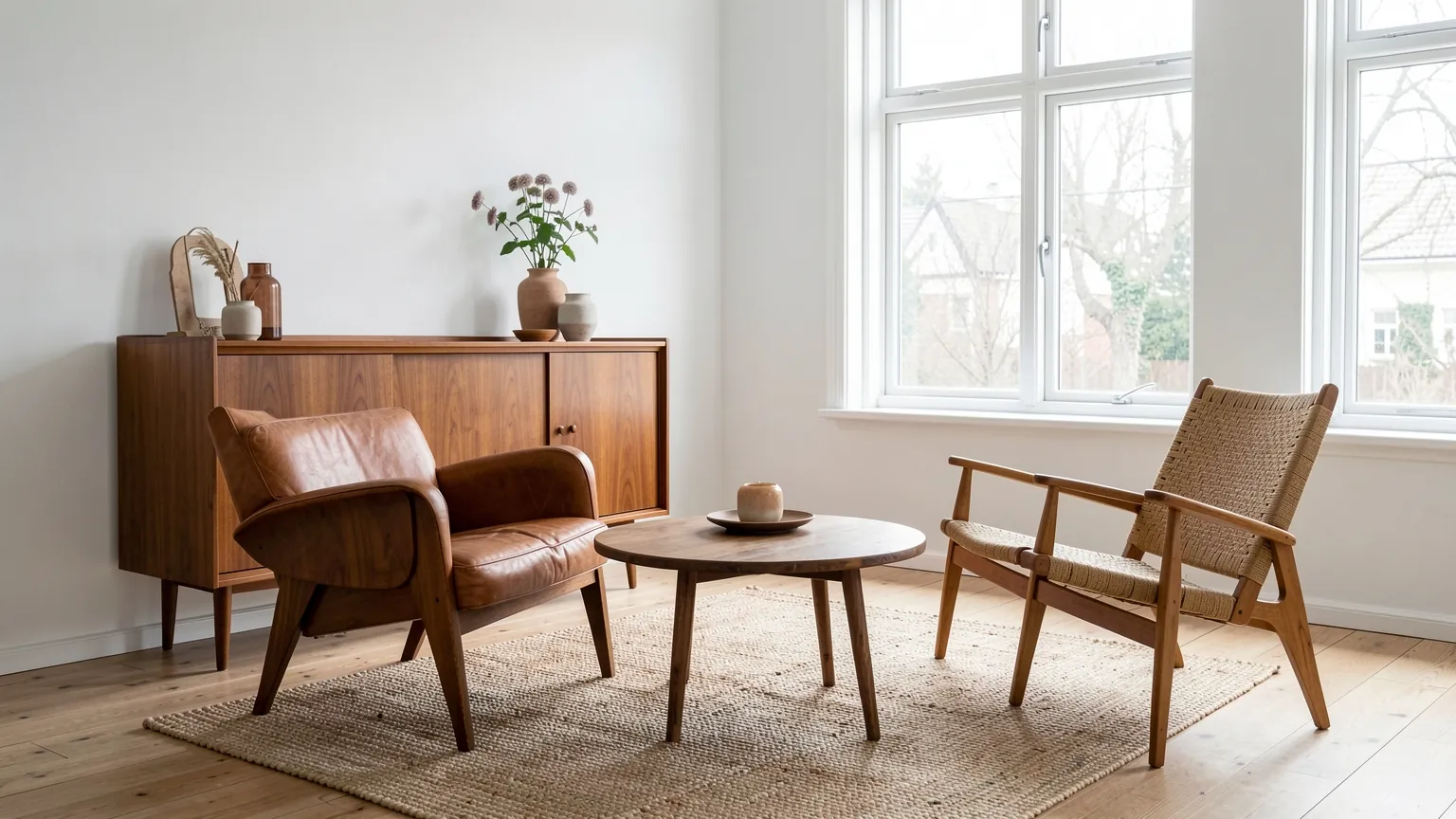
Danish modern is a style of furniture and household objects designed in Denmark in the middle of the twentieth century: simple in form, practical, and made with great care from good materials, usually wood such as oak, teak or rosewood. It grew from the teaching of Kaare Klint, who founded the furniture school at the Royal Danish Academy in 1924, and from the annual exhibitions of the Copenhagen Cabinetmakers' Guild from 1927. It reached its peak from the late 1940s to the early 1960s, when designers such as Hans Wegner, Børge Mogensen, Finn Juhl and Arne Jacobsen made it popular across Europe and the United States.
Where it came from
Kaare Klint. Klint (1888 to 1954), often called the father of modern Danish furniture design, founded the furniture school at the Royal Danish Academy in 1924. He took up the ideas of Bauhaus-influenced modernism in the 1920s, while basing his work on high-quality materials and craftsmanship. His Faaborg Chair (1914), Propeller Stool (1927), Safari Chair (1933) and Church Chair (1936) set the tone.
The cabinetmakers. From 1927 the Copenhagen Cabinetmakers' Guild held an exhibition every year, and from 1933 a competition for new furniture ran before each one. The exhibitions paired young designers with master cabinetmakers, such as Klint with Rud. Rasmussen, Ole Wanscher with A.J. Iversen, and Børge Mogensen with Erhard Rasmussen. They ended in 1966, when too few cabinetmakers remained in Copenhagen.
Export. After the war, Danish furniture found a large market abroad. When Denmark followed Britain in devaluing its currency in 1949, Danish furniture became cheaper for American buyers. From the early 1950s American manufacturers licensed Danish designs for mass production, and in 1954 the Brooklyn Museum's "Design in Scandinavia" exhibition started a fashion for Scandinavian modern furniture in America. Danish furniture exports rose from 9.8 million kroner in 1953 to 257.8 million in 1964.
The key designers
| Designer | Dates | Known for |
|---|---|---|
| Kaare Klint | 1888 to 1954 | Faaborg Chair, Safari Chair, Church Chair; the teacher of the generation that followed |
| Hans Wegner | 1914 to 2007 | More than 500 chairs, including the Round Chair ("The Chair") and the Wishbone Chair, both 1949 |
| Børge Mogensen | 1914 to 1972 | The J39 chair, the Hunting Chair and the Spanish Chair; see our Mogensen profile |
| Finn Juhl | 1912 to 1989 | Sculptural chairs such as the 45 Chair and the Chieftain Chair (1949) |
| Arne Jacobsen | 1902 to 1971 | The Ant chair (1951 or 1952), Series 7 (1955), and the Egg and Swan chairs (1958) |
| Ole Wanscher | 1903 to 1985 | The Colonial Chair in rosewood and the Egyptian Stool (1960) |
| Poul Kjærholm | 1929 to 1980 | Steel-framed furniture with leather, cane or marble, such as the PK9 (1960) |
| Arne Vodder | 1926 to 2009 | Teak and rosewood case furniture that sold especially well in the United States |
Beyond these names there is a large second circle, including Grete Jalk, Nanna Ditzel, Ib Kofod-Larsen and many others; see lesser-known Danish furniture designers and our Ib Kofod-Larsen profile.
The makers
Danish modern was made both by small cabinetmaking workshops and by factories. Among the best known are Fritz Hansen (Jacobsen and, later, Kjærholm), Carl Hansen & Søn (Wegner and Klint), Fredericia (Mogensen), PP Møbler (Wegner), Rud. Rasmussen (Klint), A.J. Iversen (Wanscher) and E. Kold Christensen (Kjærholm). Many of the designs are still made by these firms or their successors. For dating Fritz Hansen pieces, see Fritz Hansen stamps and labels.
How to recognise Danish modern
- Good wood. Solid oak, teak or rosewood, or veneers of them. Plywood became common after the war, when other materials were scarce.
- Simple, functional forms. Shapes worked out from use and comfort, with little ornament.
- Visible craftsmanship. Careful joints, shaped arms and rails, and consistent finishing.
- Marks. Look for a maker's label or brand, and on pieces from 1960 onwards, the Danish Furniture Makers' Control label; see what the Danish control stamp certifies. A "Made in Denmark" stamp records the country of manufacture, not the designer.
- Not every teak piece is Danish. British, Swedish and American makers copied the look; see G-Plan and McIntosh of Kirkcaldy.
Decline and revival
Sales of Danish furniture peaked around 1963. American manufacturers introduced cheaper substitutes in moulded plastic and wood-grain laminate, fashions moved on, and many Danish factories closed; the Cabinetmakers' Guild exhibitions ended in 1966. Interest returned from the late 1990s, and many designs are now back in production.
For the wider period, see what is mid-century modern design? For the timbers, see teak, walnut and rosewood. More guides are in furniture and objects.
Related guides
- Scandinavian glass signatures: Orrefors, Kosta, Holmegaard and Iittala
Common questions
What is Danish modern furniture?
Simple, functional, carefully made furniture designed in Denmark from the late 1920s to the 1960s, usually in oak, teak or rosewood, by designers such as Kaare Klint, Hans Wegner, Børge Mogensen, Finn Juhl and Arne Jacobsen.
Who started Danish modern?
Kaare Klint is usually credited. He founded the furniture school at the Royal Danish Academy in 1924 and trained many of the designers who followed.
When was Danish modern popular?
It flourished from the late 1940s to the early 1960s, when it was exported widely, especially to the United States. Sales peaked around 1963.
How can I tell if furniture is Danish modern?
Look for simple forms, good wood such as teak, oak or rosewood, careful joinery and a maker's mark. A Danish control label or "Made in Denmark" stamp confirms where it was made, but not who designed it.
References
- Danish modern, Wikipedia
- Scandinavian design, Wikipedia
- Kaare Klint, Wikipedia