Quick answer
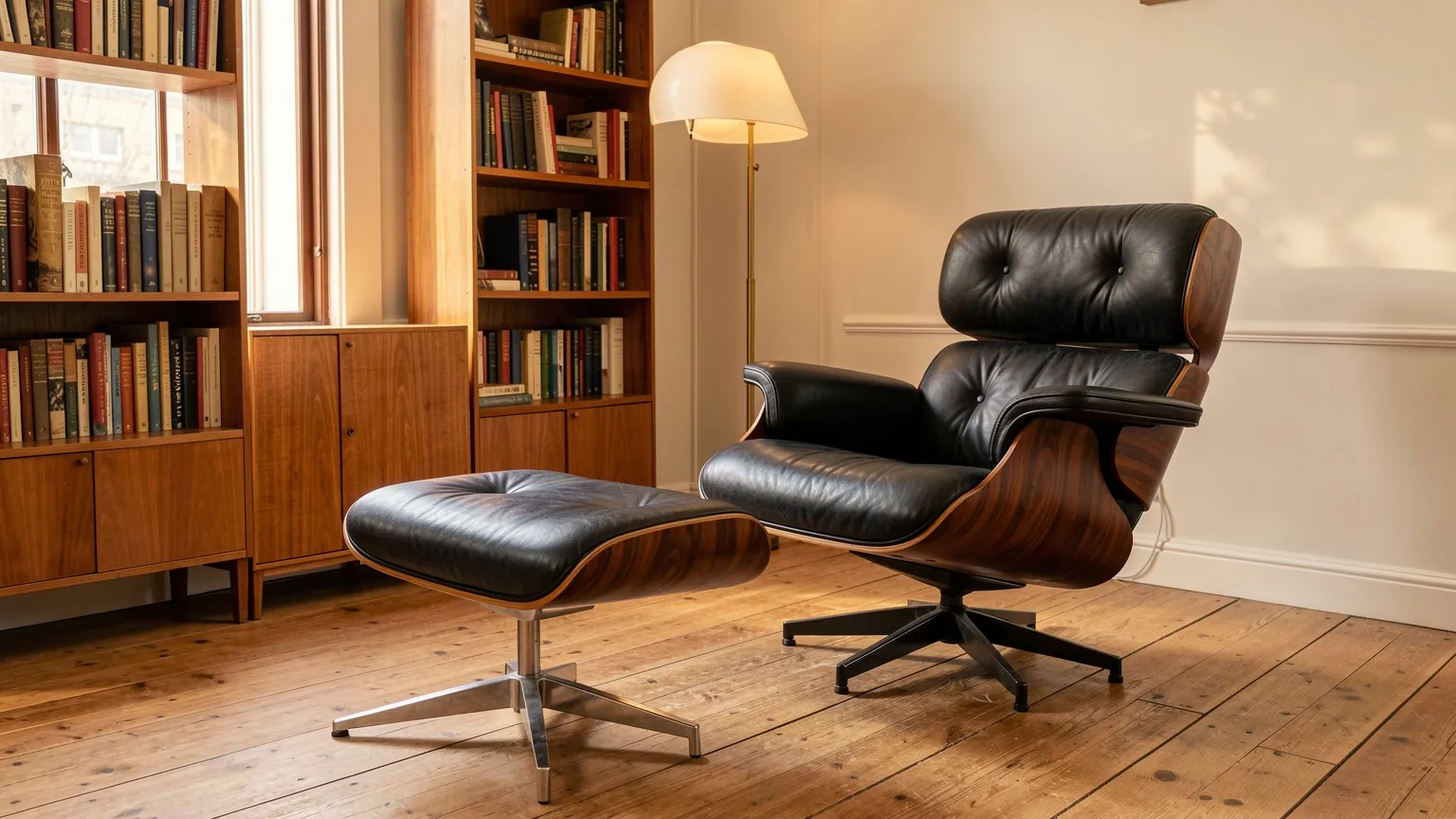
A genuine Eames Lounge Chair (model 670) and Ottoman (671) were made by Herman Miller in North America and, under licence, by Vitra in Europe. To tell one from a copy, check six things: the maker's label, the three plywood shells, the shock mounts and fixings, the cast aluminium base, the cushions, and the proportions. A copy usually fails several of these at once. A genuine chair may still have replaced parts, so the same checks also tell you how original it is.
The chair was released in 1956 and has been in production ever since. Museums date the design slightly differently: Cooper Hewitt dates its example 1956, while the V&A gives 1953 to 1955 for the design and 1955 for its own chair. Either way, so "genuine" covers everything from a first-generation rosewood chair to one made last year. The details below also help place a genuine chair in its generation.
The six checks
| Check | Genuine | Common on copies |
|---|---|---|
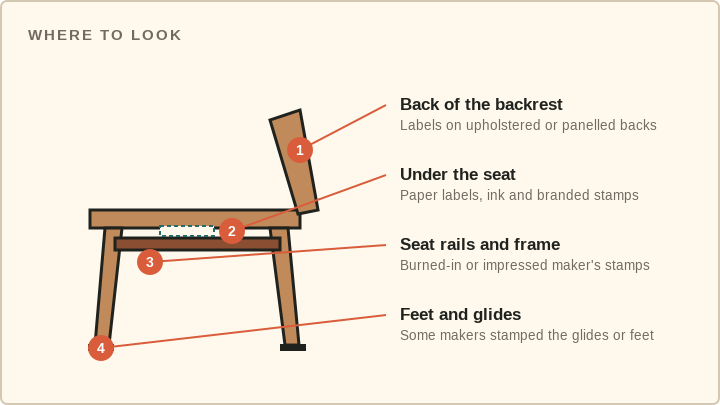
| Label | Herman Miller or Vitra label under the seat; early chairs also a paper label | No label, or a label taken from another piece |
| Shells | Three moulded plywood shells; even, well-matched veneer | Thick or printed-foil veneer; visible seams; screws visible on the outside |
| Mounts and fixings | Shock mounts under the arms; imperial (UNC) bolts | Bolted metal plates; metric or hex-key fixings |
| Base | Heavy die-cast aluminium, five-star swivel base on the chair, four legs on the ottoman | Light base, square or flat feet, legs on "tip toes" |
| Cushions | Leather over moulded backs, zipped; two buttons in each cushion | Thin leather or vinyl; a single foam slab |
| Proportions | About 80 cm (31.5 in) high; a fixed angle that does not recline | Oversized, too tall, or reclining |
Labels
The Eames Office notes that the chair "has always had at least one label". Wikipedia and the dealer Hobbs Modern describe the sequence broadly as a round silver or white medallion reading "designed by Charles Eames" and "Herman Miller Zeeland Mich" on the earliest chairs, a black oblong label in the 1970s and 1980s, a silver oblong label from the 1990s and an embossed curved label in the 2000s. The Eames Office's own label research also records a silver medal label on the lounge chair in 1964, set out in our guide to dating Herman Miller by its label.
Vitra-made chairs carry a Vitra plate. Later chairs may also carry quality-control and bar-code labels with a manufacturing date.
The Eames Office warns that a genuine Herman Miller label is sometimes stuck to a copy, so never rely on the label alone.
Shells and veneer
The chair is made from three moulded plywood shells, for the headrest, back and seat. Early chairs used thinner five-ply shells and later chairs seven-ply. The sources disagree on when the change happened: the Eames Office places it in 1974, while Wikipedia and Hobbs Modern place it around 1991.
Brazilian rosewood was the original veneer. Production in it stopped around 1990 to 1991 because of concern over the rainforest; one marketplace guide gives 1989. Later chairs were made in cherry and walnut, then Santos palisander from 2006, and in other veneers since. So a Herman Miller chair in Brazilian rosewood is an earlier chair, and one in Santos palisander is 2006 or later. For telling the timbers apart, see teak, walnut and rosewood.
Hobbs Modern notes that each shell was numbered in the factory: impressed on the inside of the shell on vintage chairs and written in black marker after 1971. Matching numbers or initials across the shells and cushion backs support originality.
Shock mounts, spacers and fixings
The shells are joined by aluminium spines and rubber shock mounts, which give the chair its slight flex. The shock mounts are also its weak point: the Eames Office calls their failure the chair's design flaw, and replacement is a normal repair.
- Armrest screws: three on first-series chairs, two from the second series.
- Spacers: originally rubber, later hard plastic.
- Bolts: genuine chairs use imperial (UNC) bolts. The Eames Office says reproductions use hex or metric fixings.
The base
The base is die-cast aluminium, heavy and solid, with a black finish on the underside and polished or black upper surfaces depending on the version. The chair swivels on a five-star base; the ottoman has four legs and normally does not swivel, though a few very early ottomans did. The original glides were marked "Domes of Silence"; early ottomans had push-on boot glides.
Cushions
Early cushions were filled with down, later with foam and fibre. They are leather, zipped onto moulded backs, with two buttons in each cushion. Early zippers were brown or black, later black only. First- and second-generation chairs used round silver cushion clips, and later chairs black rectangular clips from 1971.
Dating a genuine chair by generation
| Generation | Approximate dates | Main features |
|---|---|---|
| First | 1956 to 1960 | Rosewood; medallion and paper labels; three armrest screws; boot glides on the ottoman |
| Second | 1960 to 1971 | Rosewood; two armrest screws; round cushion clips |
| Third | 1971 to 1974 | Rosewood with clear lacquer; plastic mounts; black rectangular clips |
| Fourth | 1974 to 1991 | Rosewood; seven-ply shells according to the Eames Office |
| Fifth | 1991 to today | Cherry and walnut first, Santos palisander from 2006, other veneers since |
These generations follow the Eames Office's account. Treat the boundaries as approximate.
Before you buy
Ask for photographs of the underside of the seat, the label, the base and the back of the shells, and the dimensions. Record what you see with the object research checklist. Look-alike chairs by other makers, such as Plycraft, are legitimate furniture in their own right but are not Eames chairs and are priced accordingly. Our guide to originals, licensed reissues and reproductions explains the difference. More guides are in collecting and buying.
Related guides
- How to date an Eames fibreglass shell chair: Zenith and Herman Miller generations
- George Nelson's designs for Herman Miller: the storage, seating and clocks
- The Anglepoise 1227: a British design icon and its reissues
Common questions
How can I tell if my Eames Lounge Chair is real?
Check for a Herman Miller or Vitra label under the seat, three moulded plywood shells with good veneer, rubber shock mounts under the arms with imperial bolts, a heavy die-cast aluminium base, leather cushions with two buttons each, and correct proportions of about 80 cm high. Copies usually fail several of these.
Does a genuine Eames Lounge Chair recline?
No. The chair sits at a fixed angle and flexes slightly on its shock mounts. A chair with a reclining mechanism is not a Herman Miller or Vitra Eames Lounge Chair.
When did Herman Miller stop using Brazilian rosewood?
Around 1990 to 1991, because of concern over the rainforest. Later chairs were made in cherry and walnut, then Santos palisander from 2006.
Who makes the Eames Lounge Chair in Europe?
Vitra, under licence. Vitra-made chairs are genuine and carry a Vitra plate.
Is a chair with replaced shock mounts still original?
Yes, in the sense that it is a genuine chair. Shock mounts are the part most likely to fail and replacing them is normal maintenance, though original parts matter to collectors and affect value.
References
- Eames Lounge Chair and Ottoman (670 and 671), Eames Office
- No. 670 chair and No. 671 ottoman, Cooper Hewitt, Smithsonian Design Museum
- Lounge Chair (armchair 670), Victoria and Albert Museum
- Eames Lounge Chair, Wikipedia
- Eames Lounge Chair: real or fake, Hobbs Modern, 2025
- How to recognise a genuine Eames Lounge Chair, Whoppah, 2025