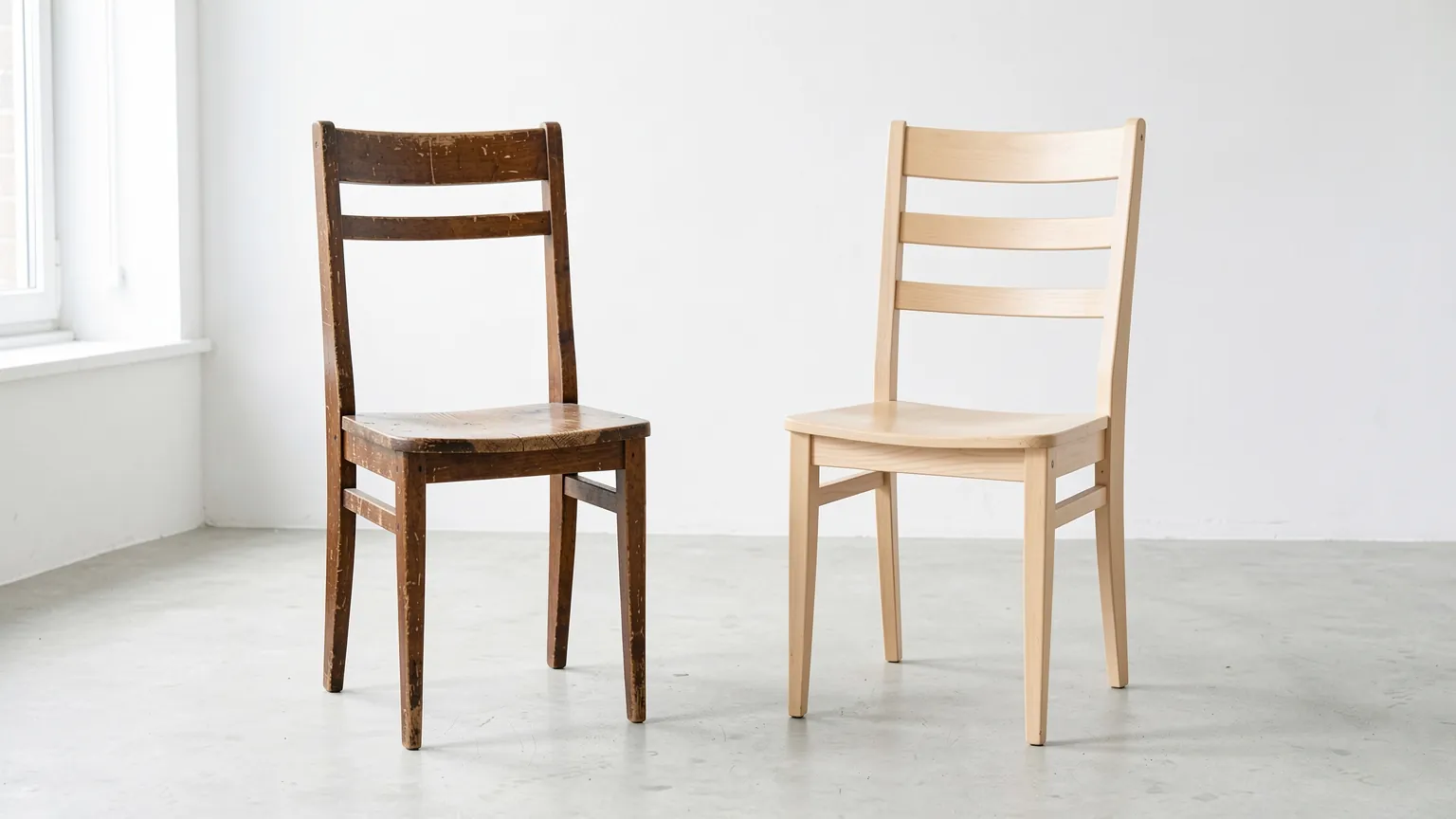
An original is a piece made by the design's authorised manufacturer during its first period of production. A licensed reissue is the same design made later by a company with the right to make it, whether production never stopped or was revived after a gap. A reproduction, often sold as a "replica", is a copy made without that permission. All three can look alike in a photograph; they differ in who made them, when, and what paperwork stands behind them.
None of them is automatically the right purchase. A vintage original carries history and may need repair. A new licensed piece usually comes with a warranty and parts. An unlicensed copy is cheaper, but in the United Kingdom it may be unlawful to sell where the design is still in copyright, and it carries none of the history buyers usually pay for.
This guide sets out the categories, shows how museum records separate a design's date from an object's date, gives the dated changes in UK law, and lists the evidence that actually settles the question.
The categories at a glance
| What it is | Who made it | Typical evidence | A fair description |
|---|---|---|---|
| Period original | The first authorised manufacturer, during the design's early production | Period label or mark, materials and hardware of that production period, provenance | "Designed 1955, made by [maker] about 1960" |
| Later licensed production | The same or a successor licensed manufacturer, in a later decade of continuous production | Later label style, changed materials or fittings, dated paperwork | "Designed 1955, made by [maker] in the 1980s" |
| Licensed reissue | A manufacturer that has acquired or licensed the rights after production stopped | Current maker's mark, receipt, often a certificate or numbered label | "Licensed reissue by [maker], 2010s" |
| Unlicensed reproduction | Anyone else | Usually none, or vague words such as "inspired by", "in the style of" or "replica" | "Unlicensed copy of a design by [designer]" |
| Generic period piece | A maker working in the same style without copying a specific design | A maker's own label, or nothing | "Mid-century style, maker unknown", unless a mark says otherwise |
The useful habit is to give two dates whenever you can: when the design was made and when the object was made. Most of the confusion in sale listings comes from collapsing them into one.
Why "original" needs a date
Many celebrated designs were never out of production. That makes "original" a question of period, not of whether a piece is genuine.
The Victoria and Albert Museum's record for Arne Jacobsen's model 3107 chair, made by Fritz Hansen and designed in 1955, notes that millions have been made over roughly half a century of continuous production. A 3107 made last year by Fritz Hansen is genuine; it is not a period original. The museum's record of Hans Wegner's Chair 24, made by Carl Hansen & Søn, gives 1950 as its date, but the example entered the collection in 1970 under accession number CIRC.327-1970, and the record does not say in which year that particular chair left the factory. Even a museum date can be the design's date rather than the object's.
The clearest case is Verner Panton's stacking chair, where the material changed with each production period. The V&A's record of its example, CIRC.73-1969, gives this history:
| Period | Material, as the V&A record gives it |
|---|---|
| 1960 | Designed; prototypes followed in extruded polystyrene and in hand-laminated and cold-pressed glass-fibre-reinforced polyester |
| 1968–71 | First mass production, in rigid polyurethane foam (the museum's example, made by Vitra for Herman Miller, 1968) |
| 1971–79 | Polystyrene |
| 1983 and 1990 | Polyurethane foam again |
| Since 1999 | Injection-moulded polypropylene, made by Vitra |
Every one of those chairs is authorised, and the material alone places a chair within a period. The record also shows why care is needed: its physical description calls the chair glass-fibre-reinforced polyester while its materials field says polyurethane foam. If a museum record can carry two answers, a sale listing deserves checking.
Licences change hands
A different maker's name on a familiar design is not, by itself, a sign of a copy. Rights are licensed, divided by region and sold on.
Eames, Nelson and Girard designs. Vitra states that it became Herman Miller's licensee for continental Europe in 1956, and that when the partnership was dissolved in 1984 the rights to the designs of Eames, Nelson and Girard were assigned to Vitra for Europe and the Middle East. Herman Miller's own distribution-rights page gives it those designers' furniture in all areas except Europe and the Middle East. An Eames chair with a Vitra label is therefore a licensed product, and so is one with a Herman Miller label; our guide to dating Herman Miller furniture by its label covers the American side.
British post-war furniture. The V&A's record of a teak-veneered cupboard designed by Christopher Heal in 1949–50 (W.29-1980) notes that the series was first made by William Birch of High Wycombe and that the licence was later taken over by Kandya Ltd of London. Two makers' labels on the same design can both be legitimate.
The practical rule: identify the maker from the mark, then check whether that maker held the rights in that region at that date. A mismatch is worth asking about; a different name is not proof of anything.
What UK law has said about replicas
For buyers in Great Britain, the legal position changed in 2016. These are the dated steps, taken from the Intellectual Property Office's guidance and its later call for views. This is a summary, not legal advice.
| Date | Change |
|---|---|
| 1988 | Section 52 of the Copyright, Designs and Patents Act limits copyright in artistic works to 25 years once more than 50 copies have been made industrially |
| 27 January 2011 | The Court of Justice of the EU rules in Flos v Semeraro (case C-168/09), the judgment the government later cited as the reason for repeal |
| 2013 | Repeal of section 52 included in the Enterprise and Regulatory Reform Act 2013 |
| 28 July 2016 | Repeal in force: all artistic works protected for the life of the creator plus 70 years; no new copies may be made or imported unless an exception applies |
| 28 January 2017 | End of the transitional period for dealing in stock of copies made in reliance on section 52 |
| 6 April 2017 | The Copyright (Amendment) Regulations 2016 in force |
| 22 June 2021 | The IPO opens a post-implementation review, naming furniture, jewellery, ceramics, lighting and homewares as the main types of work in scope |
Two limits matter. First, copyright applies only if the piece counts as an artistic work, which for most furniture means a "work of artistic craftsmanship". There is no statutory definition, and the IPO's guidance says it is ultimately for the UK courts to decide; it cites Hensher v Restawile, in which a prototype suite of furniture was held not to be such a work. Second, the IPO warns that a copy lawful in one country may be unlawful to sell into another.
Separately, consumer law covers how a piece is described. The Digital Markets, Competition and Consumers Act 2024 applies its unfair commercial practices rules to practices from 6 April 2025, and the Competition and Markets Authority's guidance lists false information about a product's origin, its method and date of manufacture, and any statement of sponsorship or approval among the things that can mislead. A seller who calls a copy "original", or a 1990s production "1960s", is making exactly that kind of statement.
The evidence that settles it
| Evidence | What it can show | Its limits |
|---|---|---|
| Maker's label, stamp or moulded mark | Manufacturer and often a production period | Labels fall off, get moved and are faked; read it with our guide to labels and maker marks |
| Certification marks | Place of manufacture and a quality standard | A Danish Furniture Makers' Control mark names no designer, and dates the object to 1960 or later, whatever the design date |
| Materials | Production period, where the material changed (as with the Panton chair) | Only useful where the history of the model is documented |
| Construction and fittings | Screws, glides, mounts and joints that match a known period | Parts get replaced in repair; note which are original |
| Dimensions | Agreement with a manufacturer's catalogue or a museum record | Copies are often measured from originals; close agreement does not prove authenticity |
| Receipts, certificates, provenance | Chain of ownership back to a shop or the maker | Paperwork can be separated from the object; check that it describes this piece |
| Price | Nothing | A low price does not prove a copy and a high one does not prove an original |
Common misreadings
"Designed 1955" read as "made 1955". A listing date is usually the design date. Ask what evidence dates the object.
"Vintage" read as "original". A copy made in the 1980s is vintage by most dealers' use of the word. Age does not settle authorisation.
"Licensed" read as "the same as the first production". Licensed makers change materials, finishes, fittings and sometimes dimensions over time. That is legitimate, but it is a different object from the first run.
"Inspired by" read as harmless. In the trade it often signals a copy of a specific design. Whether that copy is lawful depends on the design, the country and the date, not on the wording of the advert.
A designer's name read as an attribution. A design famous enough to be copied attracts lookalikes from honest period makers too. Without a mark or document, the fair description is "in the style of", and the name of the person who drew it belongs in the description only with evidence.
Which to buy
That depends on what you want the object to do.
- For daily use, a current licensed piece gives a known specification, a warranty and replacement parts. It will not carry history, and its resale value is not the same as a period piece's.
- For history and collecting, a period original is the only thing that does the job, and its value depends on proving the period. Budget for repair and keep every document.
- For a look on a budget, a generic period piece by a lesser-known maker gives honest age and character without the legal and ethical questions of a copy. Our guide to lesser-known Danish designers is a place to start.
A short method
- Write down the design, the designer, the design date and every manufacturer known to have made it, with dates.
- Photograph every mark, label and fitting, and the underside, before you discuss price.
- Match the mark to a maker and a period; check that the maker held the rights there and then.
- Compare materials and construction with a museum record or a manufacturer's catalogue of the same model.
- Ask the seller in writing what they mean by "original" and what evidence supports it.
- Record the result with two dates, design and manufacture, in our object research checklist. Where the evidence stops, write "unknown".
More practical guides are collected under collecting and buying.
Common questions
Is a new Vitra Eames chair an original?
It is genuine and licensed, but not a period original. Vitra has held the rights to Eames designs for Europe and the Middle East since the partnership with Herman Miller was dissolved in 1984, and was Herman Miller's licensee for continental Europe from 1956. A new chair is current production; a chair from the 1950s or 1960s is a period piece.
What is the difference between a reissue and a reproduction?
Permission. A reissue is made by a company that holds or licenses the rights to the design; a reproduction or "replica" is made without them. The two can look almost identical, so the evidence is in the maker's mark and the paperwork, not the shape.
Is it legal to sell replica designer furniture in the UK?
Not where the design is protected by copyright. Since 28 July 2016, artistic works have been protected for the life of the creator plus 70 years, and the transitional period for selling existing stock of copies ended on 28 January 2017. Whether a particular piece of furniture is protected depends on whether it counts as a work of artistic craftsmanship, which is ultimately for the courts. Take legal advice for a specific case.
Does "designed 1956" in a listing mean the piece was made in 1956?
Usually not. Listings and even some museum records give the design date. Many designs stayed in production for decades, so ask what evidence, such as a label style, a material or a receipt, dates the object itself.
Does a Danish Control label prove a piece is original?
No. The mark certifies Danish manufacture and a materials standard. It names no designer, and it cannot appear on furniture made before 1960, so on a design from the 1940s or 1950s it is evidence of later manufacture.
References
- Arne Jacobsen, chair model 3107, Fritz Hansen, CIRC.373-1970, Victoria and Albert Museum
- Hans Wegner, Chair 24, Carl Hansen & Søn, CIRC.327-1970, Victoria and Albert Museum
- Verner Panton, Panton Chair, Vitra for Herman Miller, CIRC.73-1969, Victoria and Albert Museum
- J. Christopher Heal, cupboard, William Birch Ltd, W.29-1980, Victoria and Albert Museum
- Herman Miller and Vitra, Vitra
- Distribution rights, Herman Miller
- Repeal of section 52 of the Copyright, Designs and Patents Act 1988: guidance for affected individuals, organisations and businesses, Intellectual Property Office (revised March 2017)
- Post-implementation review of the repeal of section 52 of the CDPA 1988: call for views, Intellectual Property Office, 22 June 2021
- Unfair commercial practices (CMA207), Competition and Markets Authority
- Court of Justice of the European Union, Flos SpA v Semeraro Casa e Famiglia SpA, case C-168/09, judgment of 27 January 2011