Quick answer
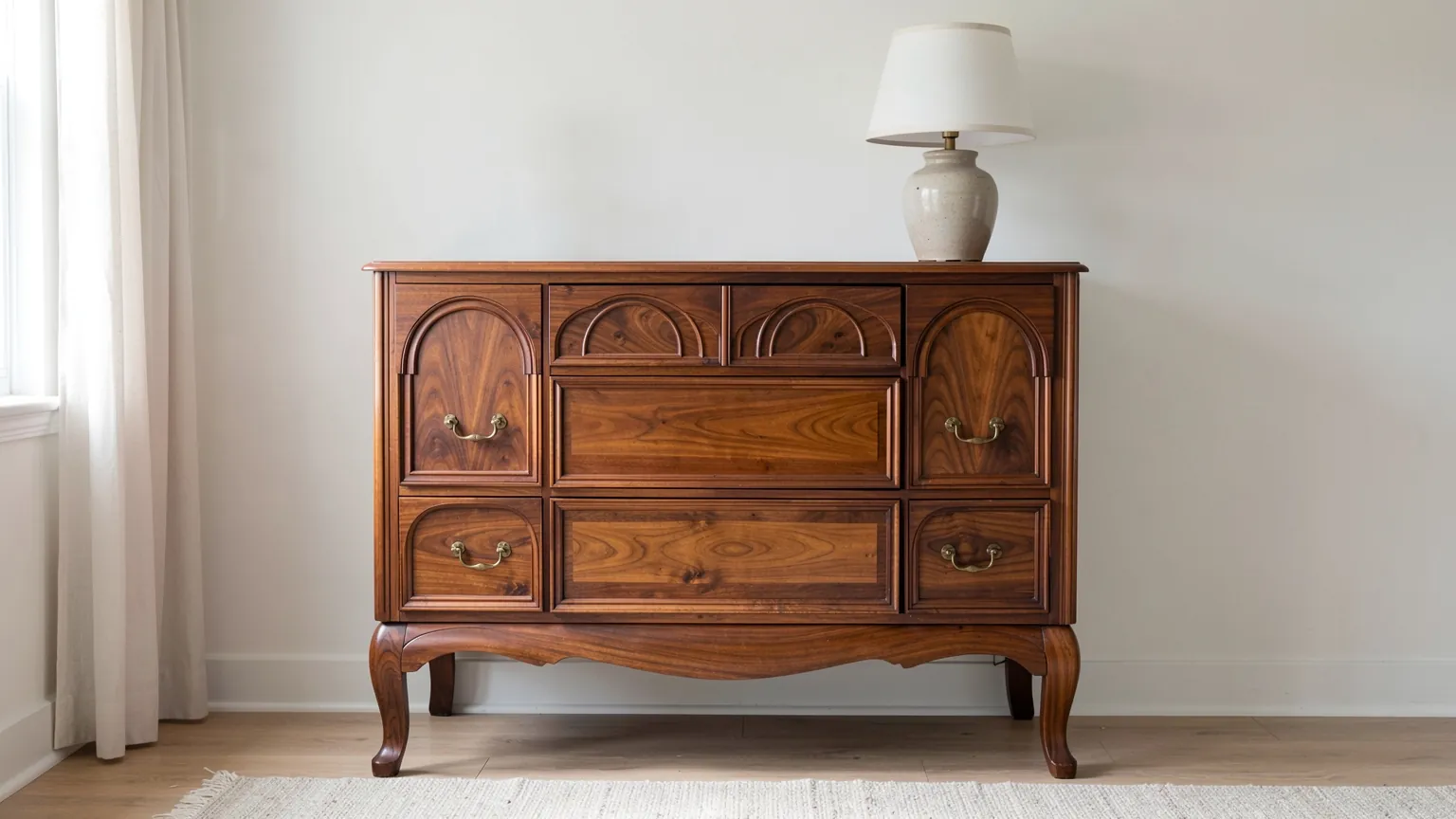
Broyhill Brasilia is a line of walnut bedroom, dining and living-room furniture made by Broyhill's Premier division from 1962 until about 1970. It is easy to recognise once you know the motif: a sculpted arch, taken from the colonnades of Oscar Niemeyer's buildings in the new Brazilian capital, repeated on drawer fronts, door panels, bases and table aprons, with arched brass pulls. Genuine pieces normally carry a label inside a drawer reading "Brasilia by Broyhill Premier" or a small Brasilia tag.
The line has a lot of myth attached to it, especially about who designed it. This guide separates what is well supported from what is repeated without evidence.
Key facts
| What the sources agree on | |
|---|---|
| Maker | Broyhill, Lenoir, North Carolina, sold under the Premier name |
| Introduced | 1962 (one source says the High Point Market, others the Seattle World's Fair) |
| Made until | About 1970; one source says the early 1970s |
| Main wood | Walnut veneer, often with strong figure, over hardwood frames |
| Hardware | Arched brass pulls; some drawers use the sculpted panel itself as the pull |
| Inspiration | Brasília, the new capital of Brazil, inaugurated in 1960, and Niemeyer's Palácio da Alvorada |
Who designed it?
This is the most confused part of the story, so it is worth being precise.
- Oscar Niemeyer inspired the line but did not design it. The arches echo his buildings in Brasília. Some listings and one guide name him as designer; others say he was at most consulted. No source consulted for this guide gives evidence that he drew any Broyhill furniture.
- Paul Broyhill and Mel Smith are named by the Cause A Frockus blog as the executive behind the line and its lead designer. A reader comment there says the US patent office credits Mel Smith.
- Stanley S. Ballenger is named as Broyhill's head designer by another blog.
- Cleo Baldon is named in one dealer FAQ, which is contradicted by everything else on the same page.
The most defensible statement is that Brasilia was designed in-house at Broyhill, probably under Mel Smith, and inspired by Niemeyer's architecture. A listing that says "designed by Oscar Niemeyer" is repeating a myth.
How to identify a genuine piece
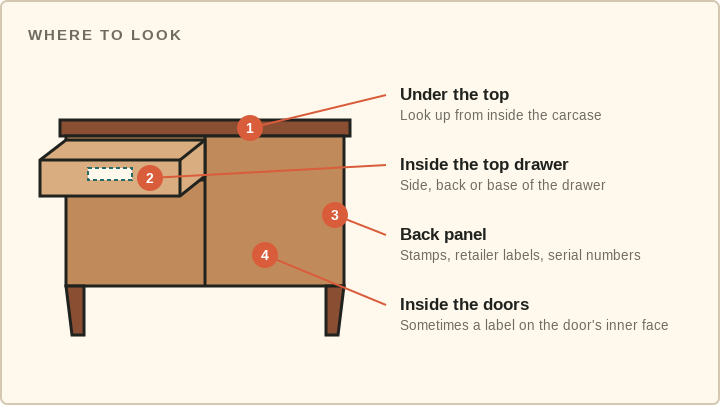
- Look for the label. Open the top drawer. Genuine pieces typically carry a paper label reading "Brasilia by Broyhill Premier", a small metal tag with "Brasilia" in italic script, or a Broyhill Premier stamp. Labels can also be on back panels or under table tops.
- Check the arch. The sculpted arch should appear as raised, carved panels on drawer fronts or doors and on the base, not as a flat applied moulding.
- Check the hardware. Pulls should be solid brass in the arched Brasilia shape. Missing or mismatched pulls are common and affect value.
- Check the construction. Walnut veneer over solid hardwood, with dovetailed drawers. Particle board in the case or drawers is a warning sign.
- Check the legs. Original bases are sculpted wood or have brass feet on some pieces. Hairpin legs are a later alteration.
Not the same line
Broyhill made several other mid-century lines, including Sculptra (from 1957, with square-in-square panels and cat's-eye pulls) and Saga. They are sometimes mislabelled as Brasilia. One blog also warns about later "Brasilia II" pieces in particle board, though some dealers date pieces sold under that name to the 1960s, so check construction rather than the name.
What the line included
Brasilia was a large line, said by one source to have more than 100 pieces. Recorded pieces include:
- Bedroom: dressers in several sizes, a gentleman's chest, highboys, nightstands and headboards.
- Dining: extension tables, dining chairs with arched or wishbone-style backs, china cabinets and hutches, some with lit interiors.
- Living room: credenzas, room dividers, modular bookcase units, coffee, end and side tables.
Style numbers recorded in listings include 6250-70 for an 80-inch credenza and 6150-60 for a modular bookcase cabinet. Model numbers in the 6100 and 6200 range are therefore consistent with Brasilia, though no full numbering list has been published.
What it is worth
Brasilia is one of the most searched-for American mid-century lines, and prices reflect that. Dealers give ranges of roughly $300 to $2,000 for nightstands and smaller pieces and $1,500 to $4,000 or more for restored credenzas, with full bedroom suites higher. Condition of the veneer, the presence of all original pulls, and an intact label make the biggest difference.
For dating the timber and construction, see veneer or solid wood and telling teak, walnut and rosewood apart. For another American line with a distinctive motif and a dating system, see our guide to Lane Acclaim and Lane serial numbers. Record what you find with the object research checklist, and find more guides in collecting and buying.
Common questions
How do I know if my furniture is Broyhill Brasilia?
Look for the sculpted arch motif on drawer fronts, doors and bases, arched brass pulls and walnut veneer, then check inside the top drawer for a "Brasilia by Broyhill Premier" label or a Brasilia tag.
When was Broyhill Brasilia made?
It was introduced in 1962 and made until about 1970, according to most sources. One source says production ended in the early 1970s.
Did Oscar Niemeyer design Broyhill Brasilia?
No. The line was inspired by Niemeyer's buildings in Brasília, but it was designed in-house at Broyhill. Sources name Mel Smith as the lead designer, with Paul Broyhill as the executive behind it.
Is Broyhill Brasilia solid wood?
It is mainly walnut veneer over solid hardwood frames, with dovetailed drawers. Veneer was normal for quality furniture of the period and is not a sign of a lesser piece.
The company behind it was founded by James Edgar Broyhill in Lenoir, North Carolina, as the Lenoir Chair Company in 1926, according to NCpedia (a family interview gives 1927). The Brasilia dates above come from dealers and collectors; we have not found a museum or company record of the line.
References
- Broyhill Furniture, NCpedia (State Library of North Carolina)
- Broyhill Brasilia, Cause A Frockus, 2016
- When Oscar Niemeyer met Broyhill, Keel & Company
- Broyhill Brasilia furniture line, Retro Furniture
- Broyhill Brasilia, ModCityMad
- Brasilia by Broyhill Premier dresser, signed, 1stDibs listing