Quick answer
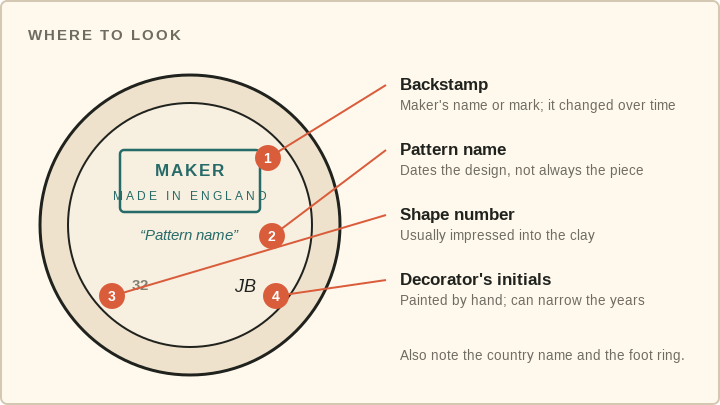
Hornsea Pottery was made in Hornsea, East Yorkshire, from 1949 until the company went into receivership in 2000, and from 1974 to the late 1980s at a second factory in Lancaster. Its marks give a rough date on their own. Marks with a hunting horn and wavy lines belong to the 1950s and early 1960s. Printed "Hornsea England" marks from the late 1960s and 1970s often include a year, such as "HORNSEA ENGLAND 1973". That year is useful but is not always the year the piece was made. Impressed numbers on the base are mould or shape numbers, not dates.
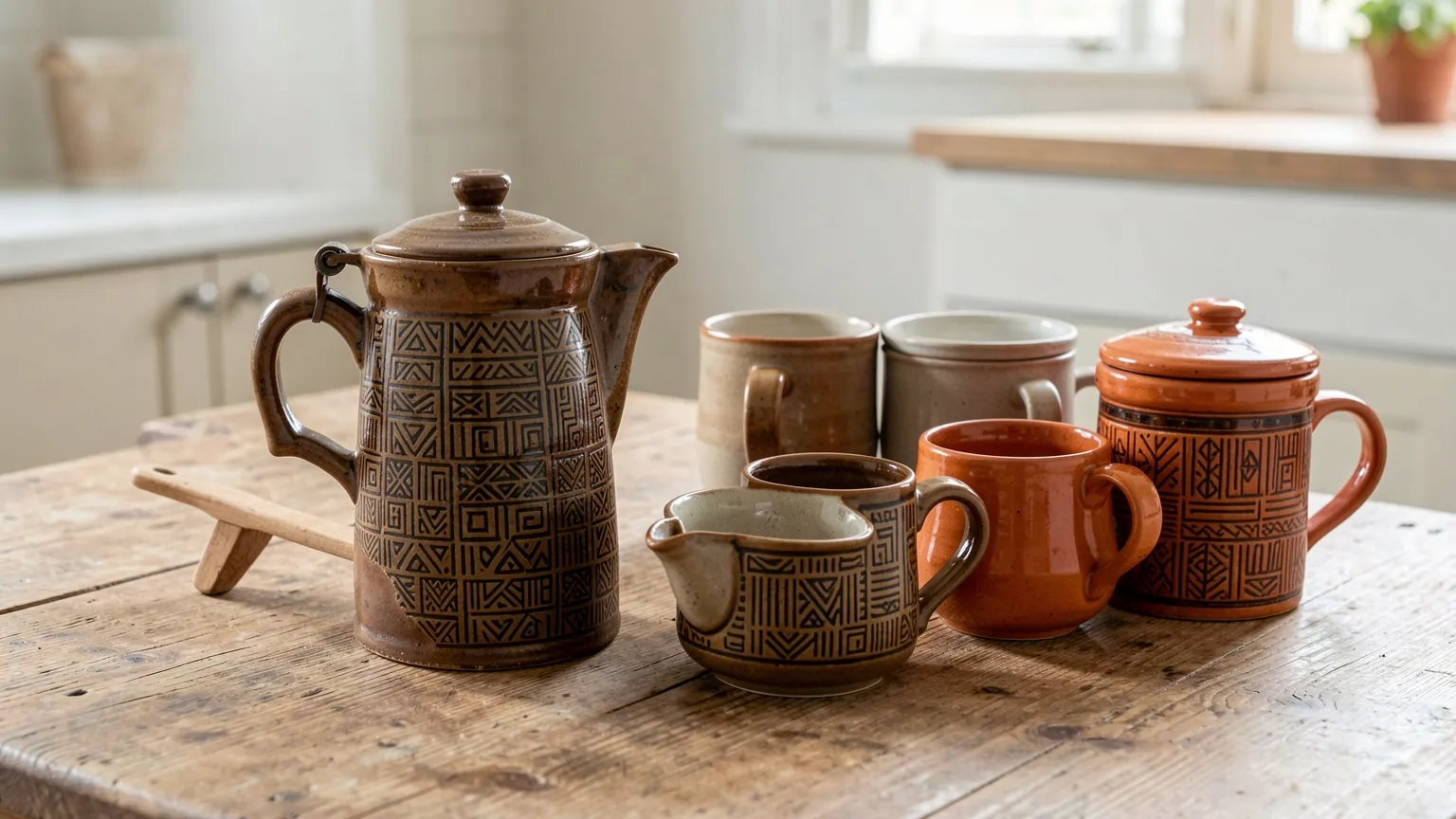
Most Hornsea found today is 1960s and 1970s tableware, especially the Heirloom, Saffron and Bronte ranges designed by John Clappison.
Hornsea in brief
- 1949: brothers Desmond and Colin Rawson start the pottery in Hornsea, with funding from Philip Clappison.
- 1954: the business moves to the site of the old Hornsea Brick and Tile Works.
- Mid-1950s onwards: John Clappison, then a student at Hull College of Art, designs for the firm, from art wares to tableware.
- 1967: the first full tableware range, Heirloom, followed by Saffron and Bronte.
- 1974: a second factory opens at Lancaster, using a new brown body called Vitramic.
- 1984: the company changes hands; Clappison is made redundant at the end of the year.
- 1987 or 1988: the Lancaster factory closes (sources differ).
- 2000: the company goes into receivership and production ends.
Wikipedia describes the 1984 change as a buy-out; one collectors' blog calls it a receivership followed by a takeover. Clappison's first period at Hornsea is given by one collector as 1958 to 1972, though he was certainly designing for the firm until 1984.
Reading the mark
| Mark | Example | Approximate period |
|---|---|---|
| Embossed or impressed "Hornsea" | "HORNSEA" impressed, sometimes with an incised designer's monogram | Early pieces; the V&A has a 1963 Clappison piece impressed "HORNSEA" and incised "WJC" |
| Printed mark with a horn and two waves | "HORNSEA POTTERY REGD MADE IN ENGLAND" with a horn and waves | 1950s to early 1960s; the V&A's example is 1961 |
| Series mark with a horn and waves | "FAUNA ROYAL HORNSEA POTTERY REG'D ENGLAND" with a horn, waves and leaves | About 1960 (the Fauna animal figures) |
| Printed "Hornsea England" with a year | "HORNSEA ENGLAND 1973" with a spiral in a square; "HORNSEA ENGLAND 1975 HEIRLOOM" | Late 1960s and 1970s |
| "Hornsea" with "Made in England" | "Hornsea / Made in England" | Seen on 1960s art wares such as Studiocraft |
The blogger Cassie Fairy, a Hornsea collector, says that until the early 1960s marks included the wavy lines (for Hornsea's coastal setting) and a hunting horn, that embossed lettering indicates an early piece, and that inked stamps often had the range name under the Hornsea name.
The year in the mark
Treat the year as "made in or after". The V&A has a Clappison mug designed and first made in 1967 whose mark reads "HORNSEA ENGLAND 1973". The year may be when that version of the stamp was introduced, or a later production run. Collectors also report Heirloom canisters with 1973, 1974 or 1976 in the mark and others with no year at all. No source we found records when Hornsea stopped putting years in its marks.
Impressed numbers
Numbers impressed in the base, such as 388, 602 or 603, are mould or shape numbers. The V&A records them alongside the maker's mark without treating them as dates. They help identify a shape when you compare a piece with documented examples, but they do not date it on their own. Some pieces, such as the Cordon cruet sets of the mid-1960s and the mushroom cruets, are reported by collectors to be unmarked.
Dating the main ranges
| Range | Designer | Dates | Look |
|---|---|---|---|
| Fauna (Fauna Royal) | Alan Luckham and others | About 1960 | Small animal figures and vases |
| Studiocraft | Shapes by John Clappison, decoration by Patrick Rylands | Mid-1960s | Screen-printed geometric vases in thin earthenware |
| Heirloom | John Clappison | From 1967 | Chunky shapes with a repeating printed pattern, mostly brown; also blue and green |
| Saffron | John Clappison | Introduced around 1970; production ended by 1992 | Caramel flowers on a burnt orange ground, in the Heirloom shapes |
| Bronte | John Clappison | Late 1960s | Same shapes as Heirloom and Saffron |
| Contrast and Concept | Queensberry Hunt (Martin Hunt) | 1970s | Plain modern shapes; Contrast is often listed with the Lancaster Vitramic body |
Sources disagree on a few of these. Wikipedia and one collectors' feature give 1967 for the start of Heirloom, Saffron and Bronte as a group, while a ceramics dealer and the Museum of the Home date Saffron's production from 1970. One collectors' site credits Contrast to Clappison in 1960, while Wikipedia credits it to the Queensberry Hunt partnership in the 1970s; we follow Wikipedia.
A step-by-step method
- Write down the mark exactly, including any range name and year.
- Note whether it is impressed, incised or printed, and its colour.
- Look for a horn and waves: if present, think 1950s to early 1960s.
- If there is a year, treat it as the earliest likely date of manufacture.
- Match the range and shape with documented examples.
- Record what you find with the object research checklist.
For other British potteries, see our guides to Denby, Poole, Troika and Carlton Ware, or start with how to identify pottery marks. More guides are in collecting and buying.
Common questions
How do I date Hornsea Pottery?
Start with the mark. A horn and wavy lines suggests the 1950s or early 1960s. A printed "Hornsea England" mark with a year suggests the late 1960s or 1970s; the piece was made in or after that year. Then match the range, such as Heirloom or Saffron, to its production dates.
What do the numbers on the bottom of Hornsea Pottery mean?
Impressed numbers such as 388 or 603 are mould or shape numbers. A four-digit number that follows "Hornsea England" in a printed mark is a year.
When was Hornsea Saffron made?
Saffron was designed by John Clappison and produced from about 1970 until production tailed off and ended by 1992. Some sources group its launch with Heirloom in 1967.
When did Hornsea Pottery close?
The company went into receivership in April 2000 and production ended. The Lancaster factory had closed earlier, in 1987 or 1988.
References
- Hornsea Pottery, Wikipedia
- Victoria and Albert Museum records: C.261-1986, C.262-1986, C.257-1986, C.255-1986 and C.263-1986
- Hornsea Heirloom teapot, Fitzwilliam Museum
- Hornsea Saffron, C20 Ceramics, 2019
- Identifying vintage Hornsea, Cassie Fairy, 2019
- Hornsea Pottery, World Collectors Net