Quick answer
The numbers on the base of West German pottery are almost always a shape number and a size. On a typical mark such as "W. Germany 242-22", 242 is the maker's form number and 22 is the height in centimetres. "W. Germany" or "West Germany" places the piece between 1949 and 1990, when the Federal Republic existed as a separate state. The maker's name was usually on a paper or foil sticker, which has usually been lost, so identifying the maker means reading the numbers, the clay and the style of the mark together.
That sounds like little to go on, but the large makers each had habits, and a handful of checks will usually narrow a piece to one or two factories.
Reading the mark
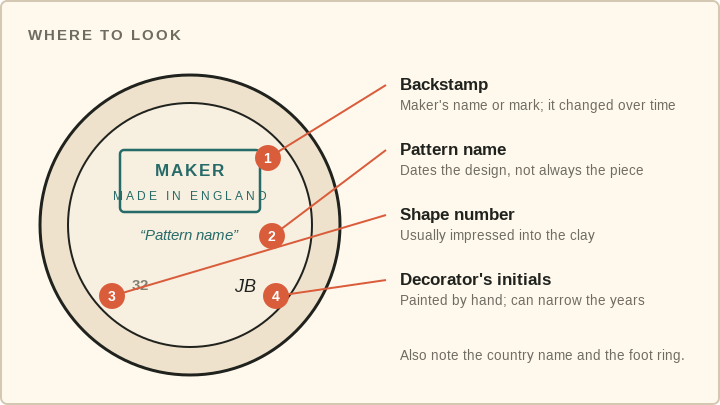
| Part of the mark | What it means |
|---|---|
| "W. Germany", "West Germany" or "Germany" | Country of origin. "W. Germany" places the piece between 1949 and 1990 |
| First number, usually three digits | The maker's form or shape number |
| Second number, after a dash, slash or space | The height in centimetres (on most makers' marks) |
| Maker's name or logo | Present on some makers' pieces, often absent |
| Sticker | Usually the only place the maker's name appeared |
"Made in Germany" on a Scheurich piece usually indicates production after reunification in 1990, according to WorthPoint.
Telling the main makers apart
The Pots and Pots identification guides, compiled by collectors from documented pieces, give the most detailed account of individual makers' marks.
| Maker | Clay | Mark habits |
|---|---|---|
| Scheurich | White | Moulded marks; three-digit form number, dash, height in cm (for example 242-22); usually no company name, just "W. Germany"; some marked "Foreign" for export |
| Bay Keramik | White | Moulded marks; often "Bay"; number and height separated by a dash or space; "West.-Germany" in some marks |
| Ruscha | White | Embossed or incised form number; never moulded with "Germany"; a size suffix 1, 2, 3 (larger as the number rises) rather than a height |
| Carstens | Red | Embossed marks; often a twin-house logo; "Germ" or "Germa" abbreviations; form numbers sometimes prefixed A to E |
| Ü-Keramik | White | Usually incised; form and height separated by a slash; company name only as an ink stamp on early pieces |
| Jopeko | White | A very varied range of base marks |
Two quick checks
Look at the colour of the clay on the unglazed foot: red clay points strongly to Carstens among the large makers. Then look at the separator: a slash suggests Ü-Keramik, and a mark with no height and a 1, 2 or 3 suffix suggests Ruscha.
Wikipedia lists the other significant West German makers as including Ceramano, Dümler & Breiden, ES Keramik (Emons & Söhne), Fohr, Gräflich Ortenburg, Ilkra, Jasba, Marei, Otto, Roth, Steuler and Karlsruhe Majolika, and names Scheurich, Carstens, Bay, ES and Dümler & Breiden as the most prolific.
Stickers and labels
If the sticker survives, it can date a piece as well as identify it. Pots and Pots records Scheurich labels as silver foil from 1954 to 1965, a "Europ Linie" export label from 1962 to 1968, and paper labels from 1968 to 1980. Carstens used gold and silver foil labels, including for its more expensive Luxus and Atelier ranges. Ruscha stickers read "Ruscha Art". Ü-Keramik used silver foil labels in the 1960s and 1970s.
What "fat lava" means
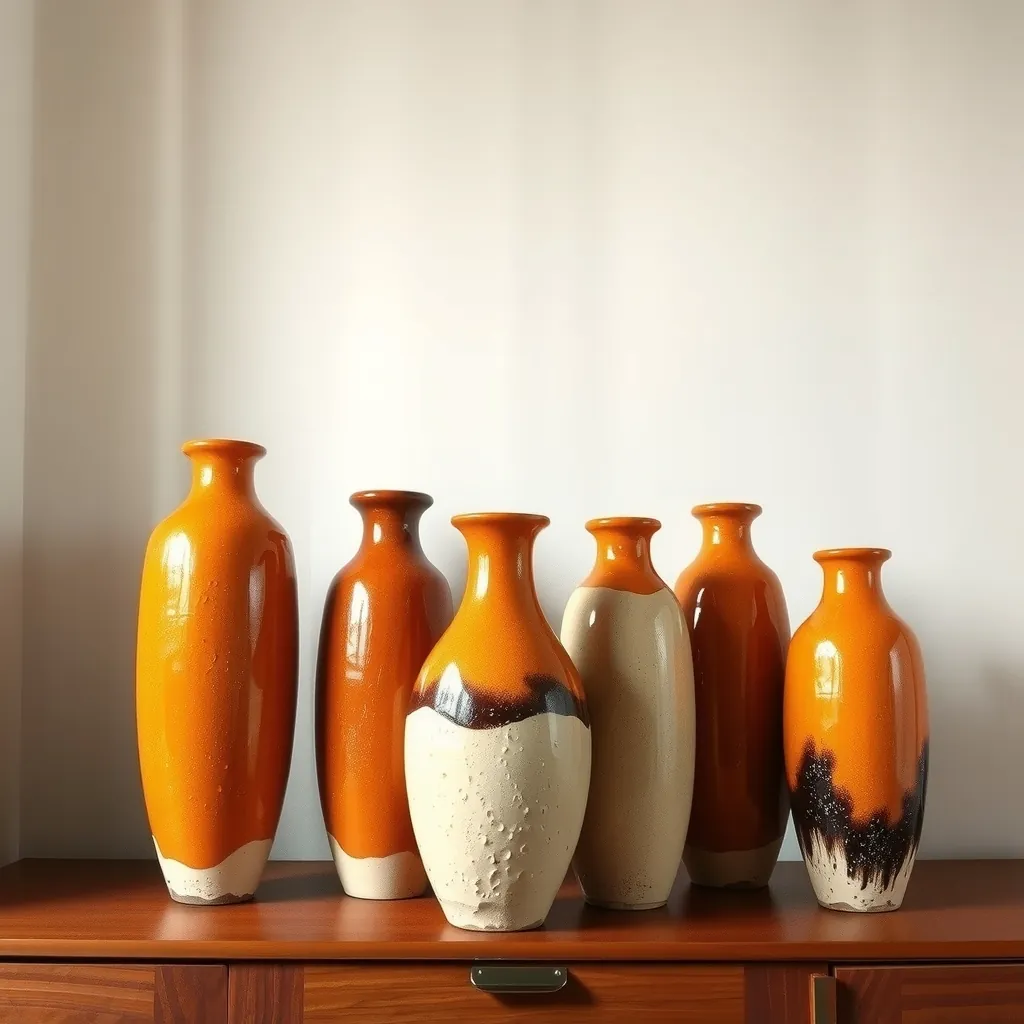
"Fat lava" is the collectors' name for the thick, bubbling, lava-like glazes used by West German makers, particularly in the 1960s and 1970s. Strictly it describes a fairly small group of glazes, and Wikipedia notes that it is often used loosely to mean West German pottery in general. The term was in use among online sellers before the Graham Cooley exhibition of 2006 that popularised it in Britain, and it probably arose from a mistranslation of the German for "thick".
A step-by-step method
- Read the base and note the full mark exactly, including separators.
- Note the clay colour on the foot.
- Measure the height and check whether it matches the second number.
- Look for a sticker or its outline.
- Compare the form number with documented examples in a maker's shape list.
- Record what you find with the object research checklist.
For British pottery marks, see our guides to Troika, Poole and Carlton Ware; for Danish porcelain, Royal Copenhagen and Bing & Grøndahl. More guides are in collecting and buying.
For Czech pottery with impressed shape numbers, see Ditmar Urbach marks.
If the base says "GDR", see GDR pottery marks; for Italian pieces, see Bitossi pottery marks.
Common questions
What do the numbers on West German pottery mean?
Usually the first number is the maker's shape or form number and the second is the height in centimetres. For example, 242-22 is form 242, 22 cm tall. Ruscha is an exception, using a 1, 2 or 3 size suffix instead of a height.
How old is pottery marked W. Germany?
"W. Germany" or "West Germany" places a piece between 1949 and 1990, when West Germany existed as a separate state. Most collected pieces date from the 1950s to the 1970s.
How can I tell who made my West German vase?
Look at the clay colour, the style of the mark and the separator between the numbers, then compare the form number with documented examples. Red clay suggests Carstens; a slash between the numbers suggests Ü-Keramik; no height suggests Ruscha.
What is fat lava pottery?
It is the nickname for West German pottery with thick, bubbling, lava-like glazes, mostly from the 1960s and 1970s. Strictly it refers to that type of glaze rather than to all West German pottery.
References
- West German art pottery, Wikipedia
- Identification guides for Scheurich, Bay, Ruscha, Carstens, Ü-Keramik and Jopeko, Pots and Pots
- Scheurich Keramik, WorthPoint Dictionary