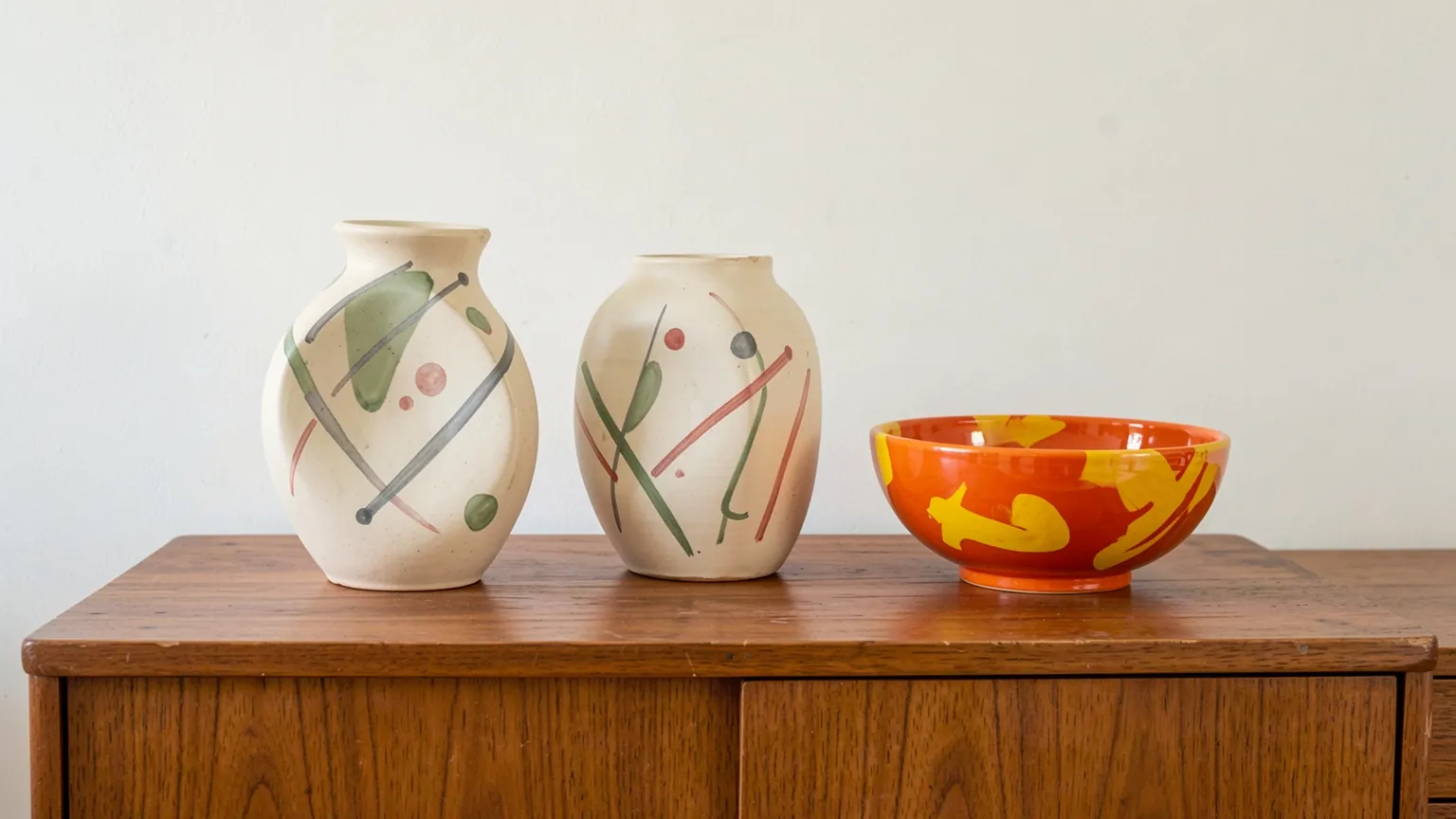
Quick answer
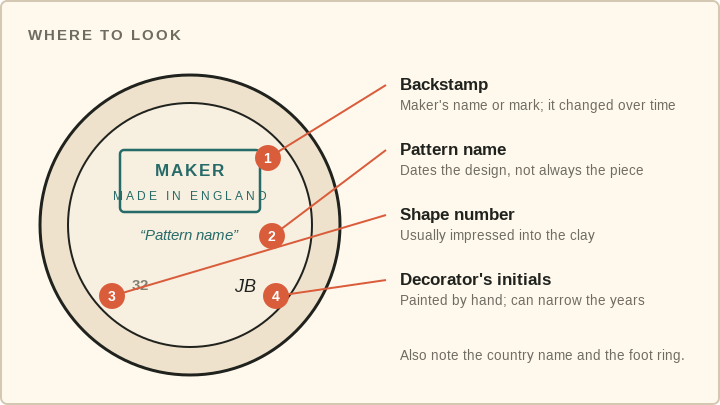
Poole Pottery marks are among the most useful in British ceramics for dating. The wording on the base, the form of the mark and any painted shape and pattern codes will usually place a piece within a span of a few years. The rough sequence runs from impressed Carter, Stabler & Adams marks in the 1920s and 1930s, through "Poole England" marks, to the stamped dolphin marks introduced in 1952, and on to the printed marks of the Delphis and Aegean studio wares from the 1960s and 1970s.
The published sources broadly agree on that sequence but differ on some start and end dates, so where a date is disputed this guide says so.
Poole Pottery in outline
- 1873: Jesse Carter, a builders' merchant, buys a run-down pottery at Poole, Dorset, which trades as Carter & Co.
- 1921: Carter, Stabler & Adams (CSA) is set up as a subsidiary of Carter & Co, joining the Carters with Harold Stabler and John Adams, with Phoebe Stabler and Truda Adams (later Truda Carter) as designers. Sources differ on whether Cyril or Charles Carter led the venture.
- 1950: Truda Carter and John Adams retire.
- 1951: Alfred Read is appointed to lead design (one source says 1950, another after 1954).
- 1952: government restrictions on selling decorated ware at home are lifted, and the stamped dolphin marks appear.
- 1958: Robert Jefferson is appointed designer, and a semi-independent studio follows.
- 1963: Delphis is launched (some sources say 1962).
- 1964: the Pilkington Tiles group takes over Carter & Co, and the pottery company is renamed Poole Pottery Ltd. The name "Poole Pottery" was already in informal use before then.
- 1970: Aegean is introduced.
- 1982: the craft section closes after Tony Morris leaves.
- 2006: the company goes into administration. It emerges in February 2007 under new owners, and production later moves from Poole to Stoke-on-Trent. The brand has changed hands since.
The marks in sequence
| Mark | Period | Source |
|---|---|---|
| Script "Carter" over "Poole", occasionally with a date | Carter & Co. era, before 1921 | WorthPoint |
| Impressed "CARTER STABLER ADAMS Ltd. POOLE ENGLAND" in a square with cut corners | About 1925 to 1934 | Antiques Info, WorthPoint |
| "Poole England" | About 1924 to 1950 | Antiques Info |
| Impressed "CARTER STABLER CARTER POOLE ENGLAND" | From about 1930 | WorthPoint |
| Impressed "Poole Pottery" | 1950 to 1951 | Virtual Museum of Poole Pottery |
| Stamped dolphin marks, first two versions | 1952 to 1955 | Virtual Museum of Poole Pottery |
| "Poole England Hand Made Hand Decorated" | 1952 to 1955 | Antiques Info |
| Stamped dolphin mark, third version | 1955 to 1959 | Virtual Museum of Poole Pottery |
| "Poole England" | 1955 to 1959 | Antiques Info |
| Studio mark | 1964 to 1966 | Antiques Info |
| Printed Poole mark on Delphis and Aegean wares | 1966 to 1980 | Antiques Info |
The dolphin marks were made in numerous variations, typically a vertical oval with "POOLE" over a dolphin and "ENGLAND" below. The Virtual Museum of Poole Pottery, which has the most detailed published account of the 1950s, distinguishes the two marks used from 1952 to 1955 from the one used between 1955 and 1959. Compare your mark with its photographs rather than with a written description.
Pink and white bases
Antiques Info notes that white-bodied wares from 1934 to 1937 had a pink slip on the base, and that the Traditional wares were covered with an overall white glaze from 1937 onwards. The colour of the base can therefore support a date suggested by the mark.
Shape numbers and pattern codes
Many Poole pieces carry painted numbers and letters as well as the factory mark. The number is the shape; the letters are the pattern. For example, 698/PRB is a shape designed by Alfred Read from 1953 in pattern PRB, and 721/HYT is a 1950s jardinière in pattern HYT.
From 1951, patterns were given an extra prefix letter showing how complex the painting was, so a code such as E/LE carries "E" for an elaborate pattern. A shape number and pattern code can be checked against published shape and pattern lists, which is often the most precise way to date a 1950s piece.
Decorators' marks
Decorators added their own monograms or symbols. Some of those documented include Ruth Pavely, who painted many of the 1950s freeform patterns; Nellie Blackmore, supervisor of the painting shop from 1950 to 1976; Gwendoline Selby (1946 to 1951); Jean Cockram (the YHP pattern, 1953 to 1955); and, on studio wares, Guy Sydenham (GS) and Jenny Haigh (JH). Ann Read, Alfred Read's daughter, joined in 1952 and used her own Poole Studio dolphin mark on some pieces. Vera Wills used a triangle with a dot in the centre.
The mid-century ranges
| Range | Period | Designer |
|---|---|---|
| Freeform | Conceived early 1950s, produced from 1956 | Alfred Read with Guy Sydenham; painted by Ruth Pavely and others |
| Contour | Late 1950s | Robert Jefferson |
| Studio wares | From about 1962 | Robert Jefferson, Guy Sydenham, Tony Morris |
| Delphis | From 1963 | Studio team |
| Atlantis | About 1969 into the 1970s | Guy Sydenham |
| Aegean | From 1970 | Leslie Elsden |
Freeform pieces with 1950s dolphin marks and Delphis pieces from the 1960s and 1970s are the core of most mid-century Poole collections. Sources differ on whether studio production began in 1961 or 1962 and whether Delphis was launched in 1962 or 1963.
How to date a piece
- Read the factory mark and note its exact wording and form.
- Note any painted shape number, pattern code and decorator's monogram.
- Check that the range, shape and mark agree.
- Compare with photographs of documented marks, such as those on the Virtual Museum of Poole Pottery.
- Record your findings with the object research checklist.
For other British pottery, see our guides to Troika pottery marks and Denby pottery marks. More guides are in collecting and buying.
Related guides
- How to identify pottery marks: a method for any mark
- Hornsea Pottery marks: horn-and-waves marks and years in the stamp
- West German pottery marks: shape numbers and heights
Common questions
When was the Poole dolphin mark used?
Stamped dolphin marks were introduced in 1952. According to the Virtual Museum of Poole Pottery, two versions were used from 1952 to 1955 and a third from 1955 to 1959. Later dolphin marks exist in many variations.
What does Carter Stabler Adams on the base mean?
Carter, Stabler & Adams was the company formed in 1921 that made Poole pottery. An impressed CSA mark generally dates a piece to the 1920s or early 1930s.
What are the numbers and letters painted on Poole pottery?
The number is usually the shape number and the letters the pattern code. From 1951 an extra prefix letter showed how complex the pattern was. Together they can often date a piece to a few years.
When was Poole Delphis made?
Delphis was launched in 1963, following studio production from about 1962, and continued into the 1970s and beyond.
References
- Carter, Stabler and Adams, Grace's Guide to British Industrial History
- Carter, Stabler and Adams, thepotteries.org (from a 1956 history)
- Poole Pottery, Victoria and Albert Museum collection
- The 1950s, The Virtual Museum of Poole Pottery
- The two ages of Poole Pottery, Roland Head, Antiques Info, November/December 2007
- Poole Pottery / Carter Stabler Adams, WorthPoint Dictionary
- A guide to Poole Pottery and Poole Pottery marks, Antique Marks