Quick answer
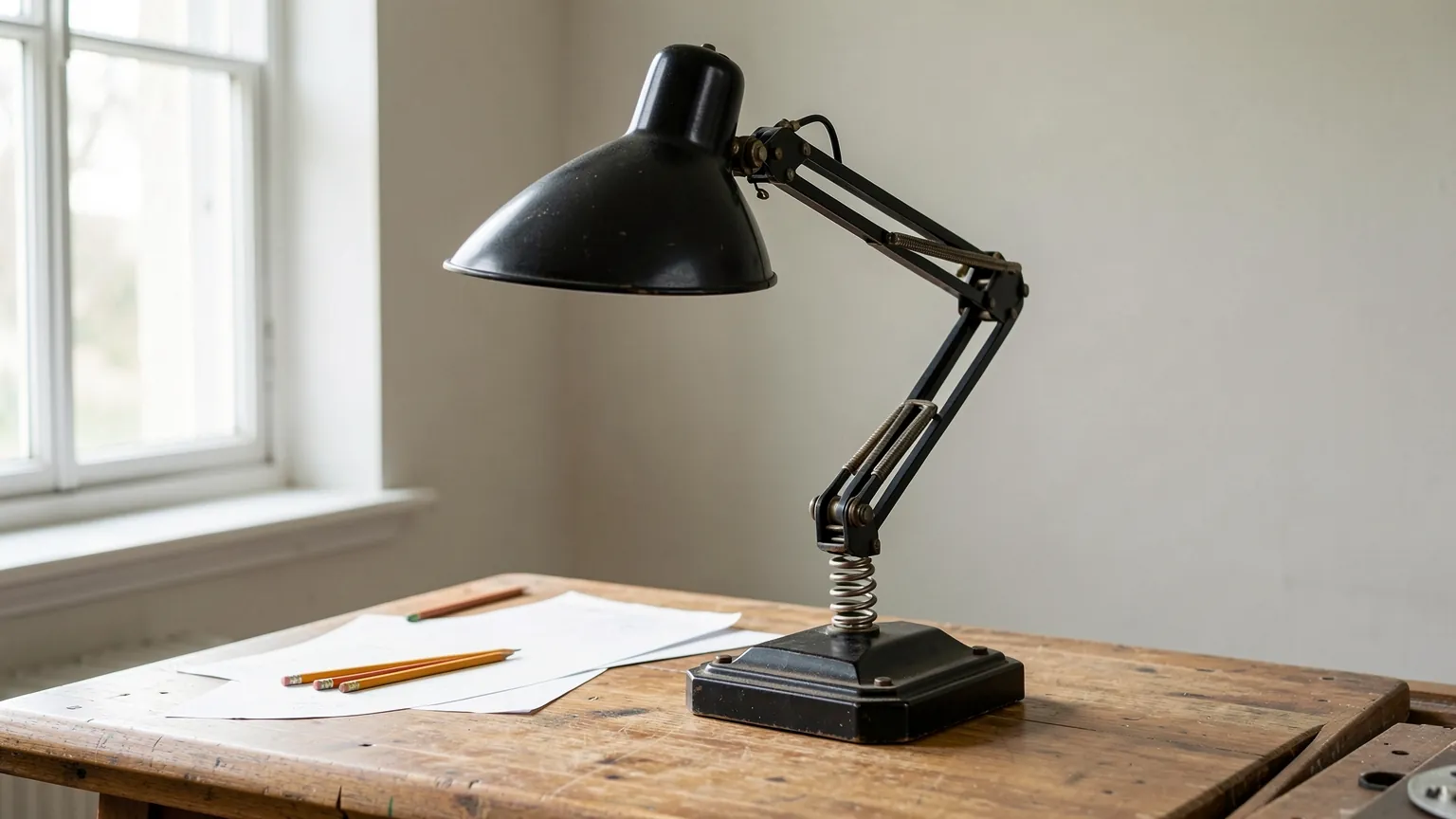
An original Anglepoise 1227 is the three-spring desk lamp designed by George Carwardine and made by Herbert Terry & Sons of Redditch from 1935 until it was replaced in the late 1960s. To identify one, count the springs (three, not four), look at the base (a square stepped base) and look for the maker's name on the fork that holds the shade: "The Anglepoise – Made by Herbert Terry & Sons". To date it, look at the base: early lamps of about 1935 to 1938 have a three-tier base, later ones a two-tier base.
The 1227 has been reissued several times, most recently since 2009 as the Original 1227, so it is also worth knowing how the modern versions differ.
The 1227 in brief
- 1932: George Carwardine, a car engineer, patents his spring-balanced arm. Sources give 4 July (the application date) or 7 July.
- 1934: Carwardine licenses the design to Herbert Terry & Sons, spring makers of Redditch. Terry's launch the four-spring 1208 and the larger 1209, mainly for industrial and workplace use.
- 1935: the three-spring 1227 for the home, protected by a further patent, 433,617.
- 1938: a revised 1227 with a two-tier base, a wider shade and a larger bulb.
- About 1968: the 1227 is replaced by the Model 75.
Terry's wanted to call the lamp "Equipoise", but the name could not be registered as a trade mark, so it became the Anglepoise.
Telling the models apart
| Model | Springs | Period | Main features |
|---|---|---|---|
| 1208 and 1209 | Four | About 1933/34 to 1968 | Heavy cast base painted black; flat steel side arms. The 1209 has longer arms |
| Early 1227 | Three | About 1935 to 1938 | Solid three-tier base; slim shade with two curves and perforations around the upper sides; chrome central block on the fork |
| Later 1227 | Three | About 1938 to 1968 | Two-tier base with a steel cover; wider shade with vents on top only; fork cast in one piece with the maker's name |
| Model 75 | Three | About 1968 to 1973 | Round base with a small footprint; rocker switch in the base |
| Model 90 | Three | About 1973 to 1985 | Small base; push-button switch on top of the shade |
| 1227 reissue | Three | About 1993 to 1996 | Made for the lamp's 60th anniversary; plastic base cover; mostly black |
| Original 1227 (current) | Three | 2009 onwards | Modern reissue; inline cable switch |
These periods follow Anglepoise's own dating guide, which gives approximate dates. The Design Museum and the Anglepoise product timeline broadly agree, but the 1208 is dated to 1933 in one and 1934 in another, and the Model 75 to 1968 or 1969.
The checks, in order
- Springs. Three springs at the base of the lower arm means a 1227 or a later domestic model. Four means a 1208 or 1209.
- Base. Square and stepped. Three steps suggests about 1935 to 1938; two steps suggests 1938 or later.
- Fork. Look for "The Anglepoise – Made by Herbert Terry & Sons" on the central block of the fork. On later lamps the wording is cast in.
- Shade. Early shades are slimmer with perforations around the upper sides; later ones are wider with vents on top only.
- Switch. Early lamps have a switch at the back of the shade, in a Bakelite housing; the V&A describes its 1938 lamp's "torpedo" switch. An inline switch on the cable suggests a modern reissue.
- Finish. The first lamps were black, but Terry's also offered special finishes; the V&A's example is cream and gold.
A museum benchmark
The Victoria and Albert Museum's 1227 (M.23-2013), given by Anglepoise and dated 1938, has a 15 cm square stepped base with a cast-iron block inside, three square-section arms anchored by steel springs, a conical shade with a wide flared rim and rows of holes near the top, a Bakelite switch and a cotton-covered flex.
Original or later?
Old lamps have often been rewired, repainted or given replacement shades. None of this makes a lamp a fake, but it does affect value, and a repaint can hide the original finish. Rewiring is a job for a qualified electrician, especially on a lamp with an earthing point on the fork.
Lamps made since 2009 are sold as the Original 1227 and are genuine Anglepoise products, not copies. Similar lamps by other makers, including the Norwegian Luxo of 1937, are separate designs. Our guide to originals, licensed reissues and reproductions explains the difference.
For other objects and their marks, see the guide to mid-century labels and maker marks. Record what you find with the object research checklist, and see collecting and buying for more.
Common questions
How do I know if my Anglepoise is a 1227?
Count the springs: the 1227 has three, while the earlier 1208 and 1209 have four. It has a square stepped base and, on originals, the words "Made by Herbert Terry & Sons" on the fork that holds the shade.
How can I date my Anglepoise 1227?
Look at the base. A three-tier base suggests about 1935 to 1938; a two-tier base suggests 1938 to about 1968. The shade, switch and fork help confirm it.
Who made the original Anglepoise?
Herbert Terry & Sons of Redditch, under licence from the designer, George Carwardine, from 1934.
Is a new Anglepoise Original 1227 a reproduction?
No. Anglepoise has made the Original 1227 since 2009 as a reissue of its own design. It is a modern lamp, not a vintage one, and differs in details such as its inline switch.
References
- How to date your vintage or current Anglepoise lamp and product timeline, Anglepoise
- Anglepoise lamp 1227, 1938, M.23-2013, Victoria and Albert Museum
- Anglepoise, Design Museum
- Anglepoise lamp, Wikipedia