Quick answer
The quickest way to date a Knoll label is to read the company name on it. "Knoll Associates" points to the earlier decades, roughly the late 1940s to the late 1960s. "Knoll International" points to the late 1960s to around 1990. "The Knoll Group" points to the early 1990s under Westinghouse, and "KnollStudio" or "Knoll, Inc." to later production. The label's design, material and placement can refine that, but the name does most of the work.
There are two catches. Knoll's designs, from the Bertoia wire chairs to the Saarinen Tulip and the Barcelona chair, have been made continuously for decades, so the design date tells you nothing about a given piece. And labels peel, fade and get swapped between parts. A label dates the part it is stuck to.
The company names and their dates
| Name on the label | Approximate period | Notes |
|---|---|---|
| H.G. Knoll (from 1938), then Hans Knoll Furniture Company (from 1941) | 1938 to 1946 | Early pieces, such as Jens Risom's 1941 designs; scarce |
| Knoll Associates | 1946 to the late 1960s | The name adopted when Hans and Florence Knoll married in 1946 |
| Knoll International | Late 1960s to 1990 | Sources give 1968 or 1969 for the change |
| The Knoll Group | From 1990 | After Westinghouse bought the company and merged it with Shaw-Walker and Reff |
| KnollStudio | From 1985 onward | The collection of classic designs, introduced in 1985 |
| Knoll, Inc. | Later 1990s onward | After the sale to Warburg Pincus in 1996 |
The disputed change
When "Knoll Associates" gave way to "Knoll International" is not agreed. A Design Addict contributor citing Knoll's own timeline gives 1968; another, citing a book, gives 1969; a dealer guide uses 1965, the year Florence Knoll retired, as its cut-off. The safe reading is that Knoll Associates labels are earlier than about 1968, and Knoll International labels later than about 1965.
Knoll's history in the dates that matter
- 1938: Hans Knoll founds the company in New York.
- 1943: Florence Schust joins; in 1945 she launches the Knoll Planning Unit.
- 1945: production moves to East Greenville, Pennsylvania.
- 1946: Hans and Florence marry, and the company becomes Knoll Associates.
- 1948: Eero Saarinen's Womb chair.
- 1952: Harry Bertoia's wire chairs.
- 1953: Knoll gains exclusive manufacturing and sales rights to Mies van der Rohe's furniture, including the Barcelona chair.
- 1955: Hans Knoll is killed in a car accident; Florence Knoll leads the company. It is later sold to Art Metal, Inc.
- 1956: Saarinen's Tulip (Pedestal) collection.
- 1965: Florence Knoll retires.
- 1966: Warren Platner's wire collection.
- Early 1980s: General Felt Industries buys Knoll and takes it public in 1983 as Knoll International.
- 1985: KnollStudio is introduced.
- 1990: Westinghouse buys Knoll International and forms The Knoll Group.
- 1996: Warburg, Pincus buys Knoll.
- 2021: Herman Miller acquires Knoll, forming MillerKnoll.
Where to find the label
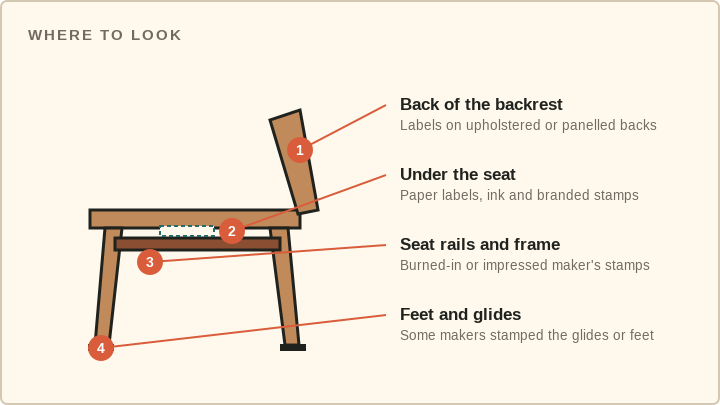
- Wire chairs (Bertoia, Platner): under the seat, on the frame or the underside of the seat pad. Labels on wire chairs are often lost, so check the wire and welds too.
- Tulip chairs and tables: under the seat shell or the table top, and on the underside of the base.
- Upholstered pieces (Womb, Barcelona, Florence Knoll sofas and lounge chairs): a woven or printed label sewn into the seat deck or under a cushion, or a label on the frame.
- Case pieces and desks (Florence Knoll credenzas, tables): a paper or metal label on the back or underside.
Dealers describe early Knoll Associates labels as including silver foil rectangles, and later labels as fabric or stamped metal. These descriptions come from dealer guides rather than from Knoll, so use the design only as supporting evidence.
Dating without a label
A missing label is normal on furniture that has been used for sixty years. The construction can then carry the argument.
- Tulip bases are cast aluminium. A plastic base is a sign of a copy, according to dealer guidance.
- Womb chairs: early examples have fibreglass shells, later ones moulded plastic.
- Bertoia wire: vintage pieces are described by dealers as having heavier wire and cleaner welds than copies.
- Barcelona chairs: Knoll frames are welded stainless steel, not cast.
- Finish and timber: Florence Knoll credenzas were made in walnut, rosewood, teak and other veneers over many years, so the timber narrows the date only loosely. Our guide to telling teak, walnut and rosewood apart helps with identification.
Note everything you see with the object research checklist before deciding.
Original, licensed or copy?
Knoll holds rights in many of its designs, and the Bertoia, Tulip and Barcelona designs in particular are widely copied. A Knoll-made piece from any decade is genuine; a piece by another maker is a reproduction, whatever the listing says. Our guide to originals, licensed reissues and reproductions sets out the difference.
For comparison, Herman Miller's labels are documented in far more detail: see dating Herman Miller furniture by its label. For marks in general, start with the guide to mid-century labels and maker marks. More guides are in collecting and buying.
Related guides
- George Nelson's designs for Herman Miller: the storage, seating and clocks
- How to date an Eames fibreglass shell chair: Zenith and Herman Miller generations
Common questions
How old is a Knoll Associates label?
Knoll Associates was the company's name from 1946 until it changed to Knoll International in the late 1960s, with sources giving 1968 or 1969. A Knoll Associates label therefore points to roughly 1946 to 1968.
When did Knoll Associates become Knoll International?
Sources disagree: Knoll's own timeline is cited for 1968, a published history for 1969. Some dealers use 1965, when Florence Knoll retired, as a rough cut-off.
What does KnollStudio on a label mean?
KnollStudio is the collection of Knoll's classic designs, introduced in 1985. A KnollStudio label means the piece was made in 1985 or later.
Where is the label on a Bertoia chair?
Look under the seat, on the frame or on the underside of the seat pad. Many wire chairs have lost their labels, so the wire, welds and seat pad have to be checked as well.
Is a Knoll chair without a label a fake?
No. Labels are often lost. Without one, the piece has to be judged on its construction and materials, and should be described as attributed to Knoll rather than certain.
References
- Knoll (company), Wikipedia
- Knoll, Cooper Hewitt, Smithsonian Design Museum
- Knoll Associates, Brooklyn Museum
- Knoll Group Inc. history, from the International Directory of Company Histories, vol. 14 (1996)
- Knoll, Inc., Reference for Business (Gale, 2006)
- Knoll sticker chronology and Knoll Associates label, Knoll International, Design Addict forum
- Knoll furniture collector's guide, ModCityMad, 2026