Quick answer
Lane furniture is unusually easy to date. Most pieces carry a stamped serial number, and reading it backwards gives the day, month and year of manufacture: a table stamped 063270 was made on 23 July 1960. A seventh digit, when there is one, is the plant number. Add the style number and the Lane mark, and you can usually identify both the line and the date of a piece without any guesswork.
This guide explains how to read the numbers, how to recognise Lane's most collected mid-century line, Acclaim, and one safety point that matters more than any of it: the old self-locking latches on Lane cedar chests must be removed.
How to read a Lane serial number
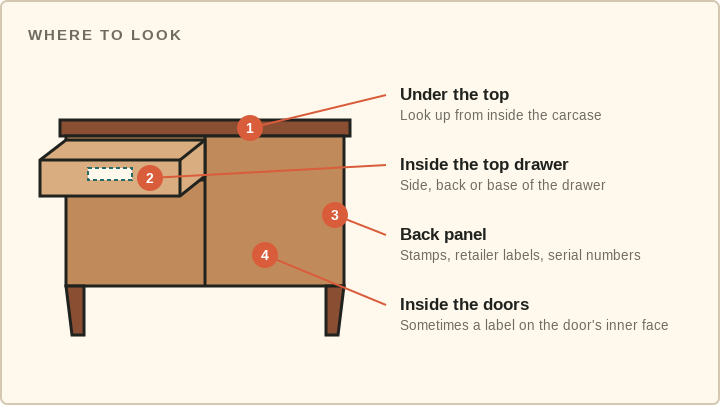
Look on the underside of a table or the inside or back of a case piece, usually near the Lane mark and a separate style number. The serial number is six or seven digits.
- Write the number down.
- Read it from right to left.
- The first two digits you read are the month, the next two the day and the next two the year.
- If there is a seventh digit on the far left, it is the plant number, not part of the date.
| Serial number | Read backwards | Date of manufacture | Source |
|---|---|---|---|
| 063270 | 07 23 60 | 23 July 1960 | Cause A Frockus |
| 658101 | 10 18 56 | 18 October 1956 | Fresh Take Furnishings |
| 951301 | 10 31 59 | 31 October 1959 | Cause A Frockus (reader query) |
| 4385230 | 03 25 83, plant 4 | 25 March 1983 | Cause A Frockus (reader query) |
The method is described the same way by 1stDibs, Fresh Take Furnishings and the long-running Cause A Frockus blog, whose comment threads contain hundreds of worked examples. It applies to all kinds of Lane furniture, not just cedar chests.
When the number does not make sense
Occasionally a backwards reading gives an impossible month, or the number is partly illegible. One dealer guide describes a different, week-and-year code on some metal tags. If the day–month–year reading fails, record the number exactly and treat the date as unknown. Lane itself said it could not date a piece without a serial number and had no master list of styles by year.
The Lane mark
Genuine Lane pieces carry a Lane mark, usually inside a drawer, on a drawer side or on the underside. Versions include "LANE Altavista, Va." and a forest motif in a half circle above the word "LANE". Some pieces also have a paper label naming the line, such as Acclaim. Lane made solid secondary woods throughout the mid-century period, so particle board in a drawer box suggests a later piece or not a Lane at all.
Lane in outline
- 1912: in Altavista, Virginia, Edward Hudson Lane, aged 21, starts the business in a packing-box plant bought at a bankruptcy sale (some accounts say his father, John Edward Lane, bought it). It is incorporated as the Standard Red Cedar Chest Company.
- 1922: renamed The Lane Company, according to company histories; by then it was selling nationally.
- 1950s: Lane adds occasional tables and other furniture lines (dealer guides give 1951 for tables and 1956 for case goods).
- 1958 to 1959: the Acclaim line is introduced.
- 2001: the last Lane cedar chest is made in Altavista.
Later ownership is reported inconsistently by the sources consulted, and the Lane brand continued on other furniture into the 2020s.
Lane Acclaim: how to recognise it
Acclaim was designed by the Dutch-born designer André Bus under Lane's head designer, Warren C. Church. Lane began making it in late 1958, and Cause A Frockus dates its debut to 1959. By 1963 it was described as the best-selling line in the country. It was made for roughly a decade; Hunker says it was discontinued by around 1972.
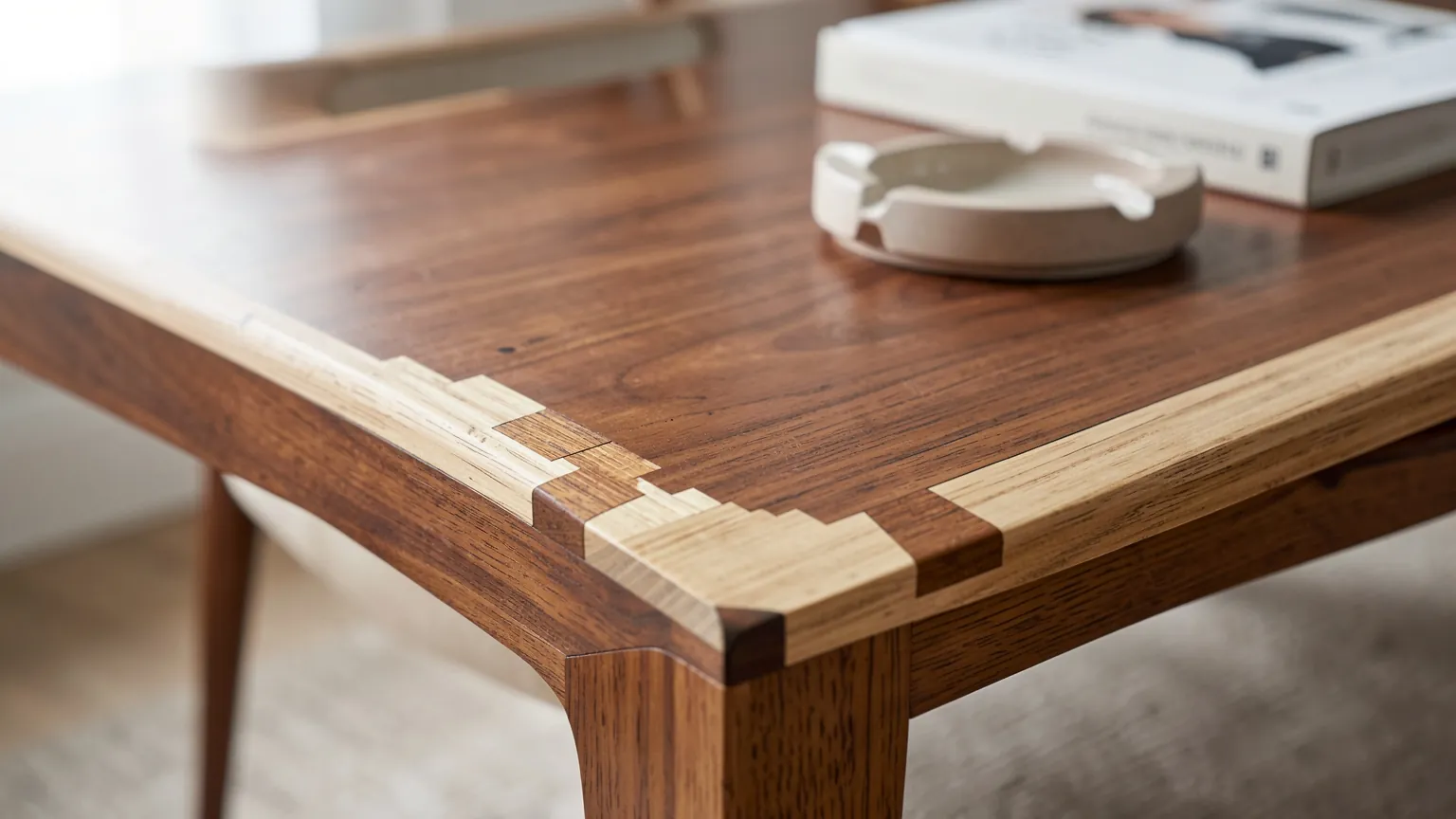
Its signature is the inlaid dovetail border: a band of dovetail shapes where a contrasting wood meets the walnut, usually around a table top. That detail gave the line its nickname, the "dovetail" collection. Other points:
- Woods: walnut veneer with a contrasting border. Hunker says the earliest pieces paired walnut with elm, later replaced by ash; a later Acclaim II line replaced the veneer with laminate.
- Forms: the line grew to at least 48 pieces, including coffee, end, wedge, step and "picture window" tables, and bedroom and dining pieces.
- Style numbers: Acclaim occasional tables are commonly numbered in the 900 series, for example 900-21 for the wedge table and 900-05 for an end table.
- Look-alikes: Virginia Maid made a similar line with inlaid bowties at the corners rather than dovetails.
Hunker reported in January 2026 that Acclaim coffee tables were listed at about $500 to $1,350, with sold examples averaging about $500. Condition of the veneer and inlay drives price more than anything else.
Other Lane mid-century lines
Dealers attribute several other lines to the 1960s and 1970s, including Perception, Staccato and Altavista, and Lane also made boomerang and wedge tables. The serial number dates all of them in the same way. Attributions of these lines to particular designers vary between sources, so treat a designer's name in a listing with caution unless it is supported by a catalogue.
Lane cedar chests: remove the old lock
Safety first
The US Consumer Product Safety Commission urges owners of Lane and Virginia Maid cedar chests made between 1912 and 1987 to remove the latch and lock immediately. The old latches lock automatically when the lid closes. Fourteen children suffocated inside these chests between 1977 and 2015. Lane recalled 12 million chests in 1996, but replacement locks are no longer available, so the CPSC now advises removing the lock completely.
Lane made cedar chests from 1912 until 2001, so they are among the most common pieces of old Lane furniture. The serial number dates a chest in exactly the same way as a table. If you sell or give away a chest, remove the lock first.
Putting it together
- Find the Lane mark and the style number.
- Read the serial number backwards to get the date.
- Check the construction and woods match the line and date.
- For Acclaim, look for the inlaid dovetail border and a 900-series style number.
- Record what you find with the object research checklist.
For identifying the timber itself, see telling teak, walnut and rosewood apart and veneer or solid wood. For other makers, start with the guide to mid-century labels and maker marks, and see collecting and buying for more.
For what a chest is likely to fetch, see Lane cedar chest value.
Common questions
How do I read a Lane serial number?
Read it backwards, from right to left. The first two digits give the month, the next two the day and the next two the year. For example, 063270 read backwards is 07 23 60, or 23 July 1960. A seventh digit on the far left is the plant number.
Where is the serial number on Lane furniture?
Usually on the underside of tables and inside or on the back of case pieces and cedar chests, often stamped near the Lane mark and a style number.
How can I tell if a table is Lane Acclaim?
Look for the inlaid dovetail border where a contrasting wood meets walnut veneer, a Lane mark, and a style number in the 900 series. Acclaim was designed by André Bus and made from about 1958 into the late 1960s or early 1970s.
Who designed Lane Acclaim?
André Bus, a Dutch-born designer, working under Lane's head designer Warren C. Church. One dealer guide credits Merton Gershun, but most sources and listings name Bus.
Is it safe to keep an old Lane cedar chest?
Only with the lock removed. The CPSC advises removing the latch and lock from all Lane and Virginia Maid cedar chests made between 1912 and 1987, because the lid locks automatically and children have suffocated inside.
References
- Lane cedar chest, Virginia Museum of History & Culture
- Edward Hudson Lane, American Home Furnishings Hall of Fame
- CPSC urges consumers to replace or remove latches/locks on Lane and Virginia Maid cedar chests, US Consumer Product Safety Commission, release 18-187, 11 July 2018 (updated 31 January 2023)
- Mid-century modern furniture by Lane (2013) and The Acclaim collection by Lane (2016), Cause A Frockus
- The valuable vintage table you should never pass up, Hunker, January 2026
- All about Lane cedar chests, Fresh Take Furnishings
- How do I date Lane furniture?, 1stDibs
- Altavista, Virginia, Wikipedia