Quick answer
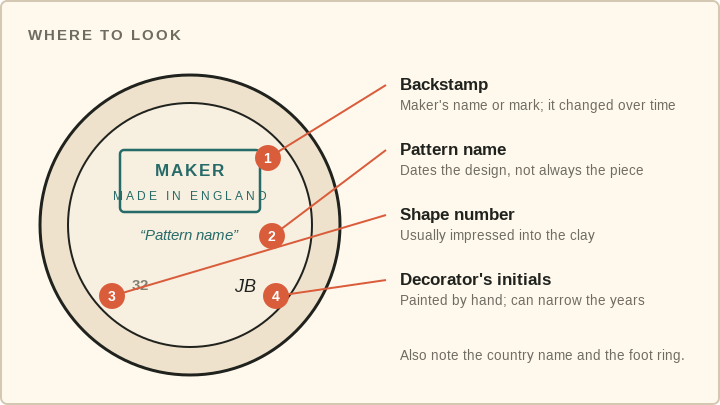
Carlton Ware marks fall into two broad groups. Early pieces carry Wiltshaw & Robinson marks, first a ribbon and then a crown, often with the initials W & R and "Stoke-on-Trent". From the mid-1920s the company used the script "Carlton Ware" mark that most people recognise, and it kept using versions of that mark for decades, through the change of name to Carlton Ware Ltd in 1958 and beyond. So a script mark tells you a piece is from the mid-1920s or later, but rarely much more.
To date mid-century Carlton Ware more closely, you have to combine the mark with the range, the shape and any registration wording. This guide sets out the marks, the dates the sources give for them, and where those sources disagree.
Carlton Ware in outline
- 1890: James Frederick Wiltshaw and the brothers James Alcock and William Herbert Robinson form Wiltshaw & Robinson in Stoke-on-Trent.
- About 1894: the "Carlton Ware" trade name is in use and the factory becomes the Carlton Works.
- 1911: the partnership is dissolved and Wiltshaw becomes sole owner, trading as Wiltshaw & Robinson Ltd.
- 1918: Wiltshaw dies in an accident at Stoke station; his son Frederick Cuthbert Wiltshaw takes over.
- January 1958: the company is renamed Carlton Ware Ltd.
- 1966 to 1967: after Cuthbert Wiltshaw's death in 1966, Arthur Wood takes over the Carlton Works.
- 1987: County Potteries buys the company.
- 1989: receivership; production ends by 1992. The name has since been revived.
The backstamps
| Mark | Suggested period | Notes |
|---|---|---|
| Ribbon mark, W & R | 1890 to 1893 | The earliest mark |
| Round crown mark, W & R, Stoke-on-Trent | 1894 to the mid-1920s | Often with "Carlton Ware" and "Made in England" |
| "W & R Stoke-on-Trent Carlton China" | About 1906 onwards | Bone china, not earthenware |
| "Carlton China Made in England" | About 1925 to 1957 | Carlton made no china after 1957 |
| Script "Carlton Ware" with "Made in England" and "Trade Mark" | From the mid-1920s, continuing after 1958 | Start date disputed: 1925, 1926 or 1928 |
| Script mark with "Handpainted" | Disputed | One source dates it from about 1925, another from 1952 |
| Design registration wording, including "Registered Australian Design" | About 1935 to 1961 | Added to protect designs in Australia and New Zealand |
Three dates for one mark
The start of the script mark is given as about 1925 by thepotteries.org and Gales Antiques, 1926 by Carlton Ware World and 1928 by Wikipedia. All agree it replaced the crown mark in the mid to late 1920s and stayed in use long after. Treat a script mark as "1925 or later" and look elsewhere for a closer date.
The "Handpainted" version is the clearest disagreement. Thepotteries.org captions it "c.1925 +", while Carlton Ware World says Carlton introduced a backstamp including "Handpainted" in 1952, when post-war restrictions on decorated ware were lifted. Both may be right about different forms of the wording, so compare your mark with photographed examples.
Gales Antiques, a long-established Carlton Ware dealer, notes that "all dating is indicative" because some marks were used throughout, and recommends using shape numbers and the introduction date of the pattern as well.
Mid-century ranges
Because the script mark spans so long, the range is often the best guide to date.
| Range | Period | Notes |
|---|---|---|
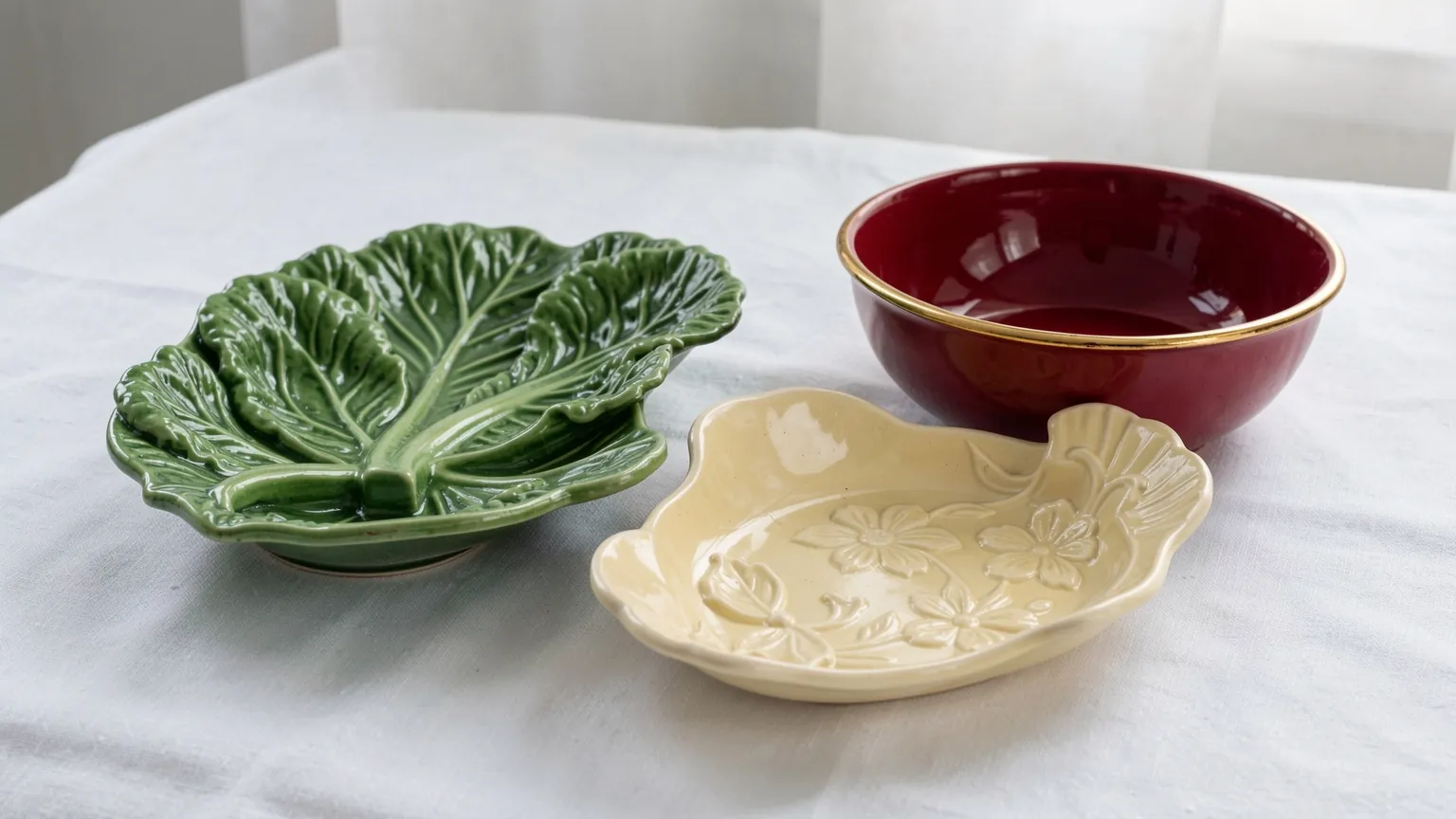
| Salad ware (lettuce and tomato), embossed floral and foliage ranges | Introduced late 1920s and late 1930s; made into the 1960s | Including Foxglove, Anemone, Apple Blossom, Wild Rose, Buttercup, Hazelnut and Magnolia |
| "Royale" high-lustre tableware, such as Rouge Royale | From 1949 into the early 1970s | Wikipedia dates the Royale brand from 1949 |
| Windswept, Twin-Tone | 1950s | Simpler post-war styles |
| Orbit and other space-age designs | 1960s | |
| Walking Ware | From about 1974 | Designed by Roger Michell and Danka Napiorkowska of Lustre Pottery |
| Novelty and advertising wares, including Guinness promotional pieces | Mainly 1970s | Made under Arthur Wood ownership |
A script-marked piece in a recognisable range, or one with registration wording, can therefore be placed with more confidence than the mark alone allows.
Copies
Gales Antiques warns that copies of Carlton Ware are appearing on the market. Check that the mark is crisp and correctly placed, that the glaze and lustre quality match documented pieces, and that the shape matches a recorded Carlton shape. Record what you see with the object research checklist.
For other British pottery marks, see our guides to Poole Pottery, Denby and Troika. More guides are in collecting and buying.
Related guides
- Clarice Cliff backstamps: dating Bizarre and later marks
- How to identify pottery marks: a method for any mark
- Hornsea Pottery marks: horn-and-waves marks and years in the stamp
- West German pottery marks: shape numbers and heights
Common questions
How old is Carlton Ware with a script mark?
The script "Carlton Ware" mark was introduced in the mid to late 1920s (sources give 1925, 1926 or 1928) and used for decades afterwards, including after 1958. It means the piece is from the mid-1920s or later; the range and shape narrow it further.
What does W & R mean on Carlton Ware?
W & R stands for Wiltshaw & Robinson, the company that made Carlton Ware. W & R marks with a ribbon or a crown are the earlier marks, used from 1890 until the script mark replaced them in the 1920s.
What does Registered Australian Design mean on Carlton Ware?
It refers to design registration in Australia, one of Carlton Ware's export markets. Gales Antiques dates registration backstamps to about 1935 to 1961.
When did Carlton Ware close?
The company went into receivership in 1989 and production ended by 1992. The Carlton Ware name has since been revived by later owners.
References
- Wiltshaw & Robinson (Ltd), thepotteries.org
- Brief history of Carlton Ware 1890 to 1997, Carlton Ware World
- Carlton Ware, Gales Antiques
- Carlton Ware, Wikipedia