Quick answer
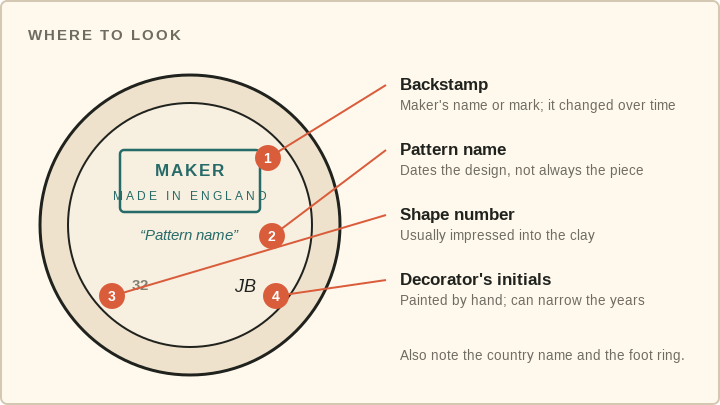
Troika pottery marks have two parts: the pottery's name, usually hand-painted on the base, and the monogram of the person who decorated the piece. The name and any place-name tell you whether a piece belongs to the St Ives years (to 1970) or the Newlyn years (1970 to 1983). The decorator's initials can narrow that further, sometimes to two or three years, because most decorators worked at Troika for a short and documented period.
Neither part is foolproof. The marks were written by hand, several decorators shared initials, and the published lists of who worked when still disagree. This guide sets out what the marks can and cannot tell you, and where the sources part company.
Troika in brief
Troika was founded by Benny Sirota, Leslie Illsley and Jan Thompson at the former Powell and Wells pottery at Wheal Dream, St Ives, Cornwall. Wikipedia gives February 1962 as the start; the collectors' sources (Cornish Ceramics, the Troika Pottery Collectors Club and others) give 1963, and most dating lists start there. The name comes from the Russian word for a set of three.
At the end of summer 1970 the pottery moved to Fradgan Place, Newlyn, after the Wheal Dream site was bought by the local council. Sirota left in 1980, and Troika closed in 1983.
Almost all Troika was cast in plaster moulds and then decorated by hand, which is why the decorator's mark matters so much: the shape was shared, the surface was individual.
Reading the base mark
| Mark | What it suggests | Notes |
|---|---|---|
| Trident (three-pronged) symbol | Early St Ives, mid-1960s | Bearnes Hampton & Littlewood describe the trident as the earliest mark. It is also the mark of the decorator Stella Benjamin (1963 to 1967) |
| "Troika St Ives", sometimes with "England" | St Ives period, to 1970 | Includes black ink stamped versions; Michael Dowse describes one as late 1960s |
| "Troika Cornwall" | Newlyn period, 1970 to 1983 | Dealers and auctioneers agree "Cornwall" replaced "St Ives" after the move |
| "Newlyn" | Never used | Both Bearnes and the dealer Hares Fur state that Newlyn never appears in the marks |
The method of marking is less consistent than some guides suggest. One guide describes early marks as stamped or impressed and later marks as hand-painted; another describes Troika marks in general as handwritten. Both kinds exist. The safest reading is that a printed or stamped "St Ives" mark is consistent with the early years, and a fluent hand-painted "Troika Cornwall" with a monogram is typical of Newlyn.
A quick rule
"St Ives" on the base points to before the move in 1970. "Cornwall" points to after it. If a piece is marked "Newlyn", treat it with suspicion.
Decorators' monograms and their dates
The table below combines the dates given by Cornish Ceramics (which marks entries it has verified), the Troika Pottery Collectors Club and the Pijjy identification guide. Where they disagree, the range shown is the widest, and the disagreement is noted.
| Monogram | Decorator | Dates | Notes |
|---|---|---|---|
| LI | Leslie Illsley | 1963–1983 | Partner and main designer |
| BS | Benny Sirota | 1963–1980 | Writing and mark vary considerably |
| Trident | Stella Benjamin | 1963–1967 | Cornish Ceramics lists her as "SB" |
| KR | Kristen Roth | 1963–1965 | |
| JB | John Bedding | 1967–1968 | Potter and decorator |
| SV | Sylvia Vallence | 1967–1969 | |
| MP | Marilyn Pascoe | late 1960s–1974 | Can be misread as MD |
| PB | Penny Black | 1960s–1974 or 1976 | End date disputed; shares initials with Penny Broadribb |
| HP / HC | Honor Perkin, later Honor Curtis | 1968–1973 | Signed HP until her marriage in 1969, then HC |
| AL | Anne Lewis | about 1969–1972 | |
| DB | David Bridge | 1969–1970 | |
| RGB or RSB | Roland Bence | 1965–1968 and 1970–1981 | Sources differ on the middle initial |
| AB | Avril Bennett | 1973–1979 | Shares initials with Alison Brigden |
| TB | Teo Bernatowicz | about 1974 | Previously misattributed to Tina Doubleday |
| SK | Simone Kilburn | 1975–1977 | Pijjy also lists Sue Kewell as SK, 1974–1975 |
| PB | Penny Broadribb | 1975–1976 | |
| SL | Sue Lowe | 1976–1977 | |
| JF | Jane Fitzgerald | 1976–1983 | |
| LJ | Louise Jinks | 1976–1981 | Senior decorator 1979–1981 |
| AJ | Anne Jones | 1976–1977 | Part time |
| AB | Alison Brigden | 1977–1983 | Senior decorator 1981–1983 |
| JP | Julian Greenwood-Penny | 1977–1983 | Became a partner in 1982 |
| TD (or DD) | Tina Doubleday | 1977–1979 | Sources differ on the form of the mark |
| HJ | Holly Jackson | 1977–1978 | Stayed seven months |
| TR | Tamsin Ruhrmund | 1978 | |
| SW | Shirley Wharf | 1979–1980 or 1981 | |
| JI | Judith Illsley | 1980 |
Several monograms are shared, which is the main trap. "SB" has been attributed to Stella Benjamin, Sue Bladen, Sally Bart and Sally Bench; "AB" to Avril Bennett and Alison Brigden; "PB" to Penny Black and Penny Broadribb; "HC" to Honor Curtis and Hilary Cox. For these, the date of the shape, the style of decoration and the place-name on the base have to settle which person is meant.
Cornish Ceramics, which has done the most systematic work on the marks, notes that every book published on Troika so far contains errors about attributions and dates. That is a fair warning for any table, including this one.
Using shape and surface to check the mark
A mark should fit the piece it is on.
- Smooth and textured wares. Troika made two ranges: smooth glazed wares and rough textured wares. The St Ives years are associated with more smooth, glazed work. The heavily textured surfaces that most people now picture as Troika belong mainly to Newlyn; one dealer dates the shift to about 1974, an auctioneer to after 1970.
- Shapes. The best-known forms include the coffin, chimney, wheel, cube, cylinder, slab and anvil vases, lamp bases, plaques, marmalade and spice jars, and the double egg cup. Bearnes notes that the coffin vase was the most popular form of the later years.
- Rare forms. Figural pieces and masks are scarce, and early St Ives pieces generally command more than later Newlyn production.
Spotting copies
Copies of Troika's best-known shapes exist, and the Troika Pottery Collectors Club was founded partly to help members avoid them. Its fakes gallery shows copies of the D-plate, marmalade jar, Love plaque, coffin vase and Stove Man plaque beside genuine examples. The general checks are:
- A mark that is printed or mechanical where you would expect a hand-painted mark, or a mark with no decorator's initials at all on a Newlyn-period shape.
- Initials that do not fit the period of the shape or the place-name.
- A smooth or glazed base where genuine bases are usually rough or unglazed.
- Carving that is shallow and soft rather than crisp.
- A price far below the going rate for the form.
None of these is proof on its own. A worn or partly missing mark on an honest piece is common. If in doubt, compare the piece with the verified examples published by the collectors' club, and record what you see with the object research checklist.
What Troika is worth
Prices range widely. Everyday pieces from the Newlyn years sell for low hundreds of pounds, while early or rare work by Illsley and Sirota has reached well into four figures: World Collectors Net records a pillar vase by Illsley at £1,600 (Woolley & Wallis, October 2017) and £1,700 (Dukes, September 2017). The mark matters to value in two ways: it confirms the piece is Troika, and the decorator and period affect desirability.
For how marks work on furniture and other objects, see our guide to mid-century labels and maker marks. More identification guides are collected in collecting and buying.
Related guides
- How to identify pottery marks: a method for any mark
- Hornsea Pottery marks: horn-and-waves marks and years in the stamp
Common questions
How can I tell if Troika is from St Ives or Newlyn?
Look at the base. A "Troika St Ives" mark, or the early trident, points to the St Ives years before the move in 1970. "Troika Cornwall" points to the Newlyn years from 1970 to 1983. Newlyn itself never appears in the marks.
What do the initials on the base of Troika mean?
They are the monogram of the decorator who painted or finished the piece. Most decorators worked at Troika for a few years, so the initials can narrow the date. Several shared initials, so check the shape and the place-name as well.
Is Troika without a mark fake?
Not necessarily. Marks can be worn or partly lost, and a few pieces left the pottery unmarked. An unmarked piece has to be judged on its shape, surface and base, and is harder to sell with confidence.
When did Troika close?
Troika closed in 1983. Benny Sirota had left in 1980, and sales had been declining since the late 1970s.
References
- Troika Pottery, St Ives and Newlyn, 1963–1983, Cornish Ceramics (updated 2020)
- Decorators' marks and fakes gallery, Troika Pottery Collectors Club
- Troika decorator marks identification guide, Pijjy, 2025
- Troika Pottery, Bearnes Hampton & Littlewood, 2009
- Troika pottery history, designers and price guide, World Collectors Net
- Troika Pottery, Wikipedia
- Troika pottery marks, Antique Marks