Quick answer
G-Plan furniture was made by E. Gomme Ltd of High Wycombe from 1953, and its label is the quickest way to date it. A gold embossed stamp reading "E Gomme, High Wycombe" with "EG" and "G-Plan" belongs to about 1953 to 1965. A red G-Plan label belongs to about 1965 to the mid-1970s. Red and gold labels were used from about 1975 until the High Wycombe factory closed in 1992. Ib Kofod-Larsen's G-Plan Danish pieces have their own label with his signature.
The dates below follow the collectors' guide published by Retrowow, the most detailed published account of the labels we found. Treat the boundaries as approximate: labels overlapped, and stock was sold for some time after it was made.
The labels by period
| Label | What it looks like | Approximate period |
|---|---|---|
| Gold embossed stamp | Stamped in gold into the wood: "E Gomme, High Wycombe", with "EG" in the centre and "G-PLAN" in capitals underneath | 1953 to about 1965 |
| G-Plan Danish label | "Designed by Ib Kofod-Larsen, G-Plan Danish Design, made by E Gomme Ltd, High Wycombe, Bucks", with Kofod-Larsen's signature | Early to mid-1960s onwards, on the Danish range only |
| Red label | A red and white paper label with "G-Plan" | About 1965 to 1975; illustrated in catalogues up to 1980 |
| Red and gold label | Like the red label, but with the lettering in metallic gold | About 1975 to 1985 |
| Red and gold label, later style | A different typeface and a different position for the word "plan" | About 1985 to 1990 |
| Red and gold label with a gold border | As above, with a gold border | 1990 to 1992 |
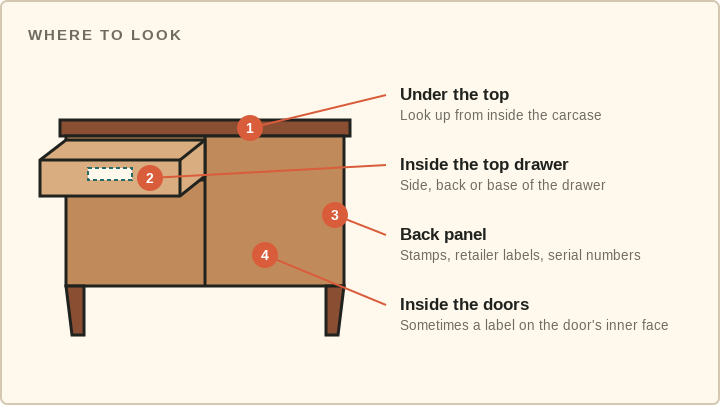
Retrowow dates the gold stamp from 1952, the year before Wikipedia's date for the launch of G-Plan. Look inside the top drawer, on the back panel, inside doors and under table tops and chair seats.
Labels can move
Paper labels can come off and be stuck onto other furniture, as Retrowow warns. The early gold stamp is pressed into the wood, so it cannot be moved. Also note that G Plan launched a modern "G Plan Vintage" collection in 2012: a "vintage" name on a new piece is not evidence of age.
G-Plan in brief
- 1898: Ebenezer Gomme starts making chairs in High Wycombe. The Leigh Street factory follows in 1909 and a second factory at Spring Gardens in 1927.
- 1953: Donald Gomme launches G-Plan, a range of modern furniture for the whole house that could be bought piece by piece. The name was coined by Doris Gundry of the J. Walter Thompson advertising agency.
- 1958: Donald Gomme leaves the company.
- Early to mid-1960s: the G-Plan Danish range, designed by Ib Kofod-Larsen.
- 1966: the teak Fresco range, designed by V.B. Wilkins.
- 1987: the Gomme family retires and sells the business to its directors. It passes to the Christie Tyler group about three years later.
- 1992: the High Wycombe factory closes.
G Plan's own website calls Donald Gomme Ebenezer's grandson; Wikipedia describes him as the firm's designer. After Christie Tyler collapsed in 2005 the brand passed to Sofa Brands International. G Plan today makes upholstery, not the cabinet furniture collectors look for.
Dating by range
| Range | Designer | Dates | Look |
|---|---|---|---|
| Early G-Plan | In-house, under Donald Gomme | From 1953 | Modern furniture sold piece by piece; gold embossed stamp |
| G-Plan Danish | Ib Kofod-Larsen | Early to mid-1960s | Danish-style designs with their own label; more expensive than other G-Plan at the time |
| Fresco | V.B. Wilkins | From 1966 | Teak |
G-Plan also made many other ranges over four decades. Catalogues often gave each piece a model number; a 1962 "Guide to the G-Plan" catalogue in the High Wycombe Furniture Archive, for example, lists wardrobes as 1040, 1041, 1050 and 1051. Comparing a piece with dated catalogue pages is the most reliable way to date it beyond the label.
A step-by-step method
- Find the label or stamp and photograph it.
- Match it to the table above to get a date range.
- Check that the label matches the style: a red label on a piece from a range dropped in the 1950s, for example, is worth questioning.
- Identify the range, then compare with catalogue pages.
- Record what you find with the object research checklist.
For Kofod-Larsen's work for other makers, see lesser-known Danish furniture designers. For other British makers, see McIntosh of Kirkcaldy and Stag Minstrel. For labels in general, see mid-century furniture labels and maker marks, and for the wood, teak, walnut and rosewood. More guides are in collecting and buying.
Related guides
- Robin Day at Hille: the Hillestak and Polypropylene chairs
Common questions
How do I date my G-Plan furniture?
Look at the label. A gold "E Gomme, High Wycombe" stamp pressed into the wood suggests about 1953 to 1965; a red label about 1965 to 1975; a red and gold label about 1975 to 1992. Then compare the piece with catalogues for its range.
What does the red G-Plan label mean?
The red and white G-Plan label was used from about 1965 until it was replaced by a red and gold label in the mid-1970s, though catalogues still showed it up to 1980.
Is G-Plan furniture Danish?
No. G-Plan was made by E. Gomme in High Wycombe, England. Its G-Plan Danish range of the 1960s was designed by the Danish designer Ib Kofod-Larsen but made in England.
When did G-Plan stop making furniture in High Wycombe?
The High Wycombe factory closed in 1992. The G Plan brand continues, mainly for upholstery.
References
- G-Plan collectors' guide, Retrowow
- G-Plan, Wikipedia
- G Plan heritage, G Plan
- Guide to the G-Plan catalogue, 1962, High Wycombe Furniture Archive