Quick answer
Clarice Cliff backstamps are one of the best dating tools in British ceramics, because the mark changed so often. Hand-painted and stamped "Bizarre" marks date a piece to 1927 to 1936. Range names such as Fantasque, Crocus or Latona in the mark narrow it further. After 1936 the Bizarre name was dropped for a plainer "Clarice Cliff" signature, and pieces from the 1940s to the early 1960s often carry a Royal Staffordshire mark. Clarice Cliff branding ended in 1964, when the factories were sold to Midwinter.
Clarice Cliff's best-known work is from before the war, but her factories carried on making her shapes and patterns through the 1950s and early 1960s. That later work is what collectors of post-war pottery most often find.
Clarice Cliff in brief
- 1916: Clarice Cliff joins A. J. Wilkinson Ltd (Royal Staffordshire Pottery) in Burslem. Sources disagree on her earlier jobs and her exact role.
- 1920: the Shorter family, who owned Wilkinson's, buy the neighbouring Newport Pottery.
- 1927: the Bizarre range is launched, hand-painted at Newport.
- 1936: the Bizarre name is phased out of the marks.
- 1940: Cliff marries Colley Shorter, the managing director.
- 1961: Colley Shorter dies.
- 1964: Cliff sells the factories to W. R. Midwinter Ltd, ending production under her name.
The Clarice Cliff backstamps in order
The Clarice Cliff Collectors Club's backstamp guide gives the fullest sequence. Its periods are approximate, and marks overlapped as old stock was used up.
| Mark | What it looks like | Approximate period |
|---|---|---|
| Lion and crown | Rampant lion and crown over a ribbon reading "Royal Staffordshire Pottery" or "Newport Pottery" | 1922 to 1927 (continued for some years at Wilkinson's) |
| Hand-painted Bizarre | "Bizarre" painted by hand, with a Newport or Royal Staffordshire mark | 1927 to 1928 |
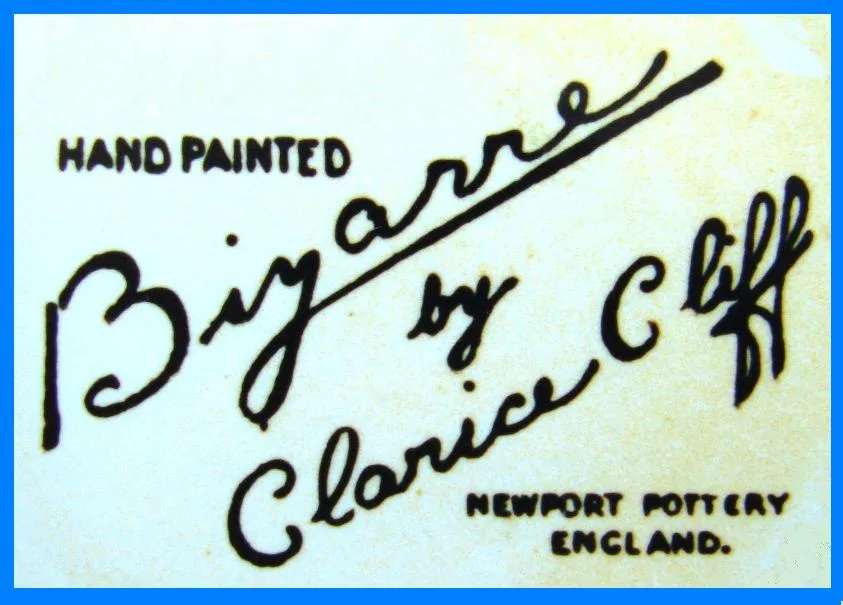
| Stamped Bizarre | "Hand Painted Bizarre by Clarice Cliff Newport Pottery", rubber-stamped in black, in two sizes | From late 1927 or early 1928, through 1929 and 1930 |
| Fantasque script | "Fantasque" in script, briefly in gilt, crediting Newport Pottery | From October 1928 |
| Range name over Bizarre | Block letters such as FANTASQUE, CROCUS or GAYDAY above a Bizarre mark | About 1929 to 1931 |
| Honeyglaze and "Registration Applied For" | "Wilkinson England Honeyglaze Hand Painted", or a registration note, under the glaze | From 1929 |
| Printed range marks | Finer printed marks naming Fantasque, Latona, Nuage, Café-au-lait and others | From 1931 |
| Biarritz | "The Biarritz Royal Staffordshire Great Britain Regd. No. 784849" | From 1933 |
| Simplified marks | Plainer stamped or printed marks as the ranges were cut back | From 1934 |
| Clarice Cliff signature marks | A "Clarice Cliff" signature without Bizarre, on Newport or Royal Staffordshire wares | From 1936 |
| Royal Staffordshire post-war | "Royal Staffordshire Ceramics by Clarice Cliff" and similar | Late 1940s to early 1960s |
Sources differ on small points. The collectors' club describes the first hand-painted Bizarre mark as rust-coloured, while Potteries Auctions says the hand-painted marks were in black ink. Both may be right for different pieces.
What Bizarre and Fantasque mean
Bizarre was the name of Cliff's first hand-painted range, launched in 1927. Within a couple of years it had become the umbrella name for all her ranges, so a mark can say both "Fantasque" and "Bizarre". Collectors call 1927 to 1936 the "Bizarre years". Fantasque was one range within that, with its own mark from October 1928. Other range names you may see in the mark include Crocus, Gayday, Latona, Appliqué, Inspiration, Nuage, Delecia and Moderne.
A range name in the mark is useful evidence, but check it against the decoration. Blanks were sometimes stamped before painting, and a mark naming one range can turn up under another.
Stamped, printed and missing marks
- Rubber-stamped marks were applied quickly by hand, so letters are often uneven, blobby or partly missing.
- Printed marks were transferred from tissue and are finer and more regular. One edge can be cut through where the mark was trimmed from a sheet.
- No mark at all does not prove a piece is a copy. The collectors' club notes that some pieces were never stamped, and small items were sometimes only partly marked.
Reissues and fakes
In the 1990s Wedgwood, which by then owned Midwinter, reissued classic Clarice Cliff shapes and patterns as limited editions. Production ended in 2002, and the reissues are collected in their own right. Their marks say they are reproductions, so read the whole mark rather than looking for the signature alone.
Fakes are a separate problem. The auctioneers Gorringes advise looking for slapdash painting, a weight that feels wrong, and a price that is too low, and comparing the backstamp against the collectors' club's reference images. A crisp, perfectly regular "Bizarre" stamp on a piece with thin, hesitant painting deserves a second look.
A step-by-step method
- Write down the full mark, including any range name, and whether it is painted, stamped or printed.
- Place it in the table above to get a period.
- Check the shape and pattern against documented examples from the same period.
- Look closely at the painting: confident brushwork and on-glaze enamel colours are typical of the Bizarre years.
- Be wary if the mark, shape and pattern point to different dates.
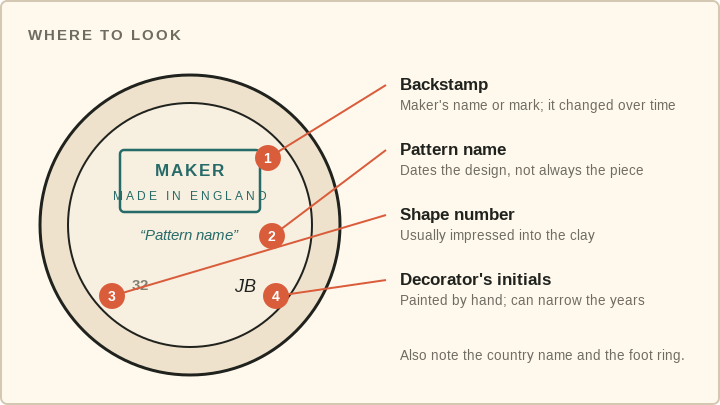
- Record what you find with the object research checklist.
Related guides
- How to identify pottery marks: a method for any mark
- Carlton Ware marks: another Staffordshire maker with dated script marks
- Poole Pottery marks: hand-painted pottery from the same decades
Common questions
How do I date Clarice Cliff from the backstamp?
A hand-painted or stamped "Bizarre" mark means 1927 to 1936. A range name such as Fantasque or Latona narrows it further. A "Clarice Cliff" signature without Bizarre is from 1936 or later, and "Royal Staffordshire Ceramics by Clarice Cliff" marks are mainly from the late 1940s to the early 1960s.
Is Clarice Cliff without a mark fake?
Not necessarily. Some pieces were never stamped and small items were sometimes only partly marked. An unmarked piece has to be judged on its shape, painting and glaze, and is harder to sell with confidence.
What does Bizarre mean on Clarice Cliff?
Bizarre was the name of Clarice Cliff's first hand-painted range, launched in 1927, and soon became the umbrella name for all her ranges. It was phased out of the marks from 1936.
Is Wedgwood Clarice Cliff original?
No. Wedgwood's 1990s pieces are licensed limited-edition reissues of original shapes and patterns, made until 2002. They are marked as reproductions and are collected separately from 1927 to 1964 pieces.
When did Clarice Cliff stop making pottery?
Production under her name ended in 1964, when she sold the Wilkinson and Newport factories to W. R. Midwinter Ltd.
References
- Backstamps and After Bizarre, Clarice Cliff Collectors Club
- Clarice Cliff pottery markings guide, Potteries Auctions, 2021
- A guide to Clarice Cliff, Gorringes, 2021
- Newport Pottery history, Pottery Histories
- Clarice Cliff, thepotteries.org