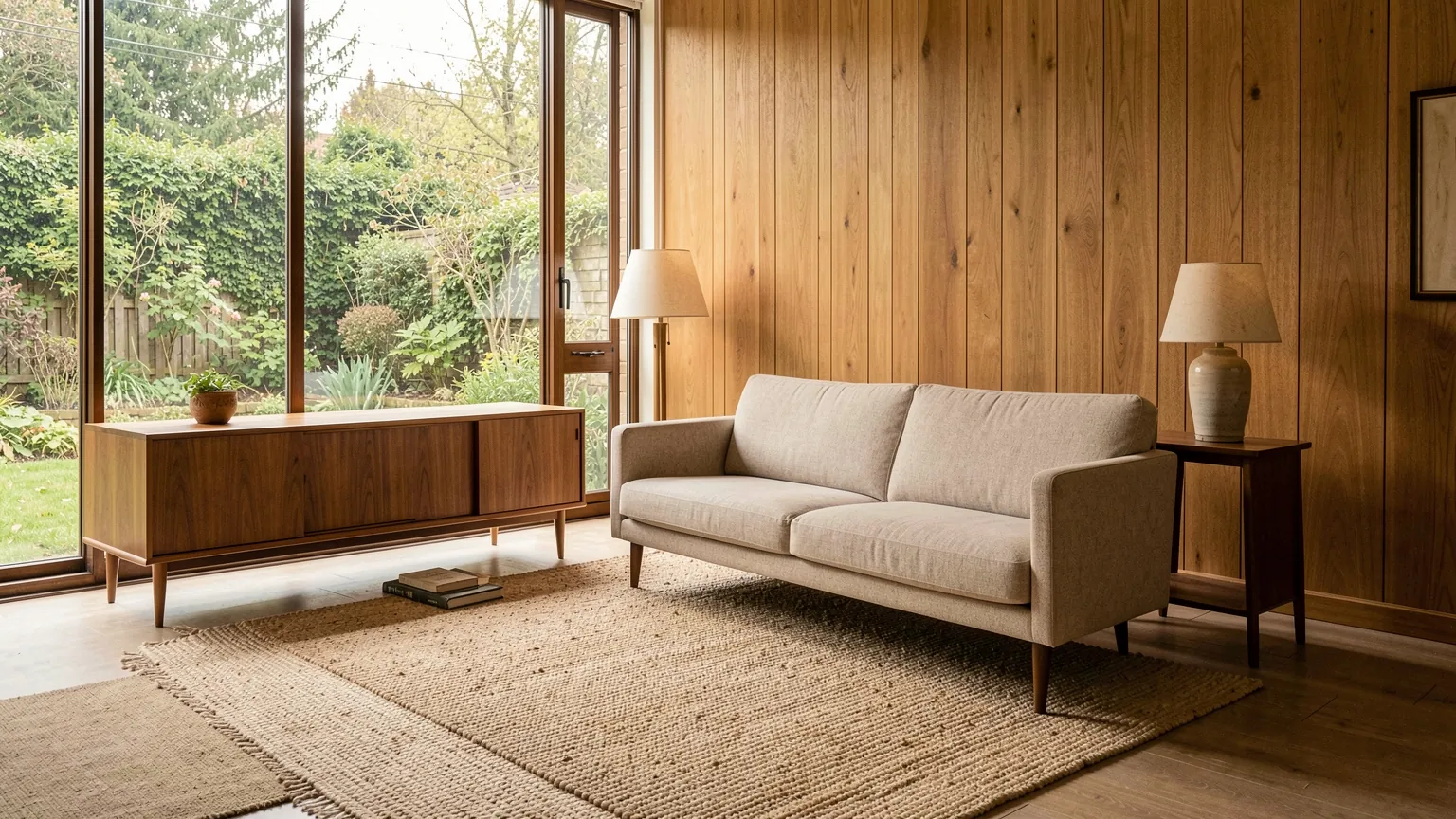
Mid-century modern is a loose name for the modern design of roughly 1945 to 1975: furniture, interiors, houses, textiles, objects and graphics that tried to make modernism domestic, affordable and pleasant to live with. It is not a single style, and it is not a name the period used for itself.
The label arrived later. It was popularised by the American writer Cara Greenberg's 1984 book Mid-Century Modern: Furniture of the 1950s, which grew out of a 1983 magazine article on fifties furniture. In a 2024 interview with Dezeen she said she was not aware of any earlier use of the phrase when the book was titled, though it may have been used before for furniture from about 1947 to 1957. So the term began as a collector's and writer's category for American furniture of one decade, and has since widened to cover three decades, every medium and most of the industrialised world.
That history explains most of the confusion around it. What follows sets out the working dates, the ideas that hold the period together, how it differed from country to country, and the single most useful habit for anyone researching a piece: keeping the design date and the production date apart.
The short version
| Question | Short answer |
|---|---|
| When? | Roughly 1945 to 1975. Mid Century Form uses those dates as a working period; the roots go back to the 1920s and 1930s. |
| Where? | Across the United States, Britain, Scandinavia, Italy, Japan, Latin America and beyond, with distinct national strands. |
| What? | Furniture, lighting, ceramics, glass, textiles, houses, interiors and graphic design. |
| Who named it? | Not its makers. The term was popularised in 1984 by Cara Greenberg's book. |
| Is it a style? | Better described as a family of approaches sharing some aims: clear structure, new materials and methods, human scale and a wide market. |
A working period, not a fixed one
Mid Century Form uses 1945 to 1975. Architecture, furniture, graphics and regional histories often draw the boundaries differently, so treat the dates as a guide rather than a rule. Several of the period's defining institutions began well before 1945 and some of its best-known designs reached production well after their design date.
The timeline below uses only events that a museum, archive or manufacturer dates directly. It is a spine to hang research on, not a complete history.
| Date | Event | Source |
|---|---|---|
| 1927–1966 | Annual exhibitions of the Copenhagen Cabinetmakers' Guild, where architects and master cabinetmakers showed new Danish furniture | Guild exhibition histories |
| 24 September – 9 November 1941 | Organic Design in Home Furnishings at MoMA, following a 1940 competition; Charles Eames and Eero Saarinen won in the chair and living room categories | MoMA exhibition archive |
| January 1945 | Arts & Architecture, edited by John Entenza, launches the Case Study House programme in California | Los Angeles Conservancy |
| 1946 | Britain Can Make It at the V&A | V&A |
| 1949 | Hille commissions Robin Day to design furniture for mass production | Design Museum |
| 1950–1955 | Five Good Design exhibitions organised by MoMA with the Merchandise Mart, Chicago; the first opened on 21 November 1950 | MoMA exhibition archive |
| 1951 | Festival of Britain; about 8.5 million visits to the South Bank site; Lucienne Day's Calyx shown in the Homes and Gardens Pavilion | V&A |
| 20 April – 16 May 1954 | Design in Scandinavia opens at the Brooklyn Museum with more than 700 objects from Denmark, Finland, Norway and Sweden, then tours the United States and Canada | Brooklyn Museum archive |
| 1956 | Sori Yanagi's Butterfly Stool launched at the Matsuya department store, Tokyo | V&A |
| 1957 | Gio Ponti's Superleggera chair (Cassina model 699) designed | V&A, MoMA |
| 1959 | Verner Panton conceives the Panton Chair; serial production with Vitra follows in 1967 | Vitra |
| 1963 | Robin Day's polypropylene chair for Hille | Design Museum |
The ideas that hold it together
No single checklist covers a Danish teak sideboard, a Californian steel-framed house and a Japanese plywood stool. What links them is a set of shared aims, visible in the period's own words and exhibitions.
- Structure you can read. When MoMA launched its 1940 competition, the curator Eliot Noyes defined organic design as a "harmonious organization of the parts within the whole, according to structure, material, and purpose". The joints, legs and shells of much mid-century furniture are meant to be seen and understood.
- New relationships between craft and industry. The period was not simply the triumph of the machine. Ponti's Superleggera had its frames made in quantity at Cassina's factory in Meda while the cane seats were hand-woven in workshops near Chiavari, according to the V&A's catalogue record.
- Material and lightness. Moulded plywood, fibreglass, steel rod, aluminium and later plastics let designers reduce weight and bulk. The V&A records its Superleggera at about 1.7 kg.
- Human scale and the ordinary home. The Organic Design winners received manufacturing and distribution contracts with department stores, and sales began on the exhibition's opening day. MoMA's later Good Design shows were organised with a Chicago wholesale market. The intended audience was households, not collectors.
- Regional traditions. Danish cabinetmaking, Italian rush-seated chairs and Japanese woodworking all fed into modern designs rather than being swept away by them.
Optimism, with qualifications
MoMA's 2019 exhibition The Value of Good Design noted that governments on both sides of the Cold War used good design as a tool of post-war reconstruction and technological progress. The period's optimism was real, but it was also policy, marketing and national image-making, and it sits alongside questions of consumption, inequality and environmental cost that the design of the time rarely asked.
Not one look: the regional strands
The common picture of mid-century modern, warm wood, tapered legs and a low sideboard, is mostly a mixture of American and Danish design. The period was far wider. Each strand below is anchored in an object or event a museum has catalogued.
| Strand | Characteristic concerns | A dated anchor |
|---|---|---|
| United States | Industrial methods, moulded plywood and fibreglass, the open-plan house, museum-led campaigns for good design | MoMA's Organic Design (1941) and Good Design (1950–1955); the Case Study House programme (from 1945) |
| Britain | Post-war reconstruction, design reform, affordable modern furniture and pattern | Britain Can Make It (1946); Festival of Britain (1951); Robin Day's polypropylene chair (1963) |
| Denmark and the Nordic countries | Cabinetmaking quality, solid wood and fine joinery, glass, ceramics and textiles | Cabinetmakers' Guild exhibitions (1927–1966); Design in Scandinavia (1954) |
| Italy | Lightness, invention and manufacturing partnerships with firms such as Cassina | Ponti's Superleggera (designed 1957) |
| Japan | Modern industrial production meeting traditional woodworking and form | Yanagi's Butterfly Stool (designed 1954, launched 1956) |
| Later, colour and plastic | Single-piece moulded forms, saturated colour, pop interiors | Panton Chair (conceived 1959, made by Vitra from 1967) |
The Brooklyn Museum's 1954 press material makes the point about regional difference in the period's own terms. It described the Scandinavian show as having distinct national characters: Danish silver and furniture, Swedish glass, Norwegian domestic crafts and textiles, Finnish rugs. Even "Scandinavian design" was never one thing.
Design date, launch date, production date
This is the most practical lesson in the whole subject, and the one most often ignored in listings. A date attached to a mid-century design can mean the year it was drawn, the year it was first shown or sold, or the year a particular example was made. Museums themselves record these separately, and they are frequently years apart.
| Object | Designed | Launched or first produced | Example in a museum made |
|---|---|---|---|
| Butterfly Stool, Sori Yanagi | 1954 (V&A) | 1956, Matsuya department store, Tokyo; made by Tendo Mokko (V&A) | MoMA dates its example 1956; the V&A's gallery label says late 1950s |
| Superleggera chair, Gio Ponti, Cassina 699 | 1957 (V&A, MoMA) | Nominated for the Compasso d'Oro on its release (V&A) | The V&A's example, Circ.325-1970, was made in 1965 |
| Panton Chair, Verner Panton | 1959 (Vitra) | Serial production with Vitra, 1967 (Vitra) | Still in production; a polypropylene version followed in 1999 |
Two consequences follow. First, "1957 Superleggera" in a sale listing tells you the design date and nothing about the chair in front of you, which may be from any year since. Cassina still makes it. Second, a disagreement between two respectable sources over a date is often not an error at all: one is giving the design date and the other the production date. The Butterfly Stool is a good example. The V&A gives a design date of 1954, and MoMA, cataloguing a stool given by the designer, dates the object 1956.
For individual pieces, the evidence that actually dates an object is physical: labels, stamps, construction and wear. Two worked examples are on this site, one on dating Herman Miller furniture by its label and one on what the Danish Furniture Makers' Control stamp certifies. The object research checklist sets out a way to record that evidence.
What mid-century modern is not
- Not only furniture. The term now covers houses, interiors, textiles, ceramics, glass, lighting and graphic design. Lucienne Day's Calyx fabric of 1951 is as central to British mid-century design as any chair.
- Not only teak. Teak is strongly associated with Danish and British furniture of the 1950s and 1960s, but the period also used walnut, oak, ash, beech, plywood, steel, aluminium, fibreglass and polypropylene.
- Not a period name used at the time. Designers and retailers spoke of modern design, good design or national labels. "Mid-century modern" is a retrospective category, which is why its edges are argued over.
- Not necessarily old. Many classics have never left production, and the phrase is used freely in retail for new furniture in a period manner. A listing that says "mid-century modern" without "vintage", a maker and evidence of date may be describing a style, not an age.
Where to see and research it
The most reliable evidence for the period sits in museum collections and archives, many of them searchable online.
| Institution | Why it matters for this period |
|---|---|
| Victoria and Albert Museum, London | Hosted Britain Can Make It in 1946; detailed online catalogue records separating design and manufacture dates |
| Design Museum, London | Designer profiles and timelines, including Robin and Lucienne Day |
| Museum of Modern Art, New York | Ran Organic Design and the Good Design series; exhibition archive with catalogues and press releases online |
| Vitra Design Museum, Weil am Rhein | Holds estates and archives including the Eames Office collection (about 1,000 items), George Nelson (about 7,400), Verner Panton (about 600), Harry Bertoia and Alexander Girard |
| Brooklyn Museum, New York | Exhibition records for Design in Scandinavia (1954) |
| Los Angeles Conservancy | Case Study House history; ten houses were listed on the National Register of Historic Places on 24 July 2013 |
Where to go next
Each section of the archive picks up a different thread:
- Designers: the people, studios and manufacturers
- Furniture & objects: what was made and how to read it
- Architecture & interiors: houses, rooms and the spaces furniture was made for, starting with how to read a mid-century house from the street
- Materials & making: plywood, teak, fibreglass and production methods
- Collecting & buying: evidence, dating and buying with care
- Visual culture: graphics, pattern and print
If you are not sure where your interest lies, the designer direction finder and the palette builder are quick ways in.
Common questions
What years count as mid-century modern?
There is no official definition. Roughly 1945 to 1975 is a common working period, and the one this site uses. The term was originally applied to American furniture of the 1950s, and its roots lie in the modern design of the 1920s and 1930s.
Who coined the term mid-century modern?
It was popularised by Cara Greenberg's 1984 book Mid-Century Modern: Furniture of the 1950s. Greenberg has said she was not aware of earlier use when the book was titled, though the phrase may have been used before. It was not a name the designers of the period used for their own work.
Is mid-century modern the same as Scandinavian design?
No. Danish and other Nordic design is one important strand, but the period also includes distinct American, British, Italian, Japanese and Latin American work. Even Nordic design was presented at the time as four national traditions rather than one.
Does a design date tell me when my piece was made?
No. A design date is when a design was created. Many designs were launched years later and stayed in production for decades. The V&A's Superleggera chair, a 1957 design, was made in 1965. Only the object's own evidence, such as labels, stamps and construction, can date a particular piece.
Is new furniture described as mid-century modern genuine?
It depends what is meant. Some classics are still made under licence by their original or authorised manufacturers, and much new furniture is simply in a mid-century manner. Neither is vintage. Check the maker, the production date and the evidence on the piece.
References
- Interview with Cara Greenberg on the term mid-century modern, Dezeen, 2024
- Organic Design in Home Furnishings, 1941, Museum of Modern Art exhibition archive
- Good Design, 1950–1951, Museum of Modern Art exhibition archive
- The Value of Good Design, 2019, Museum of Modern Art
- Sori Yanagi, Butterfly Stool, object number 153.1958.2, Museum of Modern Art
- Gio Ponti, Superleggera Chair (model 699), Museum of Modern Art
- Superleggera chair, museum number Circ.325-1970, Victoria and Albert Museum
- Butterfly Stool, museum number W.5-2017, Victoria and Albert Museum
- The Festival of Britain, Victoria and Albert Museum
- Post-war design, Victoria and Albert Museum
- Robin and Lucienne Day, Design Museum
- Archive and estates, Vitra Design Museum
- Panton Chair, Vitra
- Design in Scandinavia, 1954, Brooklyn Museum
- Case Study Houses, Los Angeles Conservancy
- Copenhagen Cabinetmakers' Guild Exhibition, summary with links to the Royal Danish Library's exhibition booklets