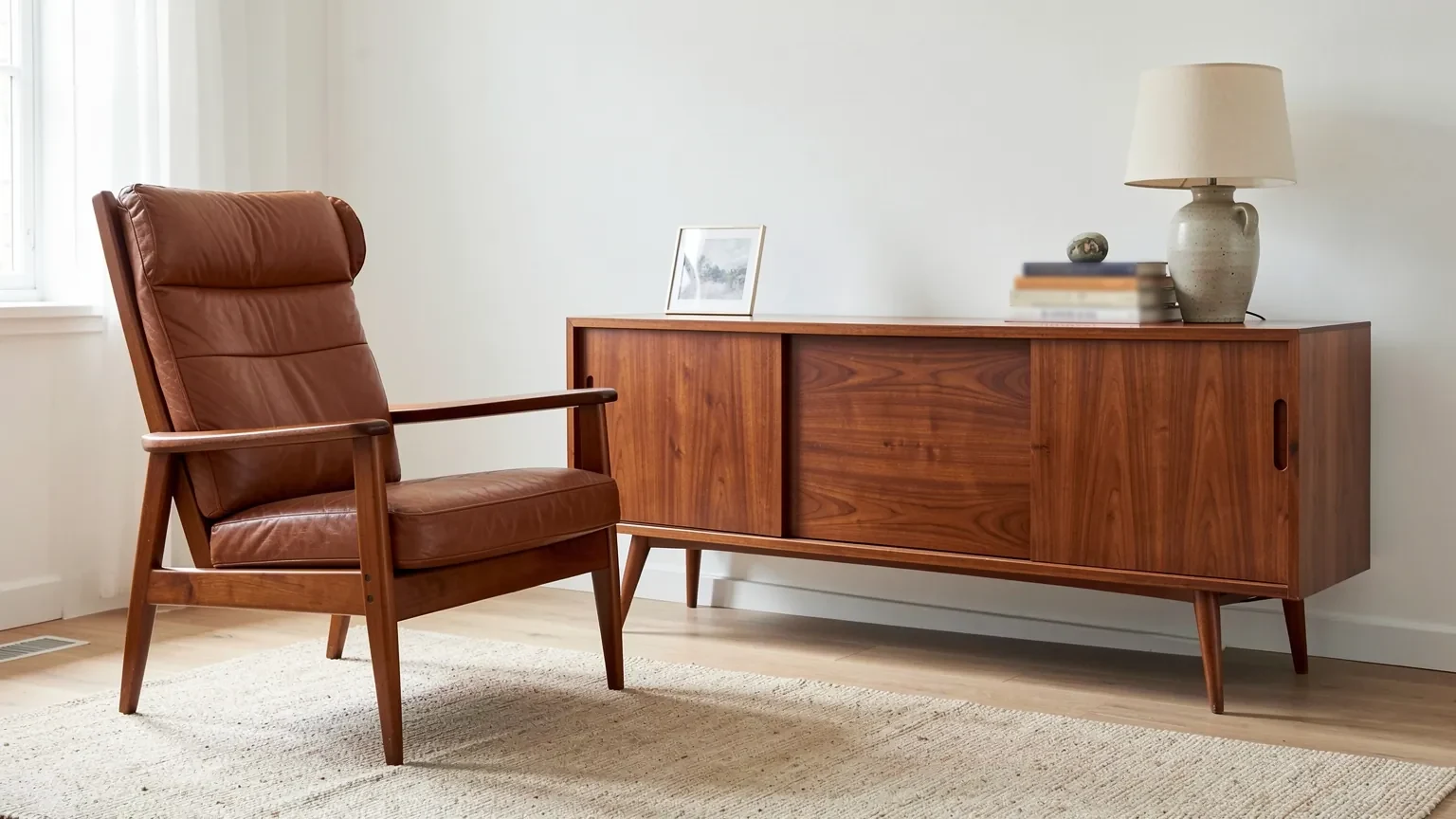
Ib Kofod-Larsen (1921 to 2003) was a Danish furniture designer who studied at the Royal Danish Academy in Copenhagen and whose designs of the 1950s and 1960s were made by firms in several countries. His best-known designs are the Elizabeth chair (U-56, 1956) for Christensen & Larsen, the Penguin or Shell chair (1953), the Seal chair for OPE in Sweden, rosewood and teak sideboards for Faarup Møbelfabrik, and the G-Plan Danish range made in High Wycombe from 1962. Because so many firms made his designs, attribution depends on the maker's label as much as on the design.
Career in brief
Kofod-Larsen was born in 1921. In 1948 he won the Holmegaard glass competition and an annual award from the Danish Cabinetmakers' Guild, and the Guild award brought him to the attention of Faarup Møbelfabrik. Through the 1950s and 1960s he designed for a long list of manufacturers in Denmark and abroad: Pamono names Faarup, Christensen & Larsen, Carlo Gahrn, Bovenkamp in the Netherlands, Fredericia, OPE and Säffle in Sweden, Selig in the United States and E. Gomme in High Wycombe. He died in 2003.
Key designs
| Design | Date | Maker | Notes |
|---|---|---|---|
| Penguin chair (also called the Shell) | 1953 | Petersens in Denmark; Selig in the United States | Selig sold it in the US from the 1950s. "Shell" is also used for a Christensen & Larsen lounge chair |
| Elizabeth chair (U-56) | 1956 | Christensen & Larsen | Teak frame, leather upholstery. Said to be named after Queen Elizabeth II, who reportedly bought a pair on a visit to Denmark in 1958 |
| Seal (Sälen) easy chair | 1950s or 1960s | OPE, Sweden | Teak and leather; dated to the 1950s in Pamono's biography and the 1960s in its listings |
| Model 66 (FA-66) sideboard | 1950s or 1960s | Faarup Møbelfabrik | Rosewood or teak; listings date examples to 1960 to 1966 |
| Chests and storage | About 1959 | Säffle, Sweden | Teak |
| G-Plan Danish range | From 1962 | E. Gomme, High Wycombe | Teak with rosewood handles; a second range followed in 1966 |
G-Plan Danish
E. Gomme launched G-Plan Danish in 1962 in response to competition from imported Scandinavian furniture, and Retrowow says all the design work was done by Kofod-Larsen. The range was mainly teak with rosewood handles, with some pieces largely in rosewood and legs often in solid afrormosia. A second range in 1966 included a 6 ft 4 in sideboard in Rio rosewood, which cost £85, or £65 in teak. The pieces were more expensive than the rest of G-Plan at the time.
The range carries its own label: "Designed by Ib Kofod-Larsen, G-Plan Danish Design, made by E Gomme Ltd, High Wycombe, Bucks", with his signature. Retrowow says that to be certain a piece is genuine G-Plan Danish, you should look for this label, but also notes that several versions of the label exist, and some readers report Danish-range pieces with only a standard G-Plan label. See our guide to G-Plan labels for the other marks.
Attributing a Kofod-Larsen piece
- Find the maker's label. Because so many firms made his designs, the label tells you which version you have. A G-Plan Danish label, for example, means a British-made piece.
- Be wary of "attributed to". Dealer listings often attribute pieces to Kofod-Larsen on style alone, and some say "in the style of". Without a label or a catalogue match, treat an attribution as unproven.
- Check the name. His name is often misspelt in listings, as Kofod Larsen, Køfod-Larsen and others, which matters when searching for comparable pieces.
- Check the wood. Most of his case furniture is teak or rosewood; see teak, walnut and rosewood.
For other Danish designers, see Børge Mogensen and lesser-known Danish furniture designers, and for the wider style, what is Danish modern furniture? For Danish marks, see the Danish control stamp. More profiles are in designers.
Common questions
What is Ib Kofod-Larsen known for?
The Elizabeth chair (1956), the Penguin chair (1953), the Seal chair for OPE, Faarup sideboards and the G-Plan Danish range made in England from 1962.
Why is it called the Elizabeth chair?
It is said to be named after Queen Elizabeth II, who reportedly bought a pair on a visit to Denmark in 1958. The model number is U-56.
Did Ib Kofod-Larsen design for G-Plan?
Yes. He designed the G-Plan Danish range, introduced by E. Gomme of High Wycombe in 1962, and a second range in 1966. Genuine pieces often carry a G-Plan Danish label with his signature.
Is Kofod-Larsen furniture Danish or British?
Both, and Swedish and American too. He was Danish, but his designs were made by firms in several countries, so the maker's label tells you where a piece was made.
References
- Ib Kofod-Larsen, Pamono
- G-Plan Danish and G-Plan collectors' guide, Retrowow