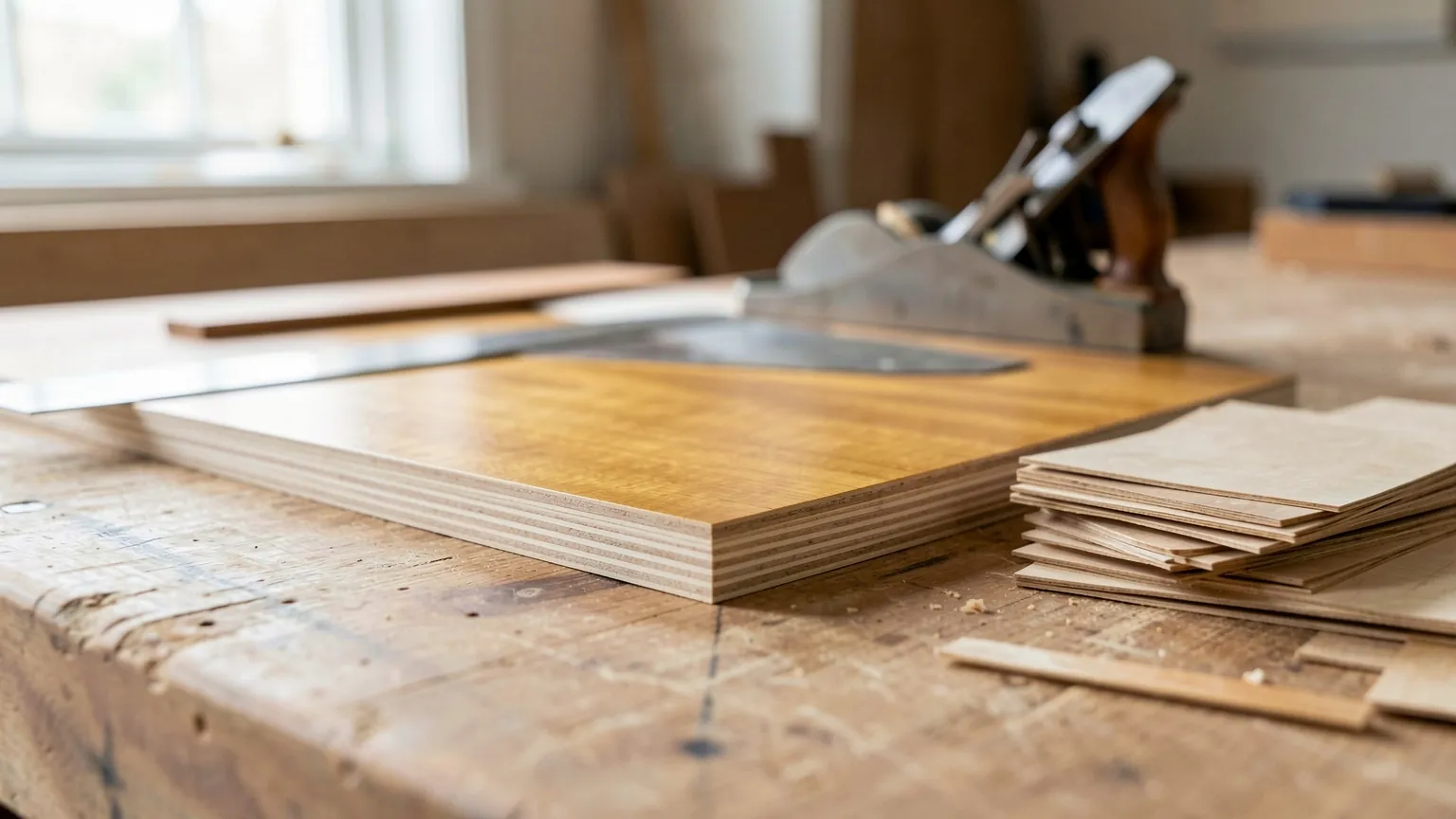
Most mid-century cabinet furniture is veneered: a thin sheet of the show timber, such as teak, walnut or rosewood, glued over a core of plywood, blockboard or chipboard. Most chair and table frames, legs and rails are solid wood. Moulded seats and backs are plywood, which is veneer by definition. A piece that is "all solid teak" from top to bottom is the exception, not the rule.
Veneer is not, in itself, a sign of cheap work. A cross-laminated panel moves far less with changes in humidity than a solid board of the same width, which is why the most admired makers of the period used it for broad surfaces. The quality question is not "veneer or solid?" but whether each material was used where it works, and how well.
This guide shows what museum records say about real pieces, explains the wood science behind the choice, and sets out how to tell the two apart without damaging anything.
What museum records say
Catalogue entries name the construction precisely, and they show veneer and plywood at the heart of the period's best-known work.
| Object | Date | Material as catalogued | Record |
|---|---|---|---|
| Gerald Summers, armchair, Makers of Simple Furniture | Designed 1934, made 1934–40 | Moulded 13-ply birch plywood | V&A W.26-1978 |
| Charles and Ray Eames, Low Side Chair (LCM), Herman Miller | 1946 | Molded walnut veneered plywood, chrome-plated steel rods | MoMA 156.1973 |
| P.B. Cow and Hunting Aviation, "Basildon New Period Furniture" dressing table | About 1946 | Chipboard clad with aluminium | V&A W.7:1 to 10-2014 |
| Hans Wegner, Shell chair, Fritz Hansen | Designed about 1948, made about 1950 | Teak veneer over plywood (seat and back), beech (frame) | V&A W.1-1989 |
| J. Christopher Heal, cupboard, William Birch | 1949–50 | Plywood, veneered in teak | V&A W.29-1980 |
| Hans Wegner, Chair 24, Carl Hansen & Søn | 1950 | Oak or beech frame with paper-cord seat; steam-bent arm and back piece | V&A CIRC.327-1970 |
| Arne Jacobsen, chair model 3107, Fritz Hansen | Designed 1955 | Moulded teak veneered plywood, satin chromium-plated tubular steel legs | V&A CIRC.373-1970 |
Four points come out of these records.
The face timber is often a veneer. The Heal cupboard is "veneered in teak over plywood"; the Jacobsen and Eames chairs are teak and walnut veneers on moulded plywood. The named timber describes the surface you see.
Mixed construction is normal. Wegner's Shell chair combines a teak-veneered plywood seat and back with a solid beech frame. A frame in a different, plainer timber is not a sign of repair or reproduction.
Solid wood was used where its strength in one direction matters. Chair 24 is solid oak or beech, with its curved arm and back piece bent under steam. Long, narrow parts carry load along the grain, which is where solid timber is strongest and most stable.
Chipboard is not proof of late or cheap manufacture. The V&A's Basildon dressing table, made around 1946 from chipboard clad in surplus wartime aluminium, was no bargain: the museum notes that a wardrobe from the same suite cost £74 7s 10d in 1946, against £16 17s for a Utility equivalent.
Why makers chose veneer: wood moves
Solid wood swells and shrinks as it takes up and loses moisture, and it does so unevenly. The United States Forest Products Laboratory's Wood Handbook (1999 edition) gives the pattern: wood shrinks most in the direction of the growth rings (tangentially), about half as much across them (radially), and only 0.1 to 0.2 per cent along the grain for most species.
The handbook's tables give these figures for shrinkage from green to oven-dry, the full range from freshly felled to completely dry. Furniture in a house moves only a fraction of this, but the proportions hold.
| Timber | Radial | Tangential | Volumetric |
|---|---|---|---|
| Teak | 2.5% | 5.8% | 7.0% |
| Black walnut | 5.5% | 7.8% | 12.8% |
| White oak | 4.4% | 8.8% | 12.7% |
| American beech | 5.5% | 11.9% | 17.2% |
The handbook notes that its teak figures come from world literature and may not represent a true species average. Even so, teak's low movement is one practical reason it suited furniture so well.
Plywood answers the problem directly. The handbook's chapter on panel products says plywood is always made with an odd number of layers, with the grain of each layer at right angles to the next. That gives the panel dimensional stability across its width and markedly reduces splitting where fasteners go in. The same chapter lists furniture and cabinet panels, "where appearance is more important than strength", as a main use of hardwood plywood, and names veneer, lumber (solid strips) and particleboard as possible cores. The Summers armchair is the idea taken to its limit: one sheet of 13 cross-grained layers, pressed in a mould, with no joints at all.
There is a second, older reason. Veneer lets one figured log face many panels, and lets a maker lay matching sheets side by side so the figure mirrors across a pair of doors. That is a choice about appearance and the economy of fine timber, not a shortcut.
Where each is usually found
| Part | Usually | Notes |
|---|---|---|
| Cabinet tops, sides, doors | Veneer over plywood, blockboard or chipboard | Often with a solid lipping strip along the visible edges |
| Drawer fronts | Veneered, sometimes solid | Check whether the grain wraps round the edge |
| Drawer sides and backs | Solid, often a plainer timber such as oak or beech | Different from the face timber is normal |
| Drawer bottoms, cabinet backs | Plywood or hardboard | Plain material out of sight; not a sign of poor quality |
| Legs, rails, chair frames | Solid | Load runs along the grain |
| Moulded seats and backs | Plywood with a face veneer | As in the Eames, Wegner Shell and Jacobsen records above |
| Table tops | Either | Large solid tops need fixings that allow movement |
These are tendencies, not rules. Makers varied, and a single piece can be solid in one place and veneered in the next.
How to tell them apart
| Look at | Suggests veneer | Suggests solid | Caution |
|---|---|---|---|
| An edge or worn corner | A thin face layer over a different core, or a separate strip glued along the edge | The same timber all the way through | A solid lipping can make a veneered panel look solid from the front |
| The end of a top | Long grain, or a strip, on all four edges | End grain (the cut ends of the fibres) on the two short edges | Some makers veneered the ends too |
| Grain across face and edge | The figure on the face stops at the edge | The figure on the face continues round onto the edge | Good veneer work can wrap an edge |
| Figure on a pair of doors | Mirror-image figure (book-matched) | Similar but not mirrored figure | Two boards from one plank can look close |
| Inside the carcass | Plain ply, blockboard or chipboard visible inside | The same timber inside as out | Insides are sometimes veneered as well |
| Cracks | Bubbles, lifting or chips at edges | Splits running along the grain | Both can be repaired well or badly |
| Weight | Chipboard cores are heavy | Solid teak is moderately heavy | Weight alone settles nothing |
Do not sand, scrape or drill to find out. The underside, the back, the inside of a drawer opening and an existing chip will tell you as much without damage. A hand lens and a torch held low across the surface help with edges and joints.
Identifying the species of a veneer is a separate step; our guide to teak, walnut and rosewood covers it, including why a veneered face and a solid frame can be different timbers.
Condition: what each fails at
Veneer lifts where the glue fails, chips at exposed edges and corners, blisters with heat or water, and can be sanded through in a single careless refinish. A face veneer is thin, and once it is gone the core shows. Patches are repairable by a competent restorer, but a sanded-through top is a serious defect.
Solid wood can split along the grain where a wide board was fixed so tightly it could not move, and it can warp or cup. It can be refinished more than once, which is one honest advantage.
When describing a piece, name the construction: "teak-veneered top on a solid teak frame", "solid oak drawer sides", "veneer lifting at the front left corner". That is more useful to a buyer, and fairer to the piece, than "solid wood" used as a general compliment.
Misconceptions worth dropping
"Veneer means cheap." The museum records above show veneer and plywood in the work of Summers, the Eameses, Wegner and Jacobsen. Cheap furniture used veneer too; so did the best.
"Solid means better." A wide solid panel restrained by its frame may split; a veneered panel will not move enough to do so. Each suits different parts.
"Chipboard means post-1970." A chipboard dressing table in the V&A dates from about 1946. Use labels, construction and documents to date a piece, not the core material alone.
"A quality mark means solid wood." The Danish Furniture Makers' Control mark certified origin and a standard for materials and making. Neither registered wording mentions solid timber, so a marked cabinet may well be veneered.
"Veneered pieces are reproductions." Construction does not separate an original from a copy. For that, see our guide to originals, licensed reissues and reproductions and the guide to labels and maker marks.
A short method
- Photograph the piece in daylight, then every edge, the back, the underside and the inside of a drawer opening.
- For each part, decide solid, veneered or unknown, and write down why.
- Note the core material where you can see it: plywood, blockboard, chipboard or hardboard.
- Identify the face timber separately from the frame and the drawer sides.
- Record condition by construction: lifting veneer, chips, sanded-through areas, splits.
- Keep the notes with the object, for example in our object research checklist.
More on materials and making is collected under materials and making, and buying guides under collecting and buying.
Common questions
Is veneered mid-century furniture lower quality than solid wood?
Not in itself. Veneer over plywood or another stable core moves far less than a wide solid board, which is why leading makers used it for cabinet tops, doors and moulded seats. Quality depends on the core, the glue, the thickness and matching of the veneer and the care of the work.
How can I tell if a sideboard top is veneered?
Look at the short ends. Solid wood shows end grain there, the cut ends of the fibres; a veneered top usually shows a thin face layer over a different core, or a strip of solid lipping. Also check whether the figure on the top continues round onto the edge, and look inside the carcass for plywood, blockboard or chipboard.
Can veneered furniture be refinished?
Yes, with care. A face veneer is thin and can be sanded through, so restorers usually prefer to clean and revive the existing finish or use chemical strippers and very light abrasion rather than heavy sanding. A solid top can be taken back further and more than once.
Was Danish teak furniture solid teak?
Often not entirely. Frames, legs and rails were commonly solid, while tops, doors and moulded seats were veneered. Museum records describe Wegner's Shell chair as teak veneer over plywood on a beech frame, and Jacobsen's model 3107 as moulded teak veneered plywood.
Does chipboard mean a piece is late or cheap?
No. The Victoria and Albert Museum holds a chipboard dressing table, clad in aluminium, from about 1946 that cost far more than its Utility equivalent. Date a piece from its labels, construction and documents, not from its core material alone.
References
- John A. Youngquist, "Wood-based Composites and Panel Products", chapter 10 of Wood Handbook: Wood as an Engineering Material, USDA Forest Service, Forest Products Laboratory, FPL-GTR-113, 1999 (archived copy)
- William Simpson and Anton TenWolde, "Physical Properties and Moisture Relations of Wood", chapter 3 of the same (tables 3-5 and 3-6)
- Gerald Summers, armchair, Makers of Simple Furniture, W.26-1978, Victoria and Albert Museum
- Charles and Ray Eames, Low Side Chair (model LCM), 156.1973, The Museum of Modern Art
- P.B. Cow and Co. and Hunting Aviation, dressing table, "Basildon New Period Furniture", W.7:1 to 10-2014, Victoria and Albert Museum
- Hans Wegner, Shell chair, Fritz Hansen, W.1-1989, Victoria and Albert Museum
- J. Christopher Heal, cupboard, William Birch Ltd, W.29-1980, Victoria and Albert Museum
- Hans Wegner, Chair 24, Carl Hansen & Søn, CIRC.327-1970, Victoria and Albert Museum
- Arne Jacobsen, chair model 3107, Fritz Hansen, CIRC.373-1970, Victoria and Albert Museum