Quick answer
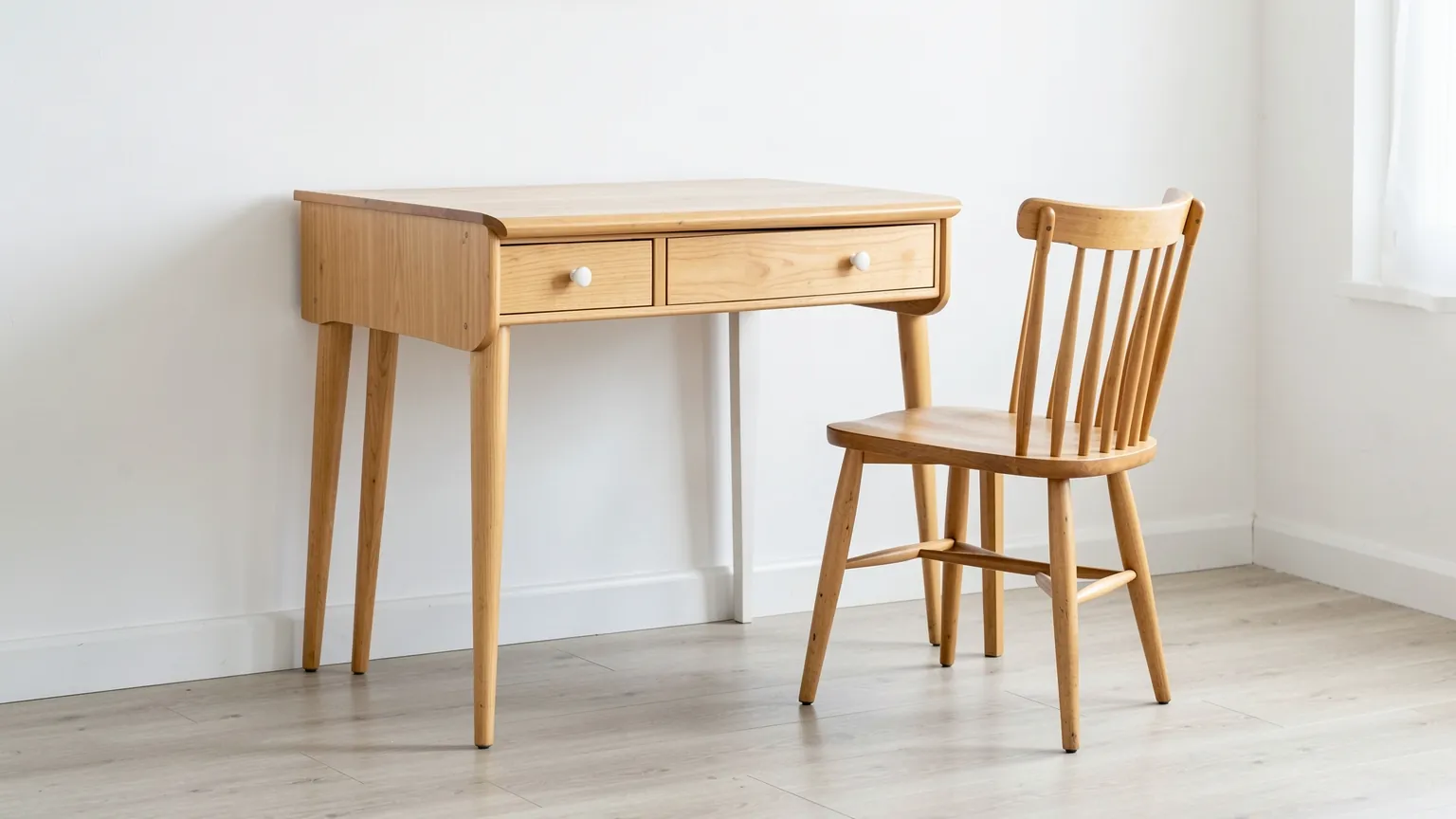
Drexel Declaration is a line of natural walnut furniture designed by Kipp Stewart and Stewart MacDougall for the Drexel Furniture Company in the late 1950s. It is identified by its pale, oiled walnut, low and slim proportions, softly rounded edges, and drawer pulls in white porcelain or brass. Pieces are usually stamped under a top or inside a drawer with "Drexel", a style number and sometimes a date.
Declaration sits between Danish modern and American Shaker furniture, which is part of its appeal: it looks lighter and plainer than most American case goods of its time.
Key facts
| What the sources say | |
|---|---|
| Designers | Kipp Stewart (born Pittsburgh, 1928) and Stewart MacDougall (born Pasadena, 1927) |
| Maker | Drexel Furniture Company, Drexel, North Carolina |
| Introduced | Late 1950s; pieces were shown at the Brussels World's Fair in 1958. One dealer gives 1960 for the public launch, another a span of 1957 to 1965 |
| Wood | Natural walnut throughout |
| Hardware | White porcelain or brass knobs and handles, as the buyer chose |
| Style | Slim, low-slung forms; spindle-back dining chairs recalling Shaker and Windsor chairs |
MacDougall's name is also spelled McDougall in some listings.
How to identify a Declaration piece
- Wood and finish. Declaration is natural walnut, typically with a light, clear finish rather than a dark stain.
- Pulls. Look for small white porcelain knobs or simple brass pulls. The porcelain knobs in particular are a Declaration signature.
- Form. Pieces are low and long, with gently rounded edges and tapered legs on tables. Some tables have woven cane lower shelves.
- Construction. Dovetailed drawers and solid secondary woods.
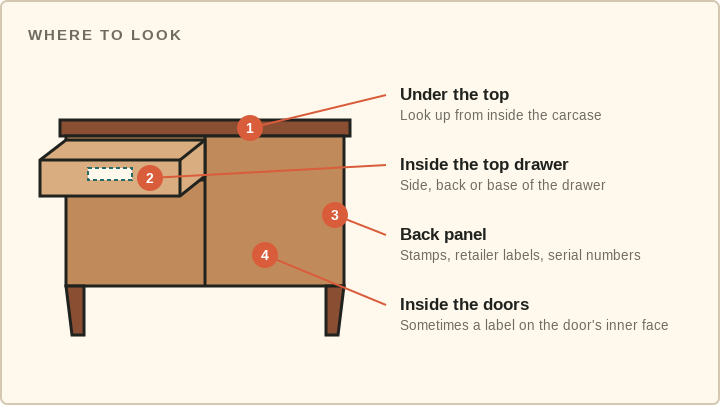
- Stamp. Look under table tops and inside or behind case pieces.
Reading the stamp
Drexel stamped its furniture with the company name, a style number, a description of the piece and often a date code. One dealer records a Declaration cocktail table stamped underneath with the style number 881-210-5, "CKT. TABLE", "DREXEL" and a date reading 1958. That is a single recorded example rather than a published system, but it shows what to look for: a Drexel name, a style number, a description of the piece and a date that can be read directly. Note the full style number, since it can be compared with other documented Declaration pieces.
Dealers' own stock numbers, such as those in online listings, are not Drexel numbers.
The pieces
Recorded Declaration pieces include bookcases, dressers (some with six dovetailed drawers), credenzas, a writing desk with drawers in a floating lower section, cocktail tables, large corner and end tables with cane shelves, side tables and dining chairs. Many were sold as bedroom, dining and living groups.
Drexel's other mid-century lines
Drexel made several modern lines alongside Declaration, which are sometimes confused with it:
- Profile and Projection, designed by John Van Koert, with more sculptural shapes; a Profile bookshelf is recorded as made in 1956.
- Counterpoint, Dateline and Sun Coast, recorded in Drexel catalogues.
- Touraine, a French Provincial line, which is not modern at all.
If the walnut is dark and the forms are sculptural, the piece is more likely Profile than Declaration.
Drexel in outline
Drexel was founded in 1903 by six partners in the small town of Drexel, North Carolina, in the foothills of the Blue Ridge Mountains. Its first product was a bedroom suite of bed, washstand and bureau. Samuel Huffman managed the company until his death in 1935, when Robert O. Huffman became president. In 1968 U.S. Plywood-Champion Papers bought Drexel Enterprises, which became Drexel Heritage Furnishings. The last Drexel Heritage plant, in Morganton, North Carolina, closed in 2014, and the brand was relaunched as Drexel in 2017.
What it is worth
Restored Declaration case pieces have been listed by specialist dealers at roughly $2,000 to $3,250, and a cocktail table at about $1,260 to $1,400. Original porcelain knobs and an undamaged walnut finish make the biggest difference.
For the timber, see telling teak, walnut and rosewood apart. For other American lines, see Lane Acclaim and Broyhill Brasilia. Record your findings with the object research checklist; more guides are in collecting and buying.
Common questions
Who designed Drexel Declaration?
Kipp Stewart and Stewart MacDougall, who worked together on the line for Drexel in the late 1950s.
When was Drexel Declaration made?
It was introduced in the late 1950s, with pieces shown at the 1958 Brussels World's Fair, and made into the 1960s. Dealers give dates from 1957 to 1965.
How can I tell if a piece is Drexel Declaration?
Look for natural walnut, slim low forms, white porcelain or brass knobs, and a Drexel stamp with a style number under the top or inside a drawer.
What wood is Drexel Declaration?
Natural walnut. Dealers and catalogue descriptions agree that the whole line was made in walnut.
A note on sources: we could not find a museum, archive or company record of the Declaration line, so the dates and attributions above come from dealer listings and company histories. Treat dates as approximate and rely on the Drexel stamp and the documented designs.
References
- Drexel Declaration walnut bookcase, 1stDibs (with Drexel company history)
- Kipp Stewart and Stewart MacDougall Declaration end tables, Modern Redux
- Drexel Declaration writing desk, Boston Mid Century Modern
- Declaration dresser for Drexel, Danish Modern L.A.
- Drexel Declaration cocktail table, Secondhand Stories
- Heritage Home Group, Wikipedia