Quick answer
Roseville pottery marks change with the period, so the mark is the quickest way to date a piece. Early art wares were often unmarked or carried a "Rozane" stamp or wafer. A small blue "Rv" ink stamp was used on many lines in the 1910s and 1920s. From the late 1920s to the mid-1930s many pieces had only a paper or foil label, now often lost. An impressed script "Roseville" followed in the mid-1930s, and from the late 1930s until the pottery closed in the 1950s, pieces carry a raised script "Roseville U.S.A." with a shape number and size.
The raised mark is also the one copied on Chinese reproductions sold since the 1990s, so a raised "Roseville" is not proof on its own.
Roseville in brief
- 1890: the company starts in Roseville, Ohio, making utility stoneware; it was incorporated in 1892, which is why some sources give that year.
- 1898 to 1910: the business moves to Zanesville, Ohio.
- 1900: the Rozane art pottery line begins.
- About 1917 or 1918: Frank Ferrell becomes art director and designs many of the best-known mid-period lines.
- 1953 or 1954: the last designs are made and the plant closes; Mosaic Tile Company buys the works in 1954.
The Roseville marks in order
| Mark | What it looks like | Approximate period |
|---|---|---|
| Unmarked | No mark, or a shape number only | Early wares before about 1900 |
| Rozane stamps and wafers | "ROZANE" die-stamped, or a round wafer seal naming the line (Egypto, Royal, Mongol, Woodland) | About 1900 to 1908 |
| Line ink stamps | Lines such as Chloron and Azurean with their own stamps | About 1903 to 1905 |
| Blue "Rv" ink stamp | A small R and v in blue ink | About 1910 to 1928 (one source says from 1923) |
| Paper and foil labels | Black, silver or gold labels, some shield-shaped | Late 1920s to mid-1930s; many have since come off |
| Impressed script "Roseville" | "Roseville" pressed into the base, no "U.S.A." | Mid-1930s to about 1938 (sources range from 1932 to 1940) |
| Raised "Roseville U.S.A." | Script in relief, with a shape number and size such as 728-10 | From about 1937 to 1940, until closure |
Sources disagree on the exact years, because lines overlapped and the factory changed methods gradually. The Wisconsin Pottery Association dates the raised mark from about 1937, while the Roseville trademark holder's site and a specialist dealer put it at 1939 or 1940. Use the table for a period, then confirm with the line and shape.
Shape numbers and sizes
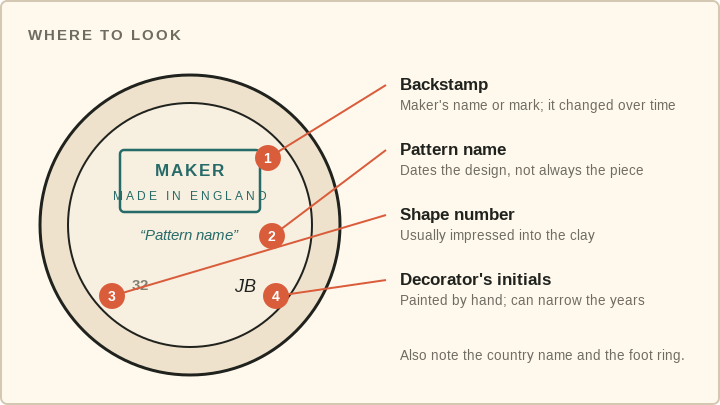
From the mid-1930s the mould mark usually includes a shape number and a size. In "728-10", 728 is the shape and 10 is the height or width in inches. Matching the shape number to a line catalogue, such as Pine Cone, Silhouette or Freesia, is the surest way to identify the pattern.
Why some genuine Roseville is unmarked
Several popular lines of the late 1920s and mid-1930s, including some Pine Cone, Blackberry, Jonquil and Luffa, were sold with paper labels rather than moulded marks. Once the label came off, the piece was left unmarked. During the change to moulded marks around 1936 to 1938, some pieces were left unmarked too. An unmarked piece should be judged on its body, glaze and shape.
Spotting Chinese reproductions
From the 1990s, reproduction wholesalers sold large numbers of Chinese-made copies with a raised "Roseville" mark and a shape number, often with an easily removed "Made in China" label. The Wisconsin Pottery Association's checks:
- The mark: a relief "Roseville" with a faint, missing or blank "U.S.A." is a warning sign. Early copies did include "U.S.A.", so its presence is not proof either.
- The clay: on the unglazed base, copies tend to be white; Roseville is yellowish or buff.
- The feel: copies feel sandy or coarse; Roseville feels smooth.
- The glaze: copies look flat and dull next to Roseville's soft, lustrous matt glazes, and the painted colours run onto the body.
- The line: a raised script mark on Blackberry, Jonquil or Luffa is wrong, because those lines were sold with labels or an Rv stamp.
- The colour: some copies come in colours the line was never made in.
A step-by-step method
- Write down the full mark, including any shape number and size.
- Place it in the table to get a period.
- Identify the line from the shape number and decoration.
- Check the clay colour, feel and glaze against the reproduction warning signs.
- Make sure the mark type matches the line's documented mark.
- Record what you find with the object research checklist.
Related guides
- How to identify pottery marks: a method for any mark
- Pottery marks by symbol: when the mark is a picture
Common questions
How do I tell how old my Roseville pottery is?
Use the mark. Rozane stamps and wafers are early 1900s, a blue Rv ink stamp is roughly 1910 to 1928, paper labels are late 1920s to mid-1930s, an impressed script mark is mid-1930s, and a raised "Roseville U.S.A." with a shape number is from the late 1930s until the 1950s.
Is Roseville without a mark real?
It can be. Many pieces of the late 1920s and mid-1930s had paper labels that have since come off, and some early wares were never marked.
How can I tell fake Roseville?
Look at the unglazed base: reproductions are usually white and feel coarse, while Roseville is buff and smooth. Check that the "U.S.A." is crisp, that the glaze is not flat and dull, and that the mark type matches the line.
What do the numbers on Roseville pottery mean?
On later pieces the number is the shape and size: in 728-10, 728 is the shape number and 10 is the size in inches.
When did Roseville pottery close?
The last designs were made in 1953 and the plant closed in 1953 or 1954. Mosaic Tile Company bought the works in 1954.
References
- Roseville Pottery, Wisconsin Pottery Association (reproduction checks from its 1999 exhibition)
- Factory marks and labels used by Roseville Pottery, rosevillepottery.org
- Roseville pottery marks, Just Art Pottery
- Roseville Pottery, Wikipedia