Quick answer
Before you buy a vintage piece you cannot see in person, ask the seller for five things in writing: full measurements, photographs of every side including the back and underside, an honest account of damage, repairs and replaced parts, the evidence behind any maker or date in the listing, and how delivery and returns will work. Then work out who you are buying from, because a dealer, a private seller and an auction house leave you with very different rights if the piece is not what you expected.
Most disappointments with vintage furniture bought online are not fakes. They are a sideboard that will not go up the stairs, a veneer lift the photographs hid, a smell that does not leave, or a "1960s Danish" description that rested on nothing. Every one of those can be found out before you pay, if you ask.
This guide gives the questions in the order a purchase happens, explains what each answer tells you, and sets out the UK consumer rules as they stand in November 2026. It is a summary, not legal advice.
First: who are you buying from?
The same chair can be sold by a dealer with a website, by a private household on a marketplace, or through an auction. The questions are the same; what you can do afterwards is not. In the United Kingdom the rules are, in outline:
| Seller | Main protection | Cancellation | What it means in practice |
|---|---|---|---|
| Business selling at a distance (a dealer's website, a shop selling on a marketplace) | Consumer Rights Act 2015: goods must be of satisfactory quality, fit for purpose and as described | Usually 14 days from delivery under the Consumer Contracts Regulations 2013, for any reason | The strongest position. "Satisfactory quality" takes age and price into account, so normal wear in a 60-year-old piece is not a fault |
| Private seller | The goods must match their description | None in law | "Buyer beware": a private seller does not have to point out faults, but must not misdescribe the piece. Ask direct questions and keep the answers |
| Public auction that individuals can attend in person | Limited: section 2(5) of the Consumer Rights Act 2015 says a buyer of second-hand goods at such an auction is not a consumer for most of the goods rights | None: public auctions are excluded from the cancellation rules | The auction's own terms of sale govern most of what follows. Read them, including the buyer's premium and collection deadline, before you bid |
| Online-only auction such as eBay | Depends on whether the seller is a business or a private individual | Business Companion's guidance notes that online auctions are not "public auctions" for the cancellation rules, so a business seller's 14 days still apply | Check the seller's status on the listing. A "private seller" label means the private-seller row above |
If a seller lists many similar pieces, buys stock to resell, or runs a shop, they are probably trading as a business whatever the listing says. Ask. A dealer who claims to be a private seller to avoid returns is not playing fair, and the answer is useful information about them.
Size and fit
- "What are the height, width and depth, measured at the widest points?" Ask for all three in centimetres, plus the seat height for chairs and the height to the top for sideboards with a raised back. Museum catalogues are a useful standard: the Victoria and Albert Museum's record of a 1949–50 teak-veneered cupboard by Christopher Heal for William Birch (W.29-1980) gives a height of 85.5 cm and a width of 76.3 cm but no depth. If even a museum record can leave out a dimension, a sale listing can too.
- "Does it come apart?" Ask whether legs unscrew, whether a top lifts off a base, and whether a wall unit is one carcase or several. Many post-war British and Danish pieces have screw-in or bolted legs; many do not.
- "What is the smallest dimension when it is carried?" That is what has to pass through your narrowest door, round the turn of the stairs and into a lift. Measure your route before you ask.
Condition: what the photographs leave out
Seller photographs are usually taken from the front, in flattering light. Ask for the ones they did not take.
- "Please send photographs of the back, the underside, inside every drawer and cupboard, and each corner of the top in raking light." A torch held low across a surface shows scratches, water rings, lifting veneer and filled dents that are invisible head-on.
- "Is any veneer lifting, chipped or missing?" Veneer is normal on mid-century case furniture and is not a defect in itself; our guide to veneer and solid wood explains where makers used each. Lifting or missing veneer on an edge is a repair job, and the cost should be in the price.
- "Do all the drawers run, and do the doors close and stay closed?" Sticking drawers can mean worn runners, a swollen carcase or a frame out of square. Ask for a short video.
- "Is it stable? Does any joint move?" For chairs, ask whether the seat rails or back move when the chair is rocked. Our field guide to chair construction shows where the stress goes in each type of frame.
- "Are there any cracks or splits in solid wood?" Splits in solid tops and panels often follow central heating. They can be stable or still moving; ask how long the piece has been in its current home.
Smell, damp and woodworm
These are the faults no photograph shows, and the ones people most often regret.
- "Has it been in a smoking household, a garage, a loft or a shed?" Smoke and damp smells soak into unfinished interiors, drawer bottoms and upholstery, and can take a long time to clear.
- "Are there any small round holes, and is there any fine dust beneath them?" English Heritage's fact sheet on the common furniture beetle describes its exit holes as round and 1.5 to 2 mm across, made when adults emerge in spring or early summer, with gritty frass in piles beneath fresh holes. It also warns that holes alone do not mean the infestation is active: old frass can fall out when a piece is moved. Fresh, pale frass and new holes are the signs to worry about.
- "What is it made of?" The same fact sheet notes that the beetle favours woods with high starch and sugar content, such as beech, ash and the sapwood of oak, and that old plywood made with animal-protein glue is readily attacked, while sound oak heartwood is not at risk. Beech frames and older plywood backs and drawer bottoms deserve a close photograph. If you cannot tell the timbers apart from pictures, our guide to teak, walnut and rosewood helps.
Repairs, refinishing and replaced parts
- "Has it been refinished, oiled, re-veneered or repaired? By whom and when?" None of these is wrong, but a fair description says so. A heavily sanded top on a veneered piece can mean the veneer is now very thin. Our guide to whether refinishing reduces value explains when it matters.
- "Are the handles, legs, glides, glass and shelves original?" Replaced parts are common and affect both value and identification. A seller who does not know should say "unknown", not "all original".
- "Has the upholstery been redone? Is the foam original?" Period foam can be crumbling inside a cover that looks fine. Ask the seller to press a seat cushion and describe it, or to show the underside if the base is open.
Maker, date and the evidence for them
A listing that names a designer or a decade is making a claim. Ask what it rests on.
- "Is there a label, stamp, brand or number? Please photograph it straight on and in raking light." Then check it yourself with our guide to furniture labels and maker marks. For British makers, see the guides to G-Plan and McIntosh; for Danish furniture, read what the Danish Furniture Makers' Control mark does and does not certify.
- "Where does the date in the listing come from?" Often it is the design date, not the date the piece was made. A label style, a material or a receipt can date the object; the year a design was first drawn cannot.
- "Is the designer's name from a mark or document, or is it a guess?" "In the style of" and an unsupported name are not the same description. If the answer is "it looks like", treat the attribution as unknown and price it that way.
- "Is it a period piece, a later licensed production or a reproduction?" Our buying guide to originals, reissues and reproductions explains the difference and the UK law on replicas.
- "Is there any paperwork or history?" Receipts, letters, a shop's label or an old catalogue page are all worth having. Ask whether they come with the piece.
Upholstered pieces and fire safety
In the United Kingdom, the Furniture and Furnishings (Fire) (Safety) Regulations 1988 set fire-resistance standards for upholstered furniture, including sofas, armchairs, beds and cushions, supplied in the course of a business. Trading Standards guidance for businesses (Business Companion, last reviewed October 2025) says used furniture must meet the same standards as new, and that pieces without the permanent label should not be sold until expert advice has been obtained. Furniture made before 1 January 1950, and materials supplied for re-upholstering it, are excluded.
So when buying an upholstered mid-century piece from a dealer, ask: "Has it been re-upholstered to the current regulations, and does it carry the permanent label?" An original period cover on a 1960s sofa, sold by a business, raises a question the seller should be able to answer. A modern fire label on a vintage frame also tells you the upholstery has been redone, which is worth knowing for its own sake.
Delivery
- "Who delivers it, and is it insured in transit?" Ask whether the seller uses a specialist courier, a general carrier or a "man with a van", and who is responsible if it arrives damaged. With a business seller, the goods are its responsibility until they reach you.
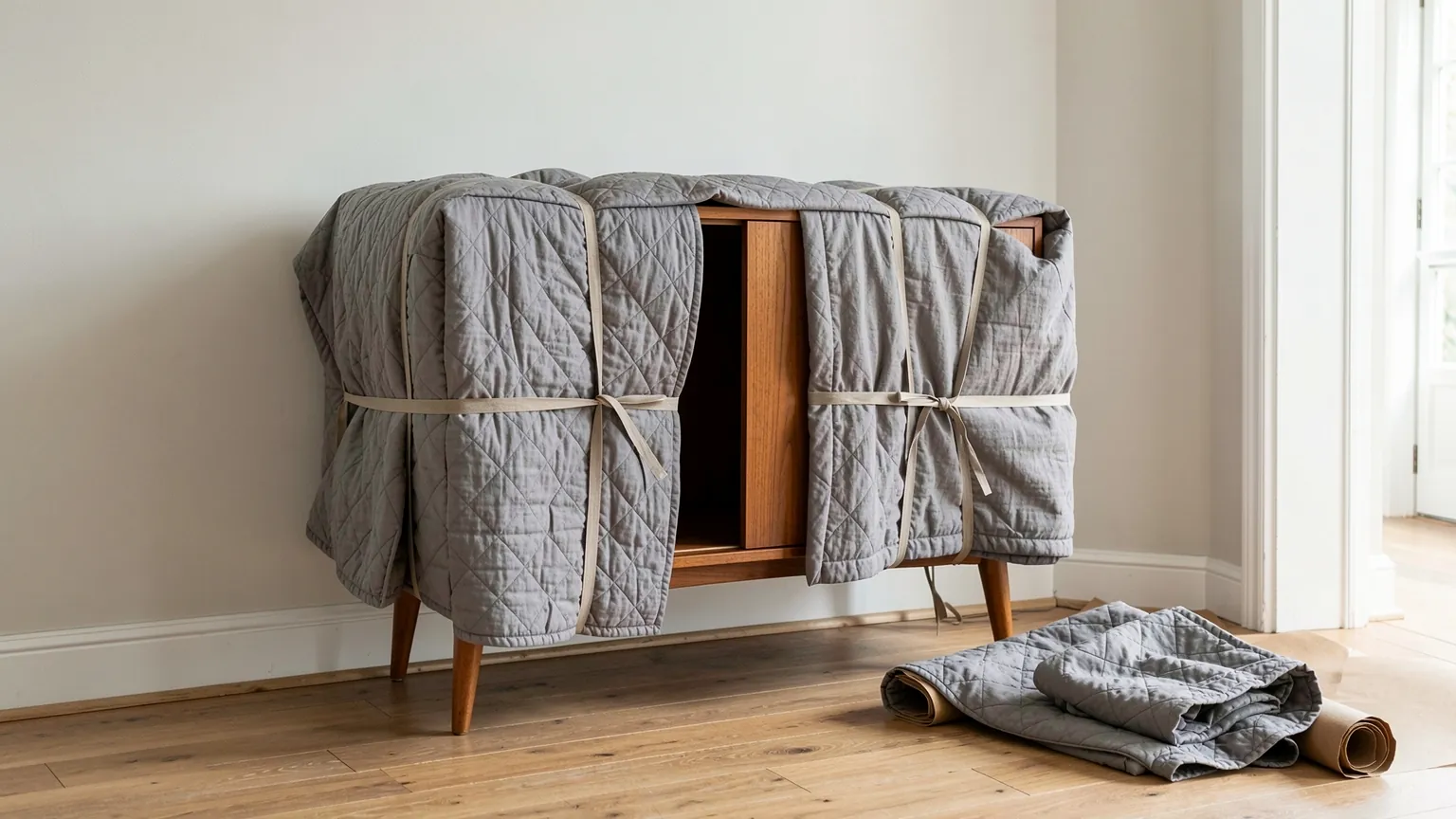
- "How will it be wrapped?" Blanket-wrapped two-person delivery suits most case furniture better than boxed parcel networks. Glass shelves and loose legs should travel separately.
- "Does delivery include carrying it in and upstairs?" Many carriers deliver to the threshold only.
- Inspect before you sign. If you are asked to sign for the piece, look at it first, and write any damage on the delivery note. Photograph the piece and the packaging before the driver leaves.
- Buying from abroad. GOV.UK's guidance says that for goods over £135 sent to Great Britain from abroad, import VAT and any customs duty are charged on delivery, and the carrier will hold the item until you pay. Ask the seller how the piece will be declared. Rosewood pieces raise separate trade questions, covered in our timber guide.
Payment and returns
- "What is your returns policy, and who pays for collection?" Under the Consumer Contracts Regulations 2013, when you buy from a business at a distance you can usually cancel within 14 days, starting the day after the goods arrive. The business must refund you, including the basic delivery charge, within 14 days of getting the goods back (or proof you have sent them). You pay the cost of returning them unless the business agreed to, or failed to tell you that you would have to. For a large piece of furniture that cost can be substantial, so ask before you buy.
- Handle it reasonably. A business may deduct for any loss in value caused by handling beyond what is needed to establish the goods' nature, characteristics and function. Inspect the piece as you would in a shop; do not oil, clean or alter it until you have decided to keep it.
- "Can I pay by credit card?" Section 75 of the Consumer Credit Act 1974 can make a card provider jointly responsible with the seller when an item's cash price is more than £100 and not more than £30,000. The Financial Ombudsman Service notes that it applies even if only part of the price was paid by credit card, and that payments made entirely by debit card or bank transfer are not covered by section 75.
- Be wary of a bank transfer to a stranger. It is the hardest payment to recover. Where a platform offers its own buyer protection, read what it covers before you pay outside it.
Common misreadings
"Good vintage condition" read as "no faults". It usually means "has faults I consider normal". Ask for them to be listed.
"Solid teak" read as literal. Much mid-century case furniture is teak veneer on a manufactured core. That is how it was made, but "solid" should mean solid.
"Danish" read as "designed in Denmark by someone famous". It may mean made in Denmark, designed elsewhere, or simply in the Danish style. Ask which.
A returns policy read as a right. A private seller's "no returns" is lawful; a business's "no returns" on a distance sale generally does not remove your 14-day cancellation right.
A high price read as proof. Price tells you what the seller hopes for, not what the piece is.
A checklist to copy
Send these to the seller in one message and keep the reply.
- Height, width and depth at the widest points, in centimetres; seat height for chairs; does it come apart?
- Photographs of the back, underside, inside every drawer and door, each corner of the top in raking light, and a short video of drawers and doors working.
- Any veneer lifting or missing, splits, loose joints, water marks or burns?
- Any smoke, damp or musty smell? Kept in a loft, garage or shed?
- Any small round holes or fine dust? How long has it been in its current home?
- Refinished, repaired or re-upholstered? Which parts are replaced: handles, legs, glides, glass, foam?
- Any label, stamp, brand or number? Photograph it. Where do the maker and date in the listing come from?
- For upholstery from a business: does it meet the 1988 fire regulations and carry the permanent label?
- Are you selling as a business or privately?
- Who delivers, how is it wrapped, is it insured, and does delivery include carrying it in?
- What is the returns policy, and who pays for collection?
- Can I pay by credit card?
When the piece arrives, record what you find in our object research checklist while the seller's answers are still fresh. More practical guides are collected under collecting and buying.
Related guides
- How to identify vintage furniture labels and maker marks: how to read the marks the seller photographs
- Original, licensed reissue or reproduction?: the evidence that separates them
- Veneer or solid wood?: what "solid" should mean
Common questions
Can I return vintage furniture bought online in the UK?
If you bought it at a distance from a business, usually yes: the Consumer Contracts Regulations 2013 give you 14 days to cancel, starting the day after delivery, and the business must refund you within 14 days of getting the goods back. You normally pay the return cost unless the seller agreed otherwise. If you bought from a private seller, there is no legal right to change your mind, though the piece must match its description.
Do I have any rights when buying from a private seller?
Fewer. A private seller does not have to point out faults, but the goods must match the description they gave. Ask specific questions in writing, such as whether there is woodworm, damp or repair, so that the answers form part of the description.
Are second-hand sofas and armchairs covered by the fire safety rules?
When supplied by a business, yes. Trading Standards guidance says used upholstered furniture must meet the same standards as new under the Furniture and Furnishings (Fire) (Safety) Regulations 1988. Furniture made before 1 January 1950 is excluded.
How do I know if woodworm is still active?
Holes alone do not prove it. English Heritage's guidance describes round exit holes about 1.5 to 2 mm across, with gritty frass in piles beneath fresh holes; old frass can fall out when a piece is moved. Fresh pale frass and new holes, especially in spring or early summer, suggest activity. Ask the seller for close photographs and, if in doubt, take advice before bringing the piece into your home.
Is paying by credit card worth it for vintage furniture?
It can be. Under section 75 of the Consumer Credit Act 1974, the card provider can be jointly responsible with the seller for items with a cash price over £100 and up to £30,000, even if only part was paid on the card. Debit card and bank transfer payments are not covered by section 75.
References
- J. Christopher Heal, cupboard, William Birch Ltd, W.29-1980, Victoria and Albert Museum
- Furniture beetle, fact sheet 2, English Heritage collections conservation guidance
- Consumer contracts: distance sales, Business Companion (Chartered Trading Standards Institute), last reviewed April 2025
- Second-hand upholstered furniture: fire safety, Business Companion, last reviewed October 2025
- The Furniture and Furnishings (Fire) (Safety) Regulations 1988, legislation.gov.uk
- Consumer Rights Act 2015, section 2: key definitions, legislation.gov.uk
- Common myths about "Section 75", Financial Ombudsman Service, 24 October 2024
- Tax and customs for goods sent from abroad: tax and duty, GOV.UK
- What are my rights when buying second-hand goods?, Which?