Quick answer
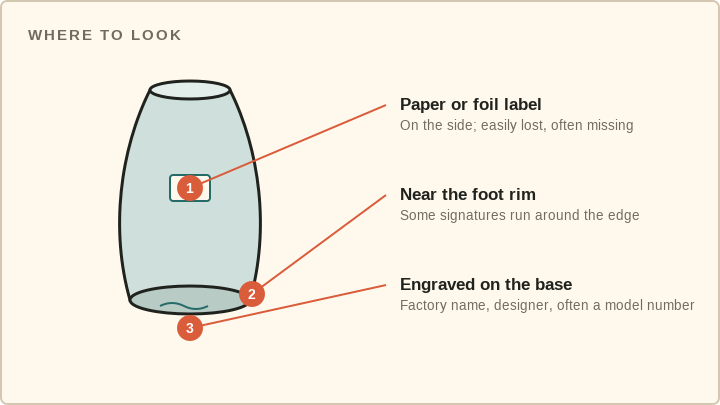
Strömbergshyttan glass is usually identified by an incised mark on the base naming the glassworks, followed by numbers. Museum records show several forms: "Strömberg T948" on a bowl made in 1963 (V&A), "S-HYTTAN 24-5 46" on a dish made in 1946 (V&A), and "S42" with the model name "Sving" on a wine glass designed in 1936 (Smålands museum). Some pieces also had a paper label naming the works and "Sweden". The works in Småland was active until 1979.
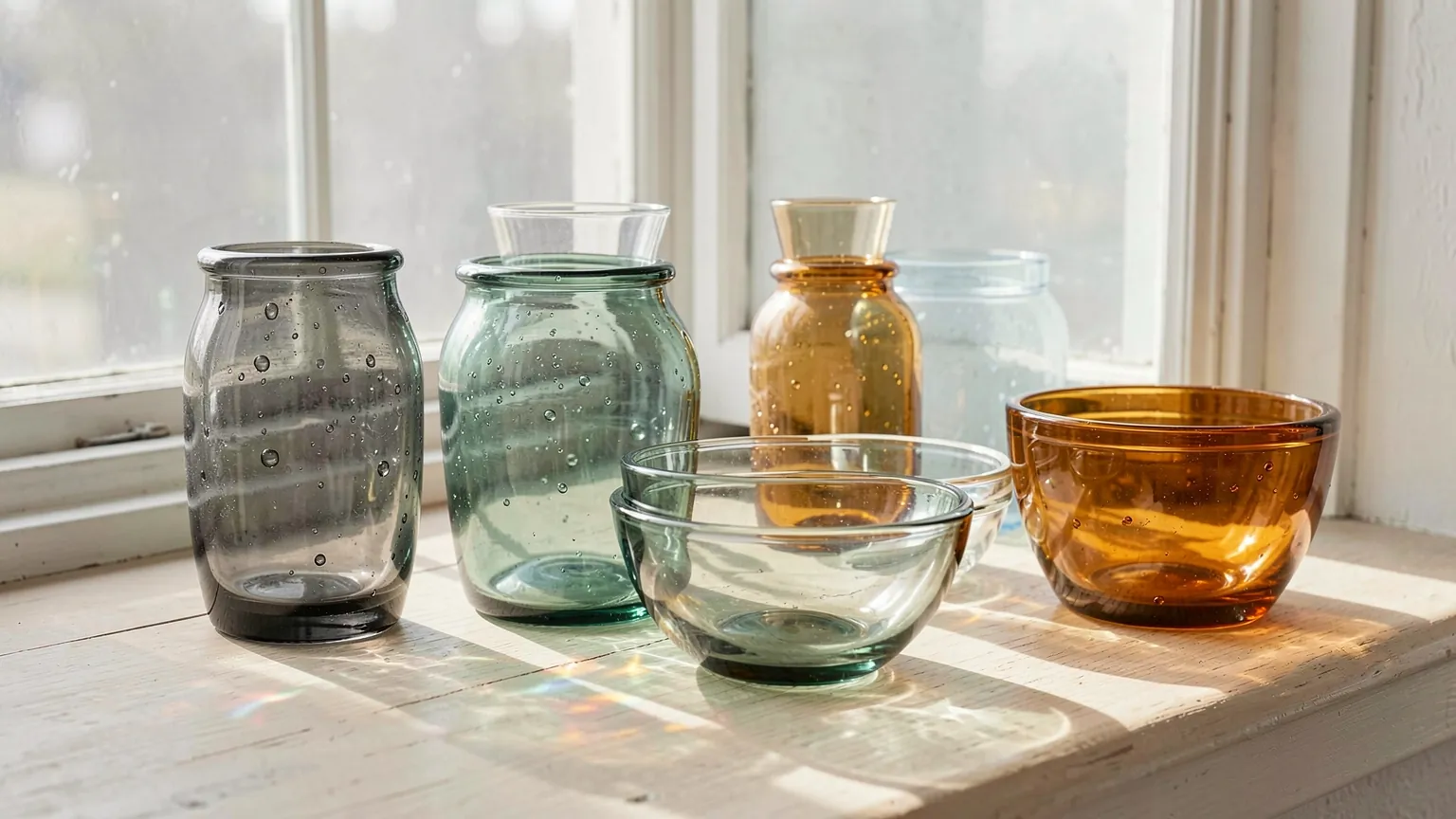
The glass itself is a strong clue. Sweden's national biographical dictionary describes the factory's signature as undecorated glass in faintly toned hues.
Strömbergshyttan in brief
- Before Strömbergshyttan: Edvard Strömberg (1872 to 1946) was a master glassblower at Kosta, ran Sandvik glassworks from 1903, became director at Orrefors in 1918 and works manager at Eda in 1927. His wife Gerda designed glass at Sandvik and, from 1927, at Eda.
- The glassworks: after Eda, Edvard and Gerda leased the closed Lindefors glassworks in Småland and named it Strömbergshyttan. The Nationalmuseum and Smålands museum date the works itself from 1876, the year of the original glassworks. Museum pieces show Strömbergshyttan production by 1936 to 1937.
- 1946: after Edvard's death, Gerda handed the running of the works to their son Eric Strömberg (1904 to 1960) and his wife Asta.
- 1979: the works closes, according to both the Nationalmuseum and Smålands museum.
Marks recorded on museum pieces
| Mark | Object | Collection |
|---|---|---|
| "S42" and the model name "Sving" | Wine glass, designed by Gerda Strömberg in 1936 | Smålands museum |
| Incised "S-HYTTAN 24-5 46" | Dish designed by Knut Bergkvist, made 1946 | V&A |
| Incised "Strömberg T948" | Bowl, designed 1950 to 1960, made 1963 | V&A |
| Part of a paper label, "...bergshyttan / Sweden" | Vase, about 1958 to 1965 | Museum of Fine Arts, Houston |
So the name can appear in full ("Strömberg"), shortened ("S-hyttan") or as a letter ("S"), with numbers after it. The museum records do not explain what each letter or number means, so treat them as references to look up, not as a date code. Paper labels often came off, and none of these sources says every piece was marked.
Designers
| Designer | What the records show |
|---|---|
| Gerda Strömberg (born 1879) | The works' designer from the start. By 1941 she had designed 3,611 models, including the services Haga, Fylgia and Håtuna. The Nationalmuseum gives her death as 1952, the Swedish biographical dictionary as 1960. |
| Knut Bergkvist | Designed a dish made in 1946, now in the V&A |
| Gunnar Nylund | Named by the V&A, with Gerda Strömberg, as possible designer of a bowl designed 1950 to 1960 |
| Asta Strömberg | Ran the works with Eric from 1946 |
Designer attributions are often disputed for this factory. Even the V&A records one bowl as "possibly" by Gerda Strömberg or Gunnar Nylund. Unless a museum or catalogue record confirms the designer, describe a piece as "Strömbergshyttan" rather than naming a designer.
The look of Strömbergshyttan glass
The Swedish biographical dictionary describes Gerda Strömberg's designs as simple, thick-sided vases and bowls with broadly ground mouths, in undecorated glass with faint tints, including a faintly brown-purple "antique" colour and a silver-toned blue. That plain, heavy, faintly tinted glass is the house style.
A step-by-step method
- Look at the base in raking light and write down the incised mark exactly.
- Separate the name (Strömberg, S-hyttan or S) from the numbers.
- Check the glass: thick, plain and faintly tinted.
- Compare the shape and mark with museum records, such as the V&A's and the Nationalmuseum's online collections.
- If it is unmarked, describe it as "attributed".
- Record what you find with the object research checklist.
Related guides
- Scandinavian glass signatures: Orrefors, Kosta, Holmegaard and Iittala
Common questions
How do I identify Strömbergshyttan glass?
Look for an incised mark on the base naming the works, such as "Strömberg" or "S-hyttan", followed by numbers. The glass is usually thick, plain and faintly tinted.
What does "S-hyttan" mean on glass?
It is a short form of Strömbergshyttan. The V&A records an incised "S-HYTTAN 24-5 46" on a dish made in 1946.
Who designed for Strömbergshyttan?
Gerda Strömberg was the main designer. Museum records also name Knut Bergkvist and, possibly, Gunnar Nylund.
When did Strömbergshyttan close?
In 1979, according to the Nationalmuseum and Smålands museum.
References
- Gerda Strömberg, Svenskt kvinnobiografiskt lexikon (Biographical Dictionary of Swedish Women)
- Strömbergshyttan, Nationalmuseum, Stockholm
- Strömbergshyttan objects, Victoria and Albert Museum (including bowl C.67-1997 and dish C.59-1976)
- Vinglas "Sving", Smålands museum, via DigitaltMuseum
- Vase, about 1958 to 1965, Museum of Fine Arts, Houston